Birdwatching in the Dubai desert, where to go and when
Why the Dubai desert suits birdwatching
The Dubai desert suits birdwatching because a creek wetland, a desert reserve with man-made lakes and open sand and gravel all sit within reach of the city. The birding site uaebirding.com puts Al Marmoom about 40 minutes from Mall of the Emirates. Dubai Municipality records 258 bird species there, 201 at Ras Al Khor and 142 at the Dubai Desert Conservation Reserve (DDCR).
The whole country has recorded 475 species in categories A, B and C, according to the Emirates Bird Records Committee (EBRC) checklist updated on 19 February 2026. The UAE's Ministry of Climate Change and Environment says the country receives around two million migratory birds a year as a stopover on the African-Eurasian flyway. The EBRC lists most of the waterbirds and raptors in this guide as migrants or winter visitors, so the cool months carry the longest lists.
Species counts differ by source because each counts a different area on a different date. This guide takes site figures from Dubai Municipality and status and population estimates from the EBRC. It names the source of every other number. A single visit shows a fraction of any list. On a first day of birdwatching in Dubai, aim for a short list of birds you can name.

Four places to watch birds near Dubai, side by side
Ras Al Khor Wildlife Sanctuary, Al Marmoom Desert Conservation Reserve, the Al Qudra Lakes and the Dubai Desert Conservation Reserve cover almost every bird a visitor to Dubai can expect to find. The table sets Dubai Municipality's figures side by side, with the Al Qudra count dated because it comes from a news report, not a Municipality page.
| Site | Area | Bird species recorded | Best for | Access, as the sources state it |
|---|---|---|---|---|
| Ras Al Khor Wildlife Sanctuary | 10.13 km² | 201 | Flamingos, ducks, waders, wintering eagles | Three bird hides. Winter hours 7:30 AM to 5:30 PM. Walk-in registration. |
| Al Marmoom Desert Conservation Reserve | 949.35 km² | 258 | Resident desert birds, lake birds, raptors | Eight bird hides built by Dubai Municipality. Lakes open through the year. |
| Al Qudra Lakes | Not listed separately | As many as 175 (2018 report) | Waterbirds, flamingos | Next to the Al Marmoom reserve. Flamingo Lake named by the Dubai Media Office. |
| Dubai Desert Conservation Reserve | 225.9 km² | 142 | Resident and migratory birds, by season | The Municipality page lists no hides or visitor hours. |
Ras Al Khor, the wetland with hides
Ras Al Khor has three bird hides for watching waterbirds. The 10.13 km² wetland was declared a protected area in 1998 and became a Ramsar wetland of international importance in 2007. Dubai Municipality lists 201 bird species among 472 species in all, 24 of them on the IUCN Red List. In winter the count of birds can reach 25,000.
Ducks lead the winter numbers, with mallards, pintails and common teals named on the Municipality page, alongside waders, shorebirds, songbirds and raptors. Threatened waterbirds on its list include the Socotra cormorant, the ferruginous duck and the sociable lapwing. The Flamingo Hide looks over the flamingos, and the Lagoon Hide opens onto the creek, where waders and raptors gather. The Mangrove Hide was marked temporarily closed on the Municipality booking page when this page was checked on 15 October 2026.
The reserve with eight hides
Al Marmoom is the largest protected area in the emirate, covering almost 23% of Dubai across 949.35 km². Dubai Municipality records 258 bird species and says it has built eight bird hides for watchers. The reserve mixes man-made lakes with natural desert ecosystems, so one morning can give both a lake list and a desert list.
uaebirding.com names the cream-coloured courser, chestnut-bellied and pin-tailed sandgrouse, black-crowned sparrow-lark and greater hoopoe-lark here and calls the lappet-faced vulture and other raptors possible. It advises starting at sunrise. The Municipality has monitored breeding birds in the reserve since 2018 and puts the main breeding season from February to June, with mostly songbirds and ground-nesting birds. For the reserve itself, see Al Marmoom Desert Reserve.
The lake system beside the reserve
The Al Qudra Lakes add a lake list to the desert list. A September 2018 Gulf News report said Dubai Municipality had revealed a count of as many as 175 species, of which Dr Reza Khan and his team had sighted 171 between 2008 and August 2018. The report described Dr Khan as the principal wildlife specialist with Dubai Safari at the time. Four more species came from other birdwatchers. The count covers a survey zone up to three kilometres around the lake.
The report named threatened species including the lappet-faced vulture, steppe eagle, Asian houbara and marbled teal. A 2022 Dubai Media Office release describes a Flamingo Lake and the heart-shaped Love Lakes, and places the Al Marmoom reserve right next to them. uaebirding.com writes the reserve as "Al Marmoom Desert Conservation Reserve (Qudra)", so this guide treats the two as one birding area. Read the Al Qudra Lakes page for the visitor side.
A protected desert with 142 recorded species
The DDCR covers 225.9 km² and Dubai Municipality records 142 bird species. It says resident and migratory birds both live there, with the mix changing by time of year. The Municipality page gives no hides or visitor hours for it, so the bird list is best read as a map of what lives there. A single visit shows only part of it. Access is covered on the Dubai Desert Conservation Reserve page.
258
bird species recorded at Al Marmoom Desert Conservation Reserve
Dubai Municipality, Dubai Protected Areas, page last modified 16 October 2026.

The best months for birds in Dubai
October to March is the best period for birdwatching in Dubai, because the migrants and winter visitors are present and the heat is gone. The EBRC dates the greater spotted eagle to late September through late April, the steppe eagle to September through late April and the desert wheatear to September through early May. Winter highs average 23 °C and summer highs 41.8 °C, according to the Dubai Government Media Office.
| Months | What is in the desert and at the water | Source |
|---|---|---|
| September to November | Arrivals. Desert wheatear and both eagles from September, Asian houbara from October, pied wheatear passing through from August to November. | EBRC checklist |
| December to February | Peak numbers. Ras Al Khor can reach 25,000 birds of 201 species in winter. Average high 23 °C. | Dubai Municipality; Dubai Government Media Office |
| March to April | Spring passage. Isabelline wheatear peaks in March and April. The eagles leave by late April. The houbara record window ends in March. | EBRC checklist |
| May to September | Residents. Greater hoopoe-lark and cream-coloured courser stay all year. The Al Marmoom breeding season runs February to June. Average high 41.8 °C. | EBRC checklist; Dubai Municipality; Dubai Government Media Office |
The best time of year for a Dubai desert safari page covers weather by month for general visits.
Start at first light, then move to Ras Al Khor
Start at sunrise at the desert and lake sites. Treat Ras Al Khor as the next stop, because the sanctuary never opens before sunrise in winter. Its winter hours are 7:30 AM to 5:30 PM from October to March. uaebirding.com advises a sunrise start at Al Marmoom.
| Date | Sunrise | Ras Al Khor opens 7:30 AM, minutes after sunrise | Sunset |
|---|---|---|---|
| 15 October 2026 | 6:17 AM | 73 | 5:51 PM |
| 15 November 2026 | 6:35 AM | 55 | 5:31 PM |
| 15 December 2026 | 6:56 AM | 34 | 5:31 PM |
| 15 January 2027 | 7:06 AM | 24 | 5:50 PM |
| 15 February 2027 | 6:53 AM | 37 | 6:12 PM |
| 15 March 2027 | 6:28 AM | 62 | 6:27 PM |
Sunrise and sunset come from MET Norway's sunrise service for central Dubai (25.20 N, 55.27 E, UTC+4), retrieved on 15 October 2026. The editorial desk subtracted each sunrise from 7:30 AM to fill the third column. The sanctuary's 5:30 PM closing falls one minute before sunset in mid-November and mid-December, so the hides close as the light goes.
From April to September the sanctuary opens at 6:00 AM. Hours can change, so check Dubai Municipality before you drive out.

Where to see flamingos, and in what numbers
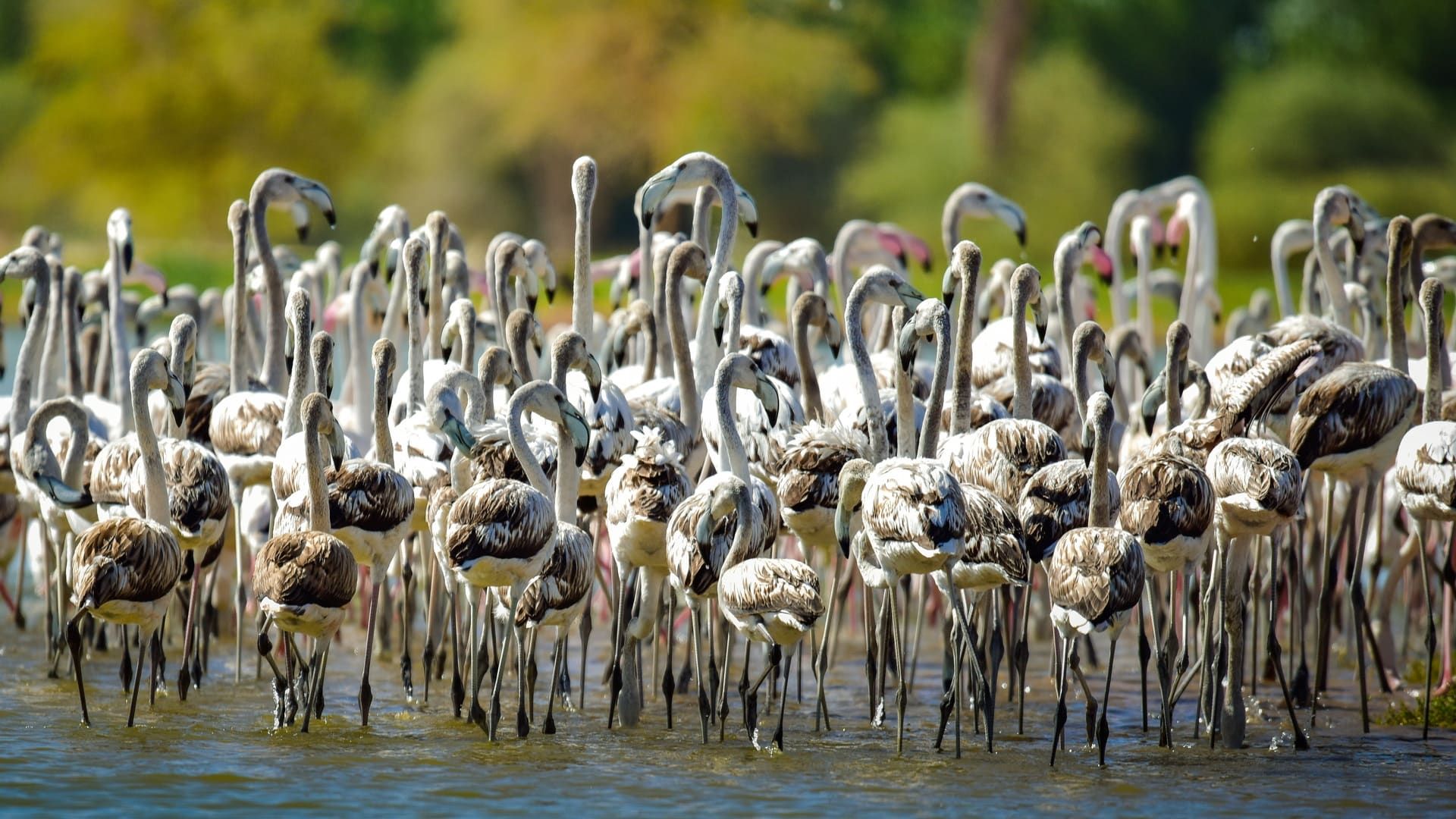
Dubai Municipality points flamingo watchers to the Flamingo Hide at Ras Al Khor Wildlife Sanctuary. It says thousands of greater flamingos have been recorded in the sanctuary and describes the hide as the place to see them all year round. The Municipality ties their pink colour to a diet of small invertebrates, crustaceans and algae.
The EBRC frames the same bird differently. It lists the greater flamingo as a common migrant and winter visitor, estimates the total non-breeding population in the UAE at 17,000 to 20,000, and puts the breeding population at Al Wathba Wetland Reserve in Abu Dhabi at about 1,600. The first confirmed breeding there was in January 1999. The two accounts fit together: numbers build in winter, and the hide is where the Municipality sends flamingo watchers.
Dubai Municipality's satellite-tracking programme, launched in 2018, planned 10 bird transmitters, for species including a greater flamingo, a lappet-faced vulture and a greater spotted eagle. The Environment Agency Abu Dhabi says Al Wathba holds as many as 4,000 flamingos in autumn and spring, though its page, which carries no date, says the reserve is temporarily closed for development, so confirm with the agency first.
Larks, coursers and sandgrouse on sand and gravel
Seven desert birds are worth knowing before you go. The EBRC rates abundance by how often a bird turns up on a visit to the right habitat in the right season: very common means over 90% of visits, common 51 to 90%, fairly common 10 to 50% and uncommon under 10%.
| Bird | EBRC status | UAE population estimate |
|---|---|---|
| Crested lark | Very common to abundant resident | 50,000 to 100,000 breeding |
| Greater hoopoe-lark | Fairly common breeding resident, little seasonal movement | 2,000 to 8,000 breeding |
| Black-crowned sparrow-lark | Locally common resident, nomadic in flocks in autumn and winter | 10,000 to 20,000 breeding |
| Desert wheatear | Common migrant and winter visitor, September to early May | 50,000 to 100,000 non-breeding |
| Chestnut-bellied sandgrouse | Common but declining resident | 200 to 2,000 |
| Cream-coloured courser | Uncommon breeding resident, post-breeding flocks widespread | 100 to 500 breeding |
| Pharaoh eagle-owl | Uncommon to fairly common breeding resident, likely under-recorded | 50 to 100 |
The figures are national estimates, not counts for one reserve. uaebirding.com names the greater hoopoe-lark, black-crowned sparrow-lark, cream-coloured courser and both sandgrouse for Al Marmoom, and names Qarn Nazwa for the Pharaoh eagle-owl. The crested lark is the common bird of open ground, and the EBRC says its numbers and range are increasing.
Waterbirds at the lakes and the creek
Waterbirds are the winter reward at Ras Al Khor, and the EBRC lists most of them as migrants or winter visitors. Dubai Municipality names ducks first at Ras Al Khor, with mallards, pintails and common teals, then waders, shorebirds and raptors.
| Bird | EBRC status | UAE population estimate |
|---|---|---|
| Northern shoveler | Locally common to very common migrant and winter visitor | 1,000 to 3,000 non-breeding |
| Grey heron | Very common migrant and winter visitor | 500 to 1,000 non-breeding |
| Eurasian spoonbill | Fairly common to common migrant and winter visitor | 200 to 300 non-breeding |
| Glossy ibis | Locally common migrant and winter visitor, regularly oversummers | 150 to 300 non-breeding |
| Pied avocet | Uncommon migrant, erratic in numbers, September to March | 250 to 500 non-breeding |
| Black-winged stilt | Common migrant and breeding resident | 200 to 1,000 breeding |
| Little grebe | Common resident, locally common winter visitor | 600 to 1,000 breeding |
The estimates cover the whole UAE and name no single site.

Eagles, vultures and the houbara
The greater spotted eagle is the raptor to plan around, because it is a common migrant and winter visitor from late September to late April. The EBRC estimates the UAE's non-breeding population at 50 to 100 birds. uaebirding.com rates it dependable at Ras Al Khor from October to April. The steppe eagle is rarer, listed as a rare to very uncommon migrant and winter visitor over the same months.
The lappet-faced vulture was once rare and is now uncommon in the UAE. The EBRC estimates 10 to 50 birds occur each year and records up to 47 at the Dubai Desert Conservation Reserve between 13 October and 6 November 2012. uaebirding.com lists it as possible at Al Marmoom.
The Asian houbara, also called MacQueen's bustard, carries a caveat. The EBRC calls it a very rare winter visitor and passage migrant from October to March and says a wild bird can no longer be told apart from a released one. A reintroduction programme released 4,400 birds in Abu Dhabi emirate from 2004 to 2012, and the species now breeds regularly in Dubai emirate. A houbara sighting proves little about wild populations.
A falcon on a gauntlet at a camp is a trained bird, so it does not count as a sighting. The falconry page covers the show and the heritage behind it.
What to bring and the rules at the hides
Bring binoculars, a camera and a bird and nature guide, the three items Dubai Municipality recommends for Ras Al Khor, and water for the desert sites. Walk-in visits need registration, and security can ask for an Emirates ID. Neither Municipality page states an entry fee, so confirm that before you go.
The hide rules set by Dubai Municipality at Ras Al Khor are short:
- Keep the hide quiet. It is a quiet zone, and phones stay away.
- Leave food, drink, smoking and pets outside. None is allowed in a hide.
- Stay within the capacity. Only 15 people are allowed in a hide at a time.
- Stay clear of the wildlife. Harming wildlife or vegetation, collecting specimens, firearms, hunting, trapping and noise-making equipment can bring heavy fines and legal action.
- Park only where marked. Parking outside the designated areas is on the same prohibited list.
Personal photography falls under the same walk-in registration. Commercial photography or filming needs a No Objection Certificate from the Natural Reserves Section of Dubai Municipality. The American Birding Association's code adds field manners that apply anywhere: keep to trails where you can, take extra care near nests, roosts and feeding sites, and limit audio playback, especially for rare and threatened species.
A one-day route for a winter weekend
A winter day runs best as a sunrise stop in the desert, then the wetland hides, then a last stop before dark. That is the order uaebirding.com suggests: Al Marmoom at sunrise, the Ras Al Khor hides, then Mushrif National Park or Qarn Nazwa. The times below use 15 December 2026 as the example.
- Before 6:56 AM, Al Marmoom. Sunrise is 6:56 AM, so arrive before it for the larks, courser and sandgrouse.
- From 7:30 AM, Ras Al Khor. The sanctuary opens at 7:30 AM and closes at 5:30 PM, so the hides fill the late morning and midday.
- Afternoon, Mushrif National Park or Qarn Nazwa. uaebirding.com names Mushrif for the resident Pallid scops owl and wintering raptors, and Qarn Nazwa for the Pharaoh eagle-owl and wintering variable wheatear. Sunset is 5:31 PM.
The sources give no drive times between the stops and no opening hours for the last two, so check both before you plan the afternoon. Swap in the dates from the sunrise table for any other winter day.
Where a safari fits a birdwatching trip
For a birder, a safari is at best a morning in the dunes. BookMySafari packages are built around dune driving, a camp and a meal, and this page makes no sighting promise for any of them.
The morning safari runs from 6:30 AM to 11:00 AM and starts at AED 149 per adult. For a visitor who wants cooler hours in the desert, it is the nearest fit. The premium private safari uses the Al Marmoom reserve at AED 1,499 per vehicle, but it is an evening package with a plated dinner, so it does not cover the first-light hours that matter most for birds. Message the desk and ask what an early reserve visit involves.
Ask the desk about an early start in the desert
Send the date you want and your hotel on WhatsApp, and say that you are coming for the birds. The desk tells you which package fits and what it does not include. Bookings on this page are fulfilled by Velari Tourism L.L.C, DET license #1491675.
Message us on WhatsAppQuick answers
Frequently asked questions about birdwatching in the desert
-
When is the best time to go birdwatching in Dubai?
October to March is the best period. The Emirates Bird Records Committee lists the greater spotted eagle, the steppe eagle and the desert wheatear as migrants or winter visitors that arrive from September and stay into April or May, and Dubai Municipality counts the highest numbers at Ras Al Khor in winter, up to 25,000 birds of 201 species. Winter highs average 23 °C, against 41.8 °C in summer, so the cooler months are also the comfortable ones. -
Can you see flamingos in Dubai?
Yes, at Ras Al Khor Wildlife Sanctuary. Dubai Municipality describes its Flamingo Hide as the place to see thousands of greater flamingos, and says thousands have been recorded in the sanctuary. The Emirates Bird Records Committee lists the species as a common migrant and winter visitor in the UAE, so plan a winter visit and check the hide is open before you go. Ras Al Khor has three hides, the Flamingo Hide, the Lagoon Hide and the Mangrove Hide, and the Mangrove Hide was marked temporarily closed on the Municipality booking page on 15 October 2026. A 2022 Dubai Media Office release also names a Flamingo Lake at Al Qudra. -
Which is better for birds, the inland reserve or the creek wetland?
It depends on the bird. Ras Al Khor is a 10.13 km² wetland with hides, and it suits flamingos, ducks, waders and wintering eagles. Al Marmoom is a 949.35 km² desert reserve, recorded with 258 bird species, and it suits resident desert birds such as the greater hoopoe-lark, the cream-coloured courser and sandgrouse. Many birders do both in one winter day, Al Marmoom at sunrise and Ras Al Khor after it opens. See the Al Marmoom Desert Reserve page for the reserve itself. -
How many bird species are there in Dubai?
Dubai Municipality records 258 species at Al Marmoom Desert Conservation Reserve, 201 at Ras Al Khor Wildlife Sanctuary and 142 at the Dubai Desert Conservation Reserve. A 2018 report on Al Qudra Lakes gave as many as 175. The sites overlap, so the numbers cannot be added. For the whole country, the Emirates Bird Records Committee checklist of 19 February 2026 counts 475 species in categories A, B and C. -
What time should you start birdwatching in the desert?
Start at sunrise. The birding site uaebirding.com advises a sunrise start at Al Marmoom, and Ras Al Khor opens at 7:30 AM in winter, between 24 and 73 minutes after sunrise from mid-October to mid-March. That makes the reserve the sunrise stop and the sanctuary the stop for later in the morning. -
What should you bring for birdwatching in Dubai?
Dubai Municipality recommends binoculars, a camera and a bird and nature guide for Ras Al Khor. Add water for the desert sites. Phones, food and drinks stay out of the hides, which hold 15 people at a time, so carry only what you need inside. Walk-in visits need registration, and security can ask for an Emirates ID. -
Is birdwatching in Dubai possible in summer?
Yes, with a short, early outing. Dubai averages a high of 41.8 °C in summer, and Ras Al Khor moves to 6:00 AM to 6:00 PM hours from April to September. Resident birds such as the greater hoopoe-lark stay all year, and Dubai Municipality monitors breeding birds at Al Marmoom, with the main breeding season running from February to June. The eagles have left by late April, and the desert wheatear by early May. -
Can you see wild houbara in the Dubai desert?
Rarely, and you cannot be sure a bird is wild. The Emirates Bird Records Committee calls the Asian houbara a very rare winter visitor and passage migrant from October to March, and says wild birds can no longer be told apart from released ones. A reintroduction programme released 4,400 birds in Abu Dhabi emirate from 2004 to 2012, and the species now breeds regularly in Dubai emirate. -
Do safari tours include birdwatching?
Only in passing, because a safari is not a bird tour. A package built around dunes, a camp and dinner gives passing sightings of resident birds at best, and no package here promises a species. For a dedicated birding day, use the sites in this guide. The morning safari is the nearest fit for an early start.
