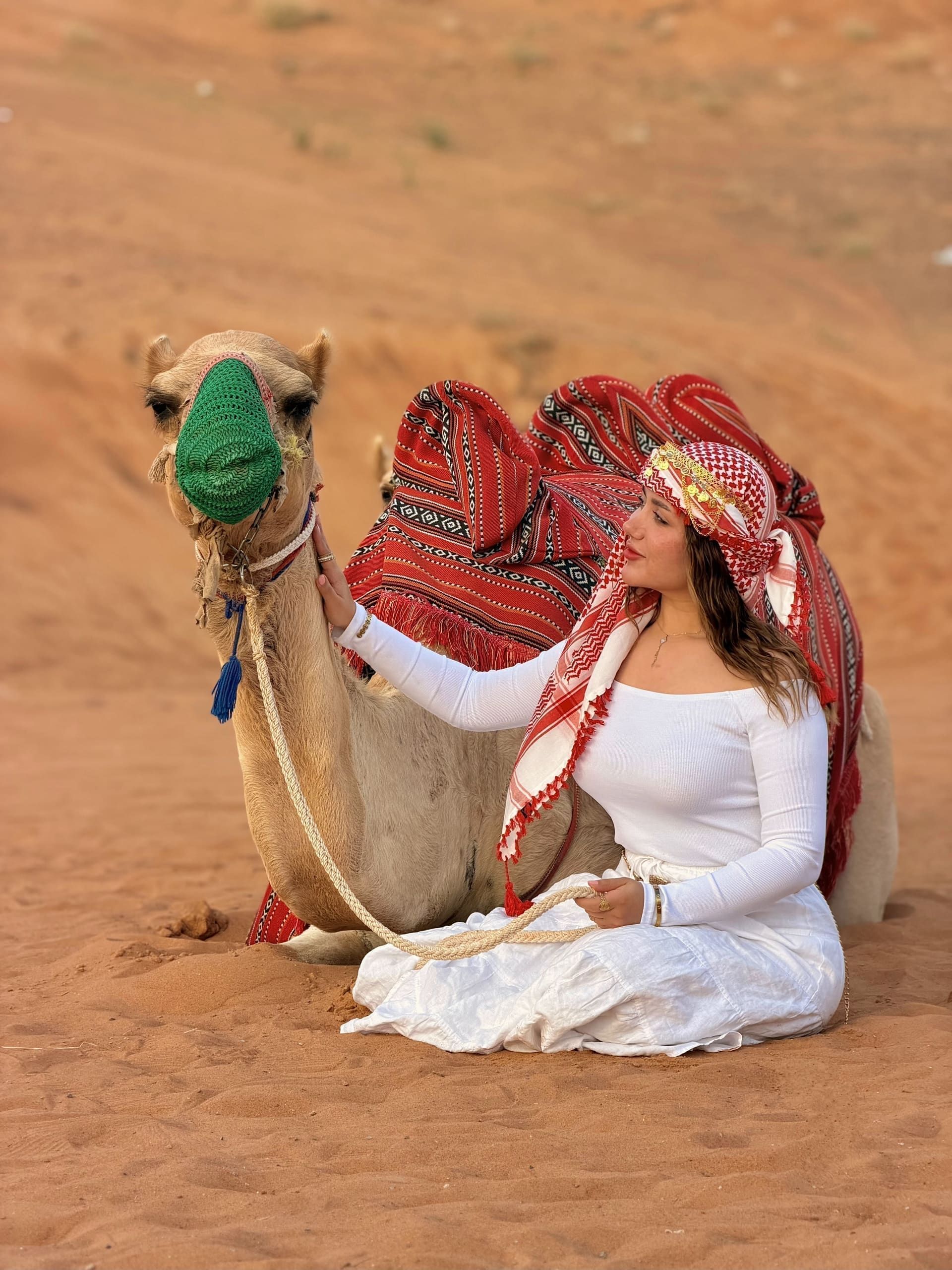
Camel riding on a Dubai desert safari
What camel riding actually is on a Dubai desert safari
Camel riding on a Dubai desert safari is a halter-led short walk on an Arabian dromedary at the desert camp, with a camel handler holding the lead rope and the guest seated on a traditional wooden Arabian saddle padded with a thick saddle blanket. The activity sits inside the standard inclusion bundle on every credible evening safari at Lahbab, Al Marmoom, and the Dubai Desert Conservation Reserve. The ride is not a self-steered experience; the handler keeps the camel walking at a controlled 4 to 5 km/h pace across a loop near the camp tents. The single-hump dromedary (Camelus dromedarius) is the native UAE camel breed; double-hump Bactrians live in central Asia and do not appear on Dubai safaris. The ride sits inside the standard inclusions on every BookMySafari package, one of the fixtures guests expect from a desert safari Dubai, and it stays optional only on the no-dune-bashing route.
Four ride lengths exist across the price ladder. The standard camp ride covers 5 to 10 minutes and sits inside the AED 149 to 250 evening ticket. An extended camp ride extends to 15 to 20 minutes and adds AED 30 at booking. A premium sunset ride lasts 30 minutes and adds AED 75 on the luxury heritage safari. The signature 60 to 90 minute sunrise camel trek crosses an open dune route at dawn and prices at AED 250 within the AED 350-plus overnight package. Each option uses the same Arabian saddle, the same handler-led pacing, and the same 130 kg weight cap; the difference is route length, time of day, and group size.
4 camel-ride options compared, minute by minute and AED by AED
Four camel-ride options run across Dubai desert safari operators. The minutes, the price, and the safari package each ride belongs to are below. The 5 to 10 minute camp ride is the most common; the 90-minute sunrise trek is the rarest because it sits inside the overnight package only.
| Option | Minutes | Belongs to | AED |
|---|---|---|---|
| Standard camp ride | 5 to 10 | Evening safari, standard AED 149 to 250 | Free |
| Extended camp ride | 15 to 20 | Premium evening, AED 350 to 500 | AED 30 |
| Sunset ride | 30 | Luxury heritage, AED 695 and above | AED 75 |
| Sunrise camel trek | 60 to 90 | Overnight safari, AED 350 and above | AED 250 |
The standard 5 to 10 minute camp ride is the cheapest entry point to the activity and the most frequent. The 90-minute sunrise trek is the editorial-desk pick for first-time visitors who want the heritage experience in full; the dawn light at the Lahbab edge and the slower walking pace make the photograph noticeably better than a queue-bound camp ride. Pricing across operators sits in a tight range because the camel rotation, the handler labour, and the saddle equipment are shared across every option.
Arabian dromedary anatomy and ride physics that decide rider comfort
Three anatomy facts decide rider comfort on a Dubai safari camel ride. The 130 kg weight cap protects the spine. The kneeling sit-stand sequence rocks the saddle in a predictable order. The minimum rider age sits at 3 with a parental hold for the same kneeling mechanics that govern adult mounts.
130 kg
Weight limit per saddle
Combined rider weight including clothing and any daypack. A working Arabian dromedary in the wild carries up to 270 kg, yet welfare-led safari operators publish the lower 130 kg figure for short repeated rides across the evening.
3 years
Minimum rider age, parental hold
Under-3 children skip the saddle because the sit-stand transition rocks at 30 to 45 degrees and the saddle horn grip exceeds toddler hand strength. Ages 3 to 7 ride seated in front of a parent.
Back first
Sit-stand transition, rising
The camel rises back-legs-first, so the rider feels the saddle pitch forward and lean back to counter the angle. The front legs follow once the rear is locked. Front-leg rise transfers the rider weight onto the hump.
Front first
Sit-stand transition, lowering
The camel kneels front-legs-first, so the rider feels the saddle pitch forward and lean forward to follow the angle. The rear legs collapse after the front locks. The lean reverses across the two halves of the dismount.
The single hump on a Camelus dromedarius is fatty tissue, not water. The hump tone and the shape over the wooden saddle are visual welfare markers; a flaccid or slumped hump signals a working camel under-fed during the evening rotation. A firm, upright hump under the saddle blanket signals a fed, rested animal. The Arabian dromedary is native to the UAE, and conservation breeding programmes at the Al Marmoom Camel Heritage village and the Dubai Camel Hospital sustain the working stock used by safari operators.
Sit-stand boarding protocol: lean back, hold horn, follow handler
The sit-stand boarding protocol covers five steps from approach to mounted seated. The protocol matters because the kneeling sequence transfers rider weight in two stages, and a rider who does not lean correctly slides forward over the camel neck during the rise.
- Approach the camel from the front while the handler holds the lead rope. The front approach lets the camel see you, reduces the spit-reflex risk, and lets the handler steady the head before the mount. Side and rear approaches startle a working animal.
- Wait for the kneel signal from the handler. The camel kneels front-legs-first and the rear follows, lowering the saddle to roughly hip height for an adult. Do not climb until the handler confirms the kneel is complete and the camel is settled on all four knees.
- Mount over the right side, swing the left leg across the saddle, settle into the wooden frame, and place both hands on the saddle horn at the front. The traditional saddle has a forward horn for grip and a rear cantle for back support.
- Lean back as the camel rises. The back legs straighten first, pitching the saddle forward by 30 to 45 degrees. A backward lean keeps the centre of gravity over the saddle. The front legs straighten next, levelling the saddle.
- Reverse the lean for dismount. The handler signals the kneel; the camel folds front-legs-first, pitching the saddle forward again. Lean forward to follow the pitch, then sit upright as the rear legs collapse. Swing the left leg back over and step off on the right.
The protocol takes 45 to 60 seconds across mount and dismount. The handler stays at the head the entire time and signals each stage. Riders who freeze during the sit-stand transition are the most common reason for a stalled queue at the camp camel station; the forward-pitch-backward-lean-and-back-pitch-forward-lean rhythm is the operative cue.
Minimum age 3 with parental hold, weight cap 130 kg
The minimum rider age for a Dubai safari camel ride sits at 3 years old with a parental hold. The cap exists because the saddle horn requires a child-grip strength most under-3 toddlers cannot maintain through the sit-stand transition. Ages 3 to 7 ride seated in front of a parent on the same saddle; ages 8 and older ride solo on a child saddle if the camp stocks one. Some premium camps stock a smaller child saddle; standard Lahbab camps share a single saddle across guests.
The 130 kg weight cap includes rider weight, clothing, and any daypack. Heavier riders are routed to a larger camel from the working rotation if available, asked to choose another activity, or paired with a stronger animal at the editorial-desk pre-pickup chat. The cap covers the seated load distribution across the wooden Arabian saddle, the padded blanket, and the single hump; the spine of the animal is the welfare bottleneck. Combined parent-and-child rides also fall under the 130 kg cap; a 95 kg parent plus a 25 kg child is acceptable, a 110 kg parent plus a 35 kg child is not.
Camel temperament and what triggers the spit reflex
A Dubai safari camel is a halter-trained working dromedary habituated to handlers and guests since calf age. The temperament under saddle reads as calm, patient, and slow; the camel walks where the handler walks and stops where the handler stops. The reputation for spitting and biting belongs to wild camels and to unneutered males in mating season, not to a camp-trained working dromedary in the standard evening rotation.
The spit reflex itself is a regurgitated mix of cud and stomach acid, not saliva. The smell is strong and the stain on fabric is heavy. The three triggers are sudden loud noises near the face, tail-pulling, and food-snatching without handler permission. The mitigation is simple: approach from the front, let the handler position the animal, keep hands off the tail, and skip the close-range flash photograph. Working camels at Lahbab, Al Marmoom, and DDCR rarely spit during the ride; reported spit incidents come almost entirely from off-script close-approach moments at the camp queue, not from the saddled ride itself.
Calm vs trot pacing is a level choice. Standard camp rides hold a 4 to 5 km/h walking pace; trotting belongs to the longer 60 to 90 minute sunrise trek where the open route and the lower group density allow a 7 to 9 km/h trot for short segments. The trot is bouncier and rocks the saddle vertically rather than tilting it; the rider keeps the same horn grip and matches the rhythm with the legs.
Inside a Dubai desert safari camel ride
Five scenes from the Lahbab camp camel station
Real frames from the standard evening ride, the handler-led walk loop, and the sunset saddle.


Camel welfare: how to spot a well-treated animal before mounting
Camel welfare on a Dubai desert safari is visible in four observable markers at the camp camel station. Body condition, hump tone, handler-to-camel ratio, and the work-rotation rule all show in the 90 seconds before the mount. The editorial desk publishes the checklist because the welfare conversation is the most under-served question across competitor pages.
1. Body condition score
The ribs are covered without protrusion. A camel with visible rib outlines under the saddle blanket is under-fed; a camel with rounded flank and even-toned hide is fit for the rotation. The shoulder blade also sits flat, not jutting.
Skip the ride if ribs show2. Hump tone and shape
The single hump is firm and upright under the saddle blanket. A slumped, leaning, or flaccid hump signals fat-store depletion from over-work or under-feeding; a working camel rested through the day shows an upright hump at the evening rotation.
Skip the ride if hump slumps3. Handler-to-camel ratio
One handler per one to two camels in a single rotation. A camp running 8 camels with 2 handlers is welfare-compatible. A camp running 12 camels with 1 handler is under-staffed; the camels miss water breaks and the queue lengthens past comfort.
Walk away if 1 handler per 6+ camels4. Work rotation rule
No single camel carries riders for more than 90 minutes of cumulative saddle time before a 30-minute rest, water, and feed break. Welfare-led camps rotate three camels through the evening to share the load; the rest pen sits visible behind the camp.
Ask the handler about the rotationThe editorial desk WhatsApps the welfare flags to a guest who asks before pickup. The premium camp operators rotate camels through the evening; the standard Lahbab camps follow the same practice when the camp manager is on-site. Conservation of native UAE camel breeds runs through the Al Marmoom Camel Heritage village and the Dubai Camel Hospital, which treats working dromedaries from the Lahbab and Al Marmoom rotation pools at no cost to the operators.
Photography of camel rides at the Lahbab camp
A camel ride photograph reads best at golden hour, between 5 to 25 minutes before sunset on the Lahbab ridge. The warm orange light catches the saddle blanket and the kaffiyeh, and the camel silhouette frames cleanly against the red dune line behind. A standard camp ride lands inside the 5:15 PM to 6:00 PM window in winter and 6:30 PM to 7:00 PM in summer; the lighting works for both.
The four practical photo rules are: shoot from a low angle to catch the dune line behind the camel, frame the rider on the rising side as the camel stands, ask the handler to pause the camel at the loop apex for the still frame, and skip the flash at close range to avoid startling the animal. Wraparound sunglasses and a kaffiyeh in earth tone or ivory read clean on camera; dark navy and pure black absorb the warm light and flatten the frame. The camp photography station charges AED 200 to 500 for edited delivery on the luxury package; standard tickets cover handler-led smartphone shots taken by the guest.
Pregnancy, back pain, and motion-sensitivity considerations
A camel ride is unsafe in the second and third trimesters of pregnancy. The sit-stand transition rocks the saddle at 30 to 45 degrees forward then backward, and the saddle horn presses against the lower abdomen during the rise. The standard alternative is a no-camel evening safari at the AED 149 to 249 price band, with the camel station skipped at the camp; the booking note carries the camel-skip flag so the camp staff route the guest to the falcon station or the henna table instead.
Lower-back pain reshapes the ride decision. The wooden Arabian saddle has firm support through the cantle yet limited shock absorption during the trot. A standard 5 to 10 minute walking-pace camp ride sits inside the tolerance for most lower-back conditions; the longer 60 to 90 minute sunrise trek with occasional trotting belongs to riders without active back conditions. Riders with sciatica, recent back surgery, or spondylosis skip the camel entirely and use the time for the falcon photograph or the Arabic coffee station.
Motion-sensitivity riders handle the walking pace without issue; the trot is the trigger. The standard camp ride at 4 to 5 km/h does not provoke motion sickness in most riders who tolerate a slow walk. Sea-sickness wristbands, ginger chews, and a light meal 90 minutes before the ride mitigate the residual sensitivity if it lingers.
What to wear on the camel ride
A camel-ride outfit is loose long trousers, a long-sleeve cotton shirt, closed-toe trainers, and a scarf for wind and dust. The trouser cut matters because the saddle horn sits between the thighs and the legs straddle the camel flank; wide-leg linen trousers and cotton chinos work cleanly, while tight jeans restrict the saddle straddle and rip at the inseam during the mount.
- Long trousers, wide-leg linen in summer, cotton chinos in winter. Both allow the camel-mount swing. Avoid tight jeans, mini skirts, and shorts above mid-thigh.
- Closed-toe trainers, canvas sneakers or mesh trainers. The camel stirrup (if fitted) accepts a trainer; open-toe sandals slip out during the trot.
- Long-sleeve cotton shirt, covers the forearms against the saddle blanket wool and the dune-ridge ultraviolet. Earth-tone or ivory reads best on camera at sunset.
- Cotton scarf or kaffiyeh, wraps wind, dust, and frames the photograph. A kaffiyeh in ivory or sand reads as a heritage detail at the saddle.
- Wraparound sunglasses, block sand and ultraviolet on the open ridge. Polarised lenses cut the dune-glare at sunset.

The 90-minute sunrise camel trek
A dawn traverse from the overnight desert camp to the Lahbab ridge
The signature 90-minute sunrise camel trek runs from 5:30 AM to 7:00 AM in winter and 4:30 AM to 6:00 AM in summer. The camel string of 6 to 8 dromedaries walks single-file across the open dune route, with one handler per two camels and a lead handler at the front. The route covers 3 to 4 kilometres at a steady 4 km/h walking pace; the first 20 minutes climb the dune slope, the middle 40 minutes traverse the ridge line, and the last 30 minutes descend back to the camp for breakfast. The dawn light shifts from indigo through orange to gold across the ride. The trek sits inside the AED 350-plus overnight package; the activity priced standalone runs AED 250 per rider where the operator allows it.
- 60 to 90 minutes saddled Continuous ride time, no dismount until the camp return
- 3 to 4 km route across open dune Single-file camel string at a 4 km/h walking pace
- One handler per two camels Welfare-led ratio; lead handler at the front of the string
- Dawn light shift indigo to gold Best photograph window between 5:50 AM and 6:30 AM in winter
Book the camel ride on WhatsApp
Pick an option above and message us. The editorial desk confirms the camel-ride length, the handler-to-camel ratio at the camp on your booking date, and the welfare flags inside reply within 10 minutes. Bookings on this page are fulfilled by Velari Tourism L.L.C, DET license #1491675.
Message us on WhatsApp
Camel ride picked, date locked
Message us the date. We confirm camel rotation and welfare flags inside 10 minutes.
Pick the camp ride, the extended ride, the sunset ride, or the sunrise trek. The editorial desk verifies handler-to-camel ratio and saddle stock at the camp before confirming.
Frequently asked questions about Dubai camel riding
-
Is the camel ride included free on a Dubai desert safari?
A 5 to 10 minute camel ride at the desert camp is included free on the standard AED 149 to 250 evening desert safari package. Every DET-licensed operator runs a camel station at the camp because the activity is part of the heritage promise. The free ride is a slow halter-led walk in a tight circle, with the handler holding the lead rope and the rider in the traditional saddle. Longer rides cost AED 30 to 75 extra at the camp, and the 90-minute sunrise camel trek belongs to the AED 350+ overnight package. Booking the camel ride as a standalone activity outside a safari is rare and runs AED 80 to 150 per person at the same camp. -
How long is the camel ride at a desert camp?
The standard desert camp camel ride lasts 5 to 10 minutes per guest. The handler walks the camel in a 30 to 50 metre loop near the camp tents while another guest waits the turn. The 5 to 10 minute figure covers the kneeling boarding, the loop walk, and the kneeling dismount; the actual saddled time on the camel sits closer to 3 to 5 minutes. Premium evening packages run the loop longer at 15 to 20 minutes for AED 30 extra, and overnight package guests board a sunrise camel trek that lasts 60 to 90 minutes across an open dune route. Group size, queue length, and camp size shift the per-guest wait time across the evening. -
Is it safe to ride a camel?
Riding a camel on a Dubai desert safari is safe when the camel is halter-led by a trained Bedouin handler, the saddle uses the traditional Arabian wooden frame with a padded blanket, and the rider follows the kneeling boarding protocol. The camel kneels first, the rider mounts the saddle, and the handler signals the stand. The camel rises back-legs-first (so the rider leans back) and dismounts front-legs-first (so the rider leans forward). The handler stays at the head the entire ride. Insurance carried by every DET-licensed operator names camel riding as a covered activity. The two real risks are a fall during the sit-stand transition if the rider does not lean correctly, and the spit reflex if the camel is provoked. -
Can children ride a camel in Dubai?
Children aged 3 and older ride a camel on a Dubai desert safari with a parent or handler hold. Under-3 children skip the camel saddle because they cannot grip the saddle horn through the sit-stand transition. Ages 3 to 7 ride seated in front of a parent on the same saddle, with the parent gripping the horn and the handler walking the lead rope. Ages 8 and older ride solo in a child saddle if the camp supplies one (some premium and Lahbab camps stock the smaller saddle; confirm on the booking thread). The handler stays alongside for every child ride regardless of age. The child rate on the safari ticket usually applies to ages 4 to 11; the camel ride is included free for children at the same level as the adult ticket. -
Do camels spit at tourists?
Camels spit at humans only when provoked, frightened, or in mating season for an unneutered male. A halter-led, well-trained, working dromedary at a Dubai desert camp rarely spits at a paying guest. The reflex itself is not saliva but a regurgitated mix of cud and stomach acid; it smells strongly and stains fabric. Triggers include sudden loud noises near the face, tail-pulling, food-snatching, or handler agitation. The mitigation is simple: approach the camel from the front, never the side or rear; let the handler position the camel; avoid feeding without permission; and skip the flash photograph at close range. Trained camp camels at Lahbab, Al Marmoom, and DDCR rarely spit during the ride because they are habituated to handlers and saddles since calf age. -
What is the camel weight limit?
A working Dubai safari camel carries a 130 kg maximum rider weight per saddle. The limit covers the rider, the rider clothing, and any daypack carried during the ride. Heavier riders are routed to a larger camel from the rotation or asked to choose another activity at the camp. The limit exists because the Arabian dromedary saddle distributes weight across the single hump, the spinal column, and the saddle blanket; weight above 130 kg compresses the spine over time and shortens the working life of the animal. Combined weights for parent-and-child rides also fall under the 130 kg cap. The cap is per saddle, not per camel; a working dromedary in the wild carries up to 270 kg, yet welfare-led safari operators publish the lower 130 kg figure for short rides. -
Can pregnant women ride a camel?
A camel ride is unsafe in the second and third trimesters of pregnancy. The sit-stand transition rocks the saddle forward then backward at angles of 30 to 45 degrees, and the saddle horn presses against the lower abdomen during the rise. A short 5-minute camel ride during the first trimester carries lower risk if a midwife or obstetrician approves it in writing. Beyond 16 weeks, the safer choice is to skip the camel station entirely and use the time for the falcon photograph, the henna application, or the BBQ buffet. The standard alternative is a no-camel evening safari at the same AED 149 to 249 price band, and pregnant guests benefit from confirming the booking note carries the camel-skip flag so the camp staff do not ask at the saddle.