Wildlife of the UAE desert, species, sightings, conservation
The Arabian oryx, the national animal recovered from extinction
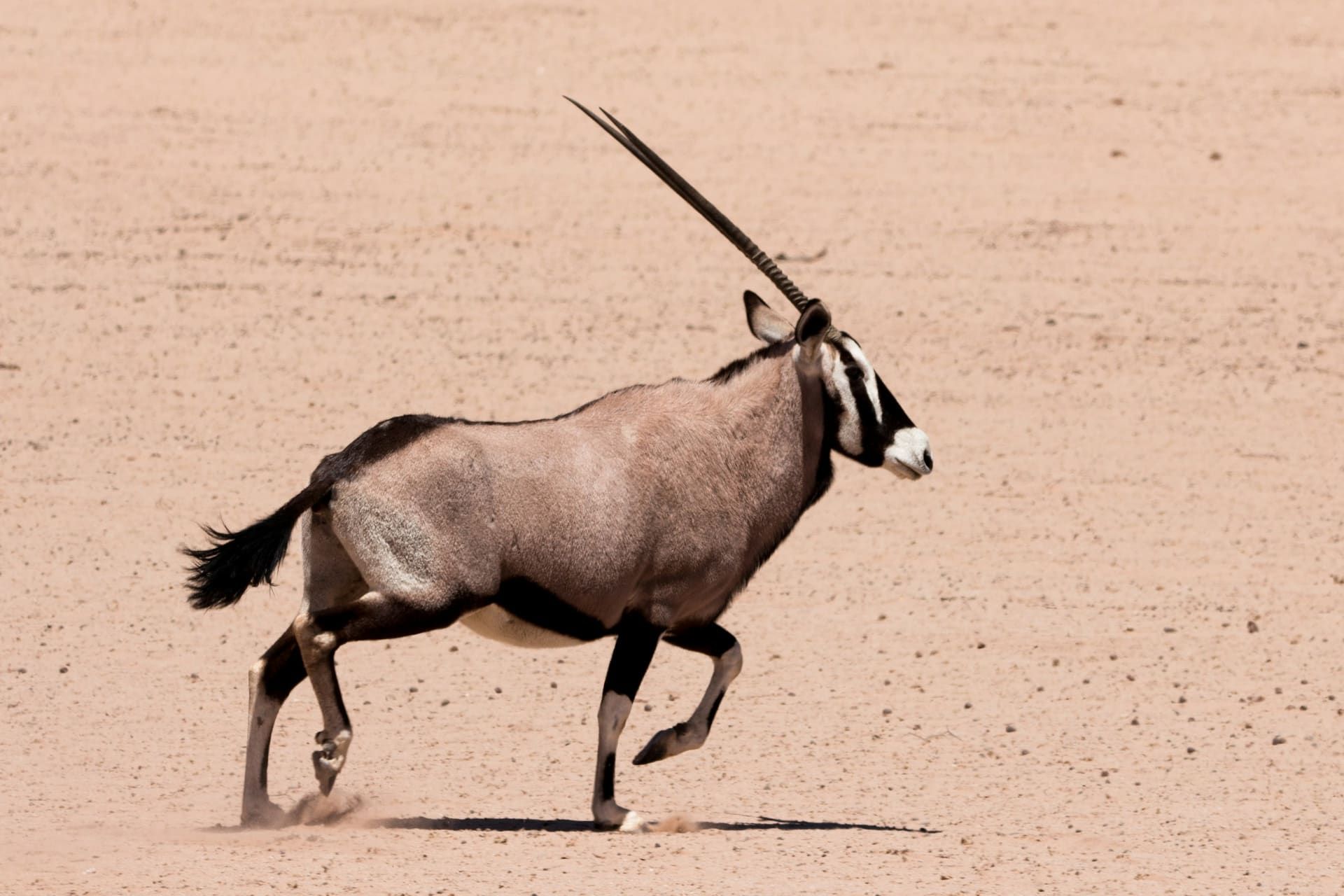
The Arabian oryx (Oryx leucoryx) is the national animal of the UAE and the species most desert-safari guests come to see. Adult oryx stand 102 centimetres at the shoulder, weigh 70 kilogrammes, and carry near-straight 60 to 80 centimetre horns on both sexes. The coat is bone-white with chocolate leg markings and a black face stripe, an adaptation that reflects radiant heat in summer when surface temperatures cross 60 degrees Celsius.
The oryx was driven to Extinct in the Wild status by 1972 through hunting pressure across the Arabian peninsula. A captive-breeding programme co-founded by Sheikh Zayed bin Sultan Al Nahyan recovered the species from a global founder population of fewer than 100 animals. The first reintroductions to the wild ran in Oman from 1982 and in the UAE from 2007. The current IUCN Red List entry classifies the species as Vulnerable; the global wild population sits at roughly 1,200 animals, with around 400 in the Dubai Desert Conservation Reserve and 100 at Al Marmoom.
Oryx are almost always seen inside the DDCR on a winter sunrise drive with a licensed luxury operator. Al Marmoom oryx are usually seen on the same time slot. Oryx graze from 5:30 AM to 7:30 AM and again 30 minutes before sunset; mid-day is poor because the herd shelters in any available shade. Photography rule one: maintain a 50-metre minimum distance per the published reserve eco-rules, no flash.
Sand gazelle and mountain gazelle, how to tell them apart
Two gazelle species share the UAE desert. The Arabian sand gazelle (Gazella marica, also marketed as the Reem gazelle in Arabic) is smaller, paler, and prefers the open sand sheets. The Arabian mountain gazelle (Gazella arabica) is larger, darker, and prefers the rockier edges of the reserves. Distinguishing them in the field comes down to three markers.
- Body size. Sand gazelle adults reach 17 to 22 kilogrammes. Mountain gazelle adults reach 18 to 25 kilogrammes, with longer legs.
- Horn profile. Sand gazelle horns are thin, lyre-shaped, and roughly 25 centimetres long. Mountain gazelle horns are thicker, S-curved, and 27 to 30 centimetres long.
- Flank colour. Sand gazelle flanks are uniform pale buff. Mountain gazelle flanks carry a darker stripe along the lower body.
Both species are present in Al Marmoom Reserve and the DDCR. Sand gazelle is the more common Al Marmoom species; mountain gazelle is occasionally seen among DDCR gazelle sightings. Sand gazelle carries Vulnerable IUCN status; mountain gazelle carries Endangered status because the global wild population has dropped below 8,000 animals.
The marquee species, photographed
Oryx, gazelle, and saker falcon in five frames
A grazing oryx, a walking sand gazelle, a saker portrait, a Reem on open ground, and the DDCR sunrise herd. Five frames from the published sighting matrix above.


Three small carnivores: sand fox, sand cat, and Gordon's wildcat
Three small carnivore species share the UAE desert. None are visible on a standard evening safari at Lahbab; sightings happen on dedicated dusk and night routes inside Al Marmoom and DDCR.
The Rüppell's sand fox (Vulpes rueppellii) is the most regularly seen. Adults weigh 1.7 kilogrammes, carry a russet coat with a white-tipped tail, and patrol the lake-edge corridor at Al Qudra and the open sand at the DDCR perimeter at dusk. It is occasionally seen on a 5:00 PM Al Marmoom route in winter, dropping to rarely seen in summer.
The Arabian sand cat (Felis margarita harrisoni) is smaller (1.8 to 3.4 kilogrammes) with the pale sand-blond coat and tufted ears that allow it to walk on hot sand. The species is strictly nocturnal and rarely seen, even by rangers, across all UAE reserves. Camera-trap data from the EAD records confirmed presence at DDCR, Al Marmoom, and Sir Bani Yas Island.
The Gordon's wildcat (Felis silvestris gordoni) is an Arabian subspecies of the wildcat, slightly larger than a domestic cat at 4 to 6 kilogrammes, marked with faint tabby stripes. Sightings on moonless DDCR night drives are rare. The species is classified Least Concern globally but the UAE genetic population sits at fewer than 500 breeding individuals, listed as a national conservation priority.
Cape hare and desert hedgehog, the small mammals
Two small mammal species turn up reliably on the slower wildlife-focused routes. The Cape hare (Lepus capensis) is a 2 to 3 kilogramme nocturnal grazer with the long ears and powerful hindquarters of the European hare. It is occasionally seen on Al Marmoom sunrise and sunset routes; the species moves between scrub thickets and freezes against the sand when spotted, which makes the eye reflection the easiest detection method.
The Ethiopian hedgehog (Paraechinus aethiopicus, the most common UAE species) is a 400 to 700 gramme nocturnal omnivore. Sightings cluster at camp edges where insect activity is highest; standard evening-safari camps rarely see them at the camp light line. The species curls into a defensive ball when approached and is not danger-aggressive. The desert hedgehog (Paraechinus aethiopicus deserti) is present in smaller numbers at the Al Marmoom dune fringes.
Sighting odds by species, reserve, and time of day
Sighting odds vary by reserve, season, and time of day. The matrix below shows how likely you are to spot each major species on a single drive, broken down by reserve, time of day, and season. Lahbab is unprotected public desert and holds no resident wildlife herd; the column reflects camp-edge incidental sightings only. The BookMySafari homepage lists which package visits which reserve in its dune-system column.
| Species | DDCR (winter AM) | Al Marmoom (winter AM) | Al Marmoom (dusk) | Lahbab (camp) |
|---|---|---|---|---|
| Arabian oryx | Almost always seen | Usually seen | Often seen | Not seen |
| Sand gazelle | Commonly seen | Often seen | Sometimes seen | Not seen |
| Mountain gazelle | Occasionally seen | Rarely seen | Rarely seen | Not seen |
| Rüppell's sand fox | Rarely seen (dawn) | Rarely seen (dawn) | Occasionally seen | Not seen |
| Sand cat | Rarely seen (night) | Rarely seen (night) | Rarely seen | Not seen |
| Gordon's wildcat | Rarely seen (moonless) | Rarely seen | Rarely seen | Not seen |
| Cape hare | Occasionally seen | Occasionally seen | Occasionally seen | Rarely seen |
| MacQueen's bustard | Occasionally seen | Sometimes seen (lake) | Occasionally seen | Not seen |
| Pharaoh eagle-owl | Rarely seen (night) | Rarely seen (night) | Rarely seen | Rarely seen |
| Desert monitor | Rarely seen (summer) | Occasionally seen (sabkha) | Rarely seen | Not seen |
| Dhub (spiny-tail) | Occasionally seen (summer) | Occasionally seen (summer) | Occasionally seen | Not seen |
| Sand viper | Rarely seen (dusk) | Occasionally seen (summer dusk) | Occasionally seen | Not seen |
| Deathstalker scorpion | Rarely seen (rocky) | Rarely seen | Rarely seen | Rarely seen |
| Camel spider | Rarely seen (summer night) | Occasionally seen | Occasionally seen (summer) | Occasionally seen |
Three patterns sit inside the matrix worth flagging. Oryx and gazelle odds collapse outside the protected reserves; if the trip exists to photograph either, book the DDCR or Al Marmoom route, not a Lahbab evening safari. The small carnivore odds are not zero but they are dusk-and-night dependent, which the standard evening-safari schedule does not serve. Reptile odds invert seasonally, most species hide in winter and surface in summer when the sand reaches operating temperature for cold-blooded foraging.
The four high-profile desert birds on the UAE checklist
The UAE checklist runs to roughly 470 recorded bird species across the country, with 200+ documented in desert and reserve habitats. The four high-profile desert birds appear below; the broader checklist sits in the Emirates Bird Records Committee log.
- MacQueen's bustard (Chlamydotis macqueenii), winter resident, IUCN Vulnerable, sometimes seen on a winter sunrise Al Marmoom lake-edge route. The namesake quarry species of UAE regulated falconry.
- Pharaoh eagle-owl (Bubo ascalaphus), resident, 60 to 70 centimetre wingspan, IUCN Least Concern but population trending. Rarely seen on a DDCR night route. Heard more often than seen.
- Greater hoopoe-lark (Alaemon alaudipes), resident, usually seen on any morning desert route. The diving courtship flight at sunrise is the loudest dawn sound in the reserves.
- Cream-coloured courser (Cursorius cursor), resident, ground-nesting, sandy-grey, occasionally seen on a winter morning. Pairs with the hoopoe-lark on the same morning routes.
The lake corridor at Al Qudra adds 158 documented bird species, including winter migrants (greater flamingo, glossy ibis, common teal) and resident waders. Birders fare best with a 400 mm lens at the lake edge between 6:00 AM and 8:30 AM in November to March.
Three UAE raptors: the saker, the peregrine, and the lappet-faced vulture
The falcon is the UAE's cultural keystone bird and the centrepiece of the country's UNESCO-recognised falconry tradition. Three raptors carry the conservation programme weight.
- Saker falcon (Falco cherrug), IUCN Endangered. 1 to 1.3 kilogramme adult weight. The traditional hunting falcon of the Gulf. Captive-bred birds at the Sheikh Zayed Falcon Release Programme return to Central Asian breeding grounds each spring; tagged-bird release counts run roughly 50 birds annually from Abu Dhabi.
- Peregrine falcon (Falco peregrinus pelegrinoides, the Barbary subspecies), IUCN Least Concern globally but a UAE national priority. The fastest animal on Earth in a stoop; the camp falconry demonstrations work the lure-flight section with peregrines and sakers depending on bird availability.
- Lappet-faced vulture (Torgos tracheliotos negevensis), IUCN Endangered. 2.7 metre wingspan, the largest Old World vulture. Resident at Sir Bani Yas Island and recorded as a vagrant at DDCR; it is rarely seen in Dubai but the species turns up on premium ranger-guided routes at the EAD reserves.
The Mohamed Bin Zayed Raptor Conservation Fund tracks all three species globally. UAE falconry is regulated under the Sheikh Zayed Centre permit framework; private ownership requires a CITES certificate and a microchip implant per bird. Bab Al Shams runs a free public falconry show in the early evening plus a paid private morning session with the resident falconer. Read the entry on Bedouin culture in the UAE for the cultural context behind the falconry programme.

The conservation backbone
Sheikh Zayed Centre releases 50,000 Houbara birds a year
The Sheikh Zayed Centre for Houbara Conservation in Abu Dhabi is the world's largest captive-breeding operation for MacQueen's bustard. Annual release counts run near 50,000 birds across Central Asia, North Africa, and the Arabian peninsula. The programme exists because the species sits on the IUCN Vulnerable list and the population is the historic quarry of UAE regulated falconry. Sustainable falconry depends on a sustainable Houbara population, which is why the breeding centre carries federal funding rather than tourism revenue.
- 50,000 birds released annually Captive-bred Houbara distributed across the historic range
- IUCN Vulnerable Sustainable falconry tied to a sustainable Houbara population
- Federal allocation Sheikh Zayed Centre and MBZ Raptor Fund carry public conservation budgets
The four reptiles you might actually see on a safari
The UAE reptile checklist runs to 72 species, with 4 of practical interest on a safari. Reptile sightings invert the mammal pattern, most species are summer-active and shelter in winter when sand temperatures fall below operating range.
- Sand viper (Cerastes gasperettii), venomous, ambush predator, 30 to 50 centimetre adult length. Buries in soft sand with only eyes and snout exposed. Occasionally seen at Al Marmoom dusk in summer. Bites are rare on commercial safaris; the species strikes only when stepped on or cornered.
- Arabian sand snake (Psammophis schokari), mildly venomous to small prey, harmless to humans. Diurnal hunter, fast across loose sand. Rarely seen on a summer morning Al Marmoom route.
- Desert monitor (Varanus griseus), UAE's largest lizard, up to 1.3 metres total length, IUCN Least Concern but population thinning. Sightings cluster near sabkha (salt-flat) margins where prey insects gather. Occasionally seen at the Al Marmoom sabkha route in summer.
- Dhub or spiny-tailed lizard (Uromastyx aegyptia microlepis), 60 to 75 centimetre stocky herbivorous lizard, the species featured on Emirati pre-oil hunting poetry. Burrow-dweller, exits midday to bask in summer. Occasionally seen at Al Marmoom in summer.
Camel spiders and scorpions, what's actually dangerous
The dangerous-arthropod stories travel faster than the actual risk. The medical record for UAE commercial safaris shows fewer than 5 scorpion stings per year across the emirate, no camel-spider envenomations on record (Solifugae carry no venom), and a long-tail risk on sand-viper bites of fewer than 2 incidents per year. The functional risk is closer to a twisted ankle than to a venomous animal encounter.
The species worth knowing:
- Deathstalker scorpion (Leiurus quinquestriatus), the most venomous UAE scorpion. 5 to 8 centimetre adult length, sandy-yellow, lives under flat stones in the rocky desert margins. Stings are extremely painful but rarely fatal in healthy adults; children and the immunocompromised carry higher risk. Rarely seen on a rocky DDCR night route.
- Arabian fat-tailed scorpion (Androctonus crassicauda), black, stockier, venom carries a higher cardiotoxic risk profile than the deathstalker. Sightings rare on commercial safaris; the species favours under-rock shelter away from visitor routes.
- Camel spider (Solifugae, 3 UAE species), fast nocturnal arachnid, 5 to 7 centimetre body length, no venom, mechanically painful bite if cornered. Drawn to camp lights; occasionally seen at summer camps. The internet folklore is uniformly false.
Practical mitigation: closed-toe shoes after sunset, a torch when walking from the camp to the vehicle, no hands under unfamiliar rocks. Camp staff carry first-aid kits with poison control numbers (national Poison Control: 998). Anti-venom for both scorpion species is stocked at Rashid Hospital in Dubai and Sheikh Khalifa Medical City in Abu Dhabi.
Conservation status, IUCN Red List for every named species
Every species named on this page sits on the IUCN Red List. The status table below combines the global IUCN classification with the UAE recovery programme responsible for the species. Status abbreviations follow the IUCN Red List of Threatened Species, published categories 2024 assessment cycle.
| Species | IUCN status | UAE recovery programme |
|---|---|---|
| Arabian oryx | Vulnerable | Sheikh Zayed Centre + MBRC reintroduction |
| Sand gazelle (Reem) | Vulnerable | MBRC Al Marmoom programme |
| Mountain gazelle | Endangered | EAD Sir Bani Yas and Wadi Wurayah |
| Rüppell's sand fox | Least Concern | National monitoring (camera trap) |
| Sand cat | Least Concern | EAD captive breeding (Al Ain Zoo) |
| Gordon's wildcat | Least Concern (global) | UAE national priority list |
| MacQueen's bustard | Vulnerable | Sheikh Zayed Centre for Houbara Conservation |
| Saker falcon | Endangered | Sheikh Zayed Falcon Release Programme |
| Peregrine falcon (Barbary) | Least Concern | MBZ Raptor Conservation Fund |
| Lappet-faced vulture | Endangered | EAD Sir Bani Yas Island |
| Pharaoh eagle-owl | Least Concern | National monitoring |
| Desert monitor | Least Concern | Federal Law 11/2002 protected |
| Dhub (spiny-tailed lizard) | Vulnerable | Federal Law 11/2002 protected |
| Sand viper | Least Concern | National monitoring |
Federal Law No. 11 of 2002 on the Regulation of Trade in Endangered Species of Fauna and Flora, amended in 2018, criminalises harassment, capture, killing, and trade of every species on the schedule. Penalties run from AED 10,000 fines to imprisonment for trade in Appendix I CITES species. Tourists are not at risk of inadvertent breaches if they stay on marked routes and follow the published eco-rules.
Three desert plants worth knowing: ghaf, sidr, and sabkha succulents
UAE desert vegetation density is low but the few resident species are ecological keystones. The three names worth knowing on a safari.
- Ghaf tree (Prosopis cineraria), the national tree of the UAE, declared so in 2008. Drought-resistant, 4 to 5 metre canopy, taproot reaching 30 metres into groundwater. The ghaf anchors the desert ecosystem; oryx and gazelle graze the fallen pods, larks nest in the canopy, and the tree fixes nitrogen into the surrounding sand. Cutting a ghaf is a criminal offence under Federal Law 24/1999.
- Sidr or Christ's-thorn jujube (Ziziphus spina-christi), the second named UAE tree species. 6 to 10 metre canopy, edible fruit, bee-loved spring blossom that produces the regulated sidr honey crop. Found at wadi edges and oasis margins rather than on the open sand.
- Sabkha succulents, salt-tolerant ground covers (Halocnemum, Halopeplis, Suaeda) that line the sabkha (salt-flat) margins. The reddish-purple flush after winter rain on the salt-flats is one of the few colour events on the UAE desert calendar. The sabkha supports the dhub, the desert monitor, and the local fox population.
Where to see each species, Lahbab vs Al Marmoom vs DDCR
The three Dubai dune systems carry sharply different wildlife profiles. The summary below lines them up by category; the dedicated location pages carry the full operator and access maps.
- Lahbab desert, unprotected public desert 45 minutes east of Dubai. No resident wild herd. Camp-edge sightings of dung beetles, geckos, and the occasional fox or hare drawn to the camp lights. Read the Lahbab desert location guide for the dune profile.
- Al Marmoom Desert Conservation Reserve, 40 minutes south of Dubai, open public access with eco-rules, 4 certified eco-tour operators. Oryx, gazelle, sand fox, MacQueen's bustard, 158-bird checklist, lake-edge corridor. The full sighting probability table lives on the Al Marmoom Reserve page.
- Dubai Desert Conservation Reserve (DDCR), 50 minutes east of Dubai, gated 225 square kilometres, 5 luxury operators only. The highest oryx and gazelle sighting odds in the emirate, restricted access for low-impact wildlife photography. The Dubai Desert Conservation Reserve page carries the operator list and the access map.
Best time of day and season for sightings
Wildlife activity in the UAE desert is shaped by surface temperature. The hour after sunrise and the hour before sunset are the high-activity windows across mammals and birds; mid-day is the low window for mammals and the high window for reptiles. The seasonal pattern inverts between the two groups.
- Winter (November to March), 6:00 AM to 8:30 AM, peak window for oryx, gazelle, hare, bustard, and the dawn lark display. The single most productive 2-hour window in the calendar.
- Winter, 4:30 PM to sunset, second-best window for oryx and gazelle, primary window for sand fox.
- Summer (May to September), 5:00 AM to 7:00 AM, compressed mammal window; routes end before 8:30 AM under the heat cap.
- Summer, 11:00 AM to 3:00 PM, peak reptile window on dedicated herpetology routes. Dhub, monitor, and sand snake are basking-active.
- Night routes (any season), 9:00 PM to midnight, sand cat, wildcat, eagle-owl, camel spider. Operator-led only inside the reserves.
The full month-by-month timing table for Dubai safaris lives on the best time for a desert safari in Dubai pillar.

The two-hour productive window
A winter dawn at Al Marmoom outperforms every other slot
The hour after sunrise and the hour before sunset carry the wildlife activity across mammals and birds. Winter sunrise at Al Marmoom from 6:00 AM to 8:30 AM is the single most productive window in the calendar. The first oryx sighting at Al Marmoom in December often lands just before sunrise; the gazelle herds graze through the next 90 minutes; the hoopoe-lark courtship dive runs between 6:10 AM and 6:30 AM. Booking an evening Lahbab safari for a wildlife trip costs you the productive window.
- Winter dawn, 6:00 to 8:30 AM Oryx, gazelle, hare, bustard, the dawn lark dive
- Winter dusk, 4:30 PM to sunset Second-best window for oryx and gazelle, primary for sand fox
- Night routes, 9:00 PM to midnight Sand cat, wildcat, eagle-owl, camel spider, operator-led only
5 wildlife encounters most safari guests miss
The headline species pull the camera; the smaller, closer encounters slide past most guests because nobody is looking for them. The 5 reliable misses, all photographable from the standard evening-safari camp without a wildlife-focused itinerary.
- The hoopoe-lark dawn dive. Greater hoopoe-larks (Alaemon alaudipes) launch into a near-vertical courtship dive between 6:10 AM and 6:30 AM in winter, calling on the descent. The first sound of the desert sunrise. Usually seen on any morning route, free of charge, missed by every guest who arrives at sunset.
- The dung beetle at the camp. Two species of Scarabaeidae work the camel droppings on the camp perimeter every evening between 7:00 PM and 10:00 PM. The ball-rolling behaviour is recordable at 60 frames per second from 30 centimetres away with a phone macro lens.
- The house gecko on the camp wall. Hemidactylus turcicus and Hemidactylus persicus colonise every camp light fitting and pick off moths from 7:30 PM onward. The vertical-wall predation sequence is the easiest reptile photograph of any UAE safari.
- The desert monitor on the sabkha edge. Varanus griseus emerges from burrows on the salt-flat margins around 10:00 AM in summer to bask. The slow walk and forked-tongue scenting behaviour photographs cleanly at 200 mm.
- The falcon training paddock. Every Al Marmoom heritage camp keeps a working falconry paddock with 3 to 6 birds on perches. Visitors who ask the handler for a 5-minute walk-through see the bird up close, the hood-fitting routine, and the lure swing, no booking required.
The four recovery programmes behind UAE desert wildlife
Four named programmes carry the conservation weight for UAE desert wildlife. The funding model combines federal allocation, EAD royalty income, and private grants from the ruling families.
- Sheikh Zayed Centre for Houbara Conservation, Abu Dhabi-based, the world's largest houbara captive-breeding operation. Annual releases of around 50,000 birds across Central Asia, North Africa, and the Arabian peninsula. Visitor access is programme-controlled, not commercial.
- Mohammed Bin Rashid Al Maktoum Centre for Wildlife (MBRC), Dubai-based, manages the Al Marmoom Reserve, the Arabian oryx and gazelle reintroduction, the certified eco-tour operator register, and the photography permit office. The public point of contact for most Dubai safari conservation questions.
- Environment Agency Abu Dhabi (EAD), manages Sir Bani Yas Island, the Arabian leopard programme, and the Marawah marine reserve. Publishes the UAE Red List assessment for each species on a 5-year cycle.
- Mohamed Bin Zayed Raptor Conservation Fund, tracks saker, peregrine, and lappet-faced vulture populations globally. The tagging programme contributes the data that supports the IUCN Red List status reviews for the species.
What to bring for wildlife sightings
A wildlife-focused safari rewards different gear than a standard evening tour. The kit list below covers the gap.
- Binoculars, 8x42 or 10x42 is the field-tested configuration. The heavier 12x glass is harder to hold steady on the vehicle window. Compact 8x25 trades light-gathering for portability and underperforms at dawn.
- Telephoto lens, 400 mm equivalent is the minimum for usable oryx and gazelle shots at the 50-metre reserve distance rule. 600 mm gives more crop room for the smaller birds. Fast aperture (f/4 or f/5.6) handles the low-light dawn window.
- Beanbag, softer than a tripod for the vehicle window mount, lighter than a monopod, and accepted everywhere a tripod is restricted. Fill on arrival with the free sand.
- Low-light camera body, anything that holds usable noise at ISO 3200. The dawn window opens before sunrise; the first oryx sighting at Al Marmoom in December often happens just before sunrise.
- Polariser and microfibre cloth, polariser for the lake reflections at Al Qudra; microfibre for the daily sand that finds the front element regardless of care.
Three ethical viewing rules: no flash, no chase, no feeding
Reserve eco-rules and basic field ethics share the same three baseline rules. Operators enforce them, rangers patrol them, and breaches carry written-warning escalation.
- No flash photography of any wildlife. Flash damages low-light vision in nocturnal species, scatters herds, and disrupts breeding behaviour. Disable flash before departure and confirm camera-body settings; some bodies fire a focus-assist beam that counts as flash under the rules.
- No off-track chasing. Stay on operator-permitted routes; never instruct a driver to leave the marked path to close the distance on an animal. The herd behaviour collapses inside a 30-metre approach and the photograph fails before the breach lands a fine.
- No feeding, no calling, no luring. Conditioning desert mammals to human food sources is treated as harassment under Federal Law 11/2002 and undermines the reintroduction programmes. The free-ranging camels at the camps are the only exception and only to the camp-supplied feed.
The wildlife-first brief
Wildlife routing on BookMySafari versus a standard Dubai evening safari
Six promises the editorial desk holds the partner operator to when the booking explicitly asks for sightings rather than dunes and dinner. Each row points back to a published table or programme above.
Wildlife bookings, sighting outcomes
Six bookings, six cities, the species each guest came for
Mumbai, London, Sydney, Toronto, Berlin, Singapore. Oryx at the DDCR, bustard at Al Marmoom, dhub on the sabkha edge, sand cat on a moonless night drive, lark dive at dawn.
I had three days in Dubai and wanted oryx photographs more than anything else. The desk routed us into a DDCR sunrise drive with a licensed luxury operator rather than the standard Lahbab evening. Two herds in the first hour, 23 frames at 400 mm, 50-metre minimum distance held the whole drive. The oryx are almost always seen there, exactly as the page promised, on a December morning.
I wanted MacQueen's bustard for a UK Birding listing trip. The desk booked the Al Marmoom lake-edge route at 6:00 AM with a ranger who had two confirmed birds the day before. Sighting at 6:42 AM along the reed margin. Ground-coloured plumage, exactly the cryptic camouflage the page describes. AED 350 for the morning, the ranger fee included, and the photograph held in my portfolio.
I am a herpetologist on holiday and I asked for a midday summer dhub route at Al Marmoom while everyone else was hiding from the heat. The desk arranged it without flinching. Three dhubs basking on the sabkha edge, one desert monitor on the salt-flat margin, a Cerastes gasperettii in soft sand under a ghaf at 11:45 AM. None of it on the standard tour menu and yet it ran without friction.
Family of four from Toronto, two of them under 10. The desk booked the Al Marmoom morning eco-route with the eco-certified operator on the MBRC register. The kids spotted hoopoe-larks diving on the dawn courtship, a Cape hare frozen against the sand, and a Rüppell's sand fox at 5:50 AM. AED 175 per adult, kids at the published 65% child rate, breakfast box at the camp. Better educational value than the science museum back home.
I shoot Berlin wildlife on weekends and treat the IUCN status of every subject seriously. The page on this site was the first Dubai source I read that paired each species with the named UAE recovery programme. We did the DDCR night drive for sand cat and Gordon's wildcat. The sand cat eluded us, the wildcat showed for nine seconds in the IR torch beam. Honest rare odds, honest result.
The "5 encounters most safari guests miss" section is the reason I left the standard evening with a better camera roll than the headline wildlife tour my colleagues paid double for. Hoopoe-lark dawn dive at 6:18 AM, two dung beetles rolling at the camp perimeter, a gecko stalking moths on the lantern wall. AED 199 standard evening, and every one of the five misses landed on my phone macro lens.
Message the desk for a wildlife-focused safari brief
Pick a reserve, share a hotel, and we route the brief to a wildlife-focused operator on the certified register. We confirm operator capacity, the eco-route, and your hotel pickup within reply within 10 minutes. Bookings on this page are fulfilled by Velari Tourism L.L.C, DET license #1491675, paired with one of the MBRC-certified eco-tour operators where the brief is wildlife first.
Message us on WhatsAppFrequently asked questions about UAE desert wildlife
-
What is the most common animal you see on a Dubai desert safari?
The single most common animal on a Dubai desert safari is the dromedary camel, present at every desert camp and free-ranging across Al Marmoom Reserve, almost always seen there. After camel, the next most common wild species varies by route. On a Lahbab evening safari, dung beetles and house geckos appear at the camp itself; wild mammals are rare because Lahbab is unprotected public desert. On an Al Marmoom or DDCR sunrise eco-route, Arabian oryx and gazelle are the most common wild species, with oryx almost always seen on a winter morning DDCR drive and usually seen on the Al Marmoom equivalent. -
Are scorpions and snakes a real danger in the UAE desert?
The medical-incident risk from scorpions and snakes on a UAE desert safari is statistically negligible. The UAE hosts 4 medically significant scorpion species, including the yellow deathstalker (Leiurus quinquestriatus); recorded human stings on commercial safaris run at fewer than 5 per year across the emirate, with no fatalities on record in the past decade. Sand vipers and Arabian horned vipers are present but nocturnal, ambush-only, and shelter under rocks during safari hours. Closed-toe shoes and a torch at night are the only practical precautions. Camp staff carry first-aid kits with anti-venom protocol numbers programmed. -
What is a camel spider and is it venomous?
A camel spider is a member of the arachnid order Solifugae, neither spider nor scorpion, and is not venomous. The UAE hosts 3 documented Solifugae species, with body lengths of 50 to 70 millimetres. They are fast, nocturnal, predatory hunters of insects and small lizards; the viral internet claims (jumping at humans, screaming, anaesthetic bites) are folklore. A camel spider bite is mechanically painful (powerful chelicerae) but injects no venom and carries no toxic risk. They most often turn up on summer night routes inside the camp lights, where they are occasionally seen. -
Where can I see Arabian oryx in Dubai?
The Dubai Desert Conservation Reserve (DDCR) and Al Marmoom Reserve are the two reliable Dubai venues for Arabian oryx sightings. DDCR holds a free-ranging herd of around 400 oryx across its 225 square kilometres; a sunrise drive with a licensed luxury operator sees oryx almost always in winter. Al Marmoom holds a smaller reintroduced herd, usually seen on a winter sunrise. Lahbab desert is unprotected and holds no resident oryx population. The oryx is the national animal of the UAE and listed as Vulnerable on the IUCN Red List, recovered from Extinct in the Wild status during the 1980s through the Sheikh Zayed Centre captive-breeding programme. -
Is wildlife photography allowed on a desert safari?
Wildlife photography for personal use is permitted across every Dubai desert reserve without paperwork. Three rules apply universally: no flash photography near wildlife (treated as harassment under the eco-rules), no off-track movement to chase a shot, no drone flying without a Mohammed Bin Rashid Al Maktoum Centre permit. Commercial photography, paid shoots, and tripod set-ups inside Al Marmoom and DDCR require a permit issued by the reserve management office with 5 to 10 working days of processing time. Recommended gear for a wildlife-focused safari: a 400 mm telephoto lens, polariser, beanbag for the vehicle window, and warm-bias white-balance settings (5,500 to 6,500 K) to hold the dune palette. -
What is the difference between Reem and sand gazelle?
Reem gazelle (Gazella marica, formerly Gazella subgutturosa marica) and Arabian sand gazelle are the same species under most current taxonomies; "Reem" is the Arabic name for the same animal. Two distinct gazelles share the UAE range. The first is the Reem/sand gazelle: small, pale, 17 to 22 kilogrammes, with thin lyre-shaped horns, classified Vulnerable on the IUCN Red List. The second is the Arabian mountain gazelle (Gazella arabica), slightly larger at 18 to 25 kilogrammes, with thicker S-curved horns and a darker flank stripe, classified Endangered. Both share Al Marmoom and DDCR ranges; mountain gazelle prefers rockier ground at the reserve edges, sand gazelle prefers the dune sheets at the centre. -
Are MacQueen's bustard sightings guaranteed?
MacQueen's bustard sightings are not guaranteed on any Dubai safari. The species (Chlamydotis macqueenii) is a quiet, ground-dwelling migrant present in the UAE October to March, with a small resident breeding population at Al Marmoom Reserve and at Houbara Protected Area in Abu Dhabi. Winter sunrise sighting odds at Al Marmoom show the bustard sometimes seen along the lake-edge route, dropping to occasionally seen by sunset and rarely seen in summer. DDCR carries lower odds, occasionally seen in winter mornings, because the protected interior limits ranger-led tracking. The species is classified Vulnerable on the IUCN Red List and is protected as the namesake quarry of the UAE's regulated falconry tradition. -
How does the UAE protect endangered species like the oryx?
The UAE protects endangered desert species through 4 named programmes. The Sheikh Zayed Centre for Houbara Conservation runs the world's largest houbara captive-breeding operation, releasing roughly 50,000 birds annually across the species' range. The Mohammed Bin Rashid Al Maktoum Centre for Wildlife manages the Arabian oryx and gazelle reintroduction at Al Marmoom and supervises the certified eco-tour operator register. The Environment Agency Abu Dhabi (EAD) runs the Sir Bani Yas Island reserve and the Arabian leopard programme. The Mohamed Bin Zayed Raptor Conservation Fund tracks saker and peregrine falcon populations globally. The Federal Law on the Conservation of Wildlife (No. 11 of 2002, amended 2018) regulates trade, captive holding, and harassment penalties.