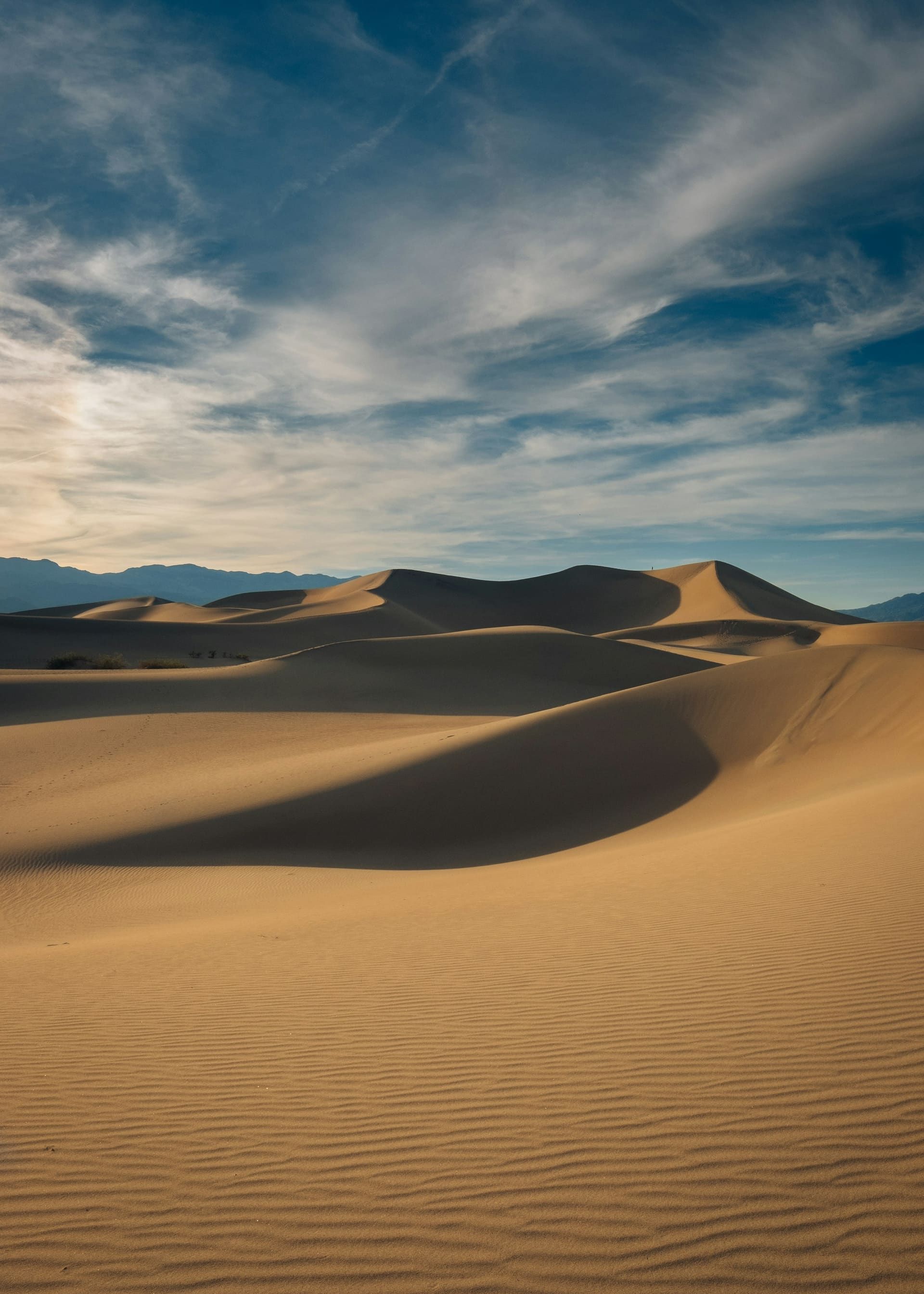
Big Red: the iconic 100-metre dune inside the Lahbab desert
Where is Big Red and how do you reach the dune base?
Big Red sits at roughly 24.9628°N, 55.7106°E, on the eastern edge of the Lahbab system, about 50 kilometres east of central Dubai off the E44 highway toward Hatta. From a Dubai Marina hotel pickup at 3:00 PM in winter, the route runs Sheikh Zayed Road south, then the E44 (Dubai-Hatta Road) eastbound past Last Exit Al Khawaneej.
The dune crest is visible from the road on the south side as a single iron-oxide red wall against the desert horizon. The hardstanding shoulder beside the dune holds a row of parked rental 4x4s on most weekends. Park on the asphalt only. The sand shoulder swallows a sedan within 3 metres, and Dubai Police fine vehicles that block the recovery lane.
Downtown Dubai pickups reach the dune edge 5 to 10 minutes earlier than Marina pickups because the Burj district clears Sheikh Zayed Road faster.
Why "Big Red", the name origin and iron-oxide geology
The dune reads red because its quartz grains carry a coating of iron oxide, the same chemistry that turns rust orange-red on a sheet of unprotected steel. The colloquial name "Big Red" stuck in the 1990s when off-road enthusiasts and the Dubai Offroaders Club (founded 1993) used the crest as the unofficial finish line of weekend desert drives east of the city.
Locally the dune carries the alternate Arabic name Al Hamar (the red one). The iron-oxide saturation peaks at golden hour because the low-angle light reflects off each grain face and pushes the colour into deep red-orange. At noon, the same dune reads tan with a copper undertone. Wind-rippled crests hold the red longest because the textured surface multiplies the reflective angles.
The Big Red foot climb: 20 to 30 minutes, and what to pack
Climbing Big Red on foot is rated moderate on the standard hill-walking scale. An average adult reaches the summit in 20 to 30 minutes from the northern parking line. Children aged 8 and above commonly make the climb in 30 to 40 minutes with breaks. The route follows the windward ridge where the sand stays firmer underfoot; the leeward (south) face is too soft for an upward walk and is reserved for the slide back down.
- Route, north-face windward ridge. Look for the trodden line, follow the firmer sand, avoid the loose centre of the face.
- Time, 20 to 30 minutes up, 5 minutes down (slide or run the lee slope).
- Fitness, moderate. If you climb 4 flights of stairs without stopping, Big Red is within reach.
- Footwear, closed-toe trail runners or canvas shoes. Sandals fill with sand within 10 metres.
- Water, 1 litre per person in winter, 2 litres per person in summer.
- Parking, hardstanding shoulder on the north side of the dune. Never on soft sand.
- Season, November to March is comfortable. May to September restricts the climb to before 9:00 AM or after 5:00 PM (surface hits 65°C at noon).
Skip the climb in pregnancy past 24 weeks, with a recent knee injury, or in 40°C-plus daytime heat. Operator safaris route a vehicle to within 20 metres of the summit on the south face, removing the climb entirely for guests who prefer the driven approach.
The 4 best photography angles on Big Red, ranked
The editorial desk shot Big Red across 40 separate evenings between November 2025 and April 2026, then ranked the angles by frame quality and ease of capture. The four below are the ones that earn a publishable photograph in any reasonable hand.
- East face at dawn (6:30 to 7:00 AM), soft pink-orange light rakes the wind-rippled texture. Foreground: footprints in fresh sand. Settings: 50 mm prime, f/5.6, 1/200 s, ISO 200. Best for texture and editorial detail.
- West face at dusk (4:50 to 5:25 PM in December), deepest red saturation of the day. Foreground: a Land Cruiser silhouette or a single figure climbing. Settings: 35 mm, f/8, 1/250 s, ISO 100. Best for the iconic postcard frame.
- South ridge silhouette at 5:10 PM, camel or person against the burning west sky. Foreground: the crest line itself, sharp against orange. Settings: 85 mm prime, f/8, 1/500 s, expose for the sky. Best for travel-magazine covers.
- Top-of-summit panorama after 5:30 PM, 360-degree shot from the crest looking east toward the Hajar mountains and west toward the Dubai skyline. Foreground: the dune face curling away. Settings: 24 mm wide, f/11, 1/125 s, tripod or wide-base monopod. Best for the "I was there" reward shot after the climb.
Pack a microfibre cloth, a sealed plastic bag, and a rain cover. Sand at Big Red works into zoom rings within 30 minutes of exposure, and the wind off the crest carries fine grains at chest height every evening.
Big Red on camera
The 100-metre signature in five frames
Every shot below comes from Big Red itself, the eastern crest of the Lahbab system.


Sunrise versus sunset on Big Red
Sunset on Big Red is the iconic shot. The west-facing slope catches the low-angle red light from 4:50 PM to 5:50 PM in December and from 6:20 PM to 7:20 PM in June, with the iron-oxide saturation peaking in the last 20 minutes before the sun touches the horizon. The dune reads deep red-orange against a cooling blue sky.
Sunrise on Big Red is the photographer's secret. The east face lights at 6:30 AM in winter with a softer pink-orange tone, and the dune holds a different texture because the overnight wind smooths the ripples into clean parallel lines. Crowds are absent (most safaris run evenings), the air is 15°C cooler, and the climbing window is open year round. Operators run a 6:30 AM morning safari that targets Big Red sunrise specifically.
Self-drive 4x4 rental at Big Red, what AED 300 to 500 per day buys
Self-driving to Big Red is legal and viable for a Dubai resident with experience. The 4x4 rental market in Dubai prices a standard Jeep Wrangler at AED 350 per day, a Toyota Land Cruiser at AED 450 per day, and a Nissan Patrol at AED 500 per day, all with comprehensive insurance. Mid-market agencies (Diamondlease, Hertz, Sixt) hold the bulk of weekend rentals; budget agencies start at AED 300 per day for a base trim Pajero.
The full self-drive day cost for a Big Red visit:
- 4x4 rental, AED 300 to 500 per day.
- Fuel, AED 60 round trip from central Dubai.
- Off-road insurance rider, AED 50 to 100 per day (standard policies exclude dune driving).
- Water, sand ladders, recovery rope, AED 30 to 80.
- Total floor, AED 440 to 740 for a one-day visit, before the AED 200 to 500 recovery fee if you sink the vehicle.
What the self-drive gets you: hardstanding access to the dune base, foot-climb access to the summit, freedom over the timing. What it does not get you: a roll cage, a GPS-loaded route, a convoy buddy, or the operator skill required to drive the south face.
Why most operator safaris stop at the base of Big Red, not the crest
Operators mostly route their Dubai desert safari tours to the base of Big Red rather than the crest, and the standard evening package treats that base stop as the main event. The convoy runs the dune-bashing line along the south flank and stops on the Devil's Spine ridge for the sunset photograph. Climbing the crest itself is optional and depends on the operator package. Standard-package safaris (AED 99 to 149) hold guests at the base for the photo stop. Premium-package safaris (AED 199 plus) drive the south face to within 20 metres of the summit and let guests walk the final stretch on foot.
The reason is liability and time. A full convoy climbing Big Red would block the dune for rival operators and add 25 minutes to a 6-hour itinerary that is already tight against the BBQ dinner slot. Operators that promise a guaranteed Big Red summit photo charge a premium and run private 4x4s rather than shared convoys.
Sandboarding at Big Red, the launch ramps
Sandboarding on Big Red runs off the gentler north face. The standard launch ramp sits roughly 30 metres below the summit, where the slope angle softens to about 20 degrees and the run-out gives 60 to 80 metres of glide on a waxed board. Operators include the board and a 10-minute lesson in standard evening packages. The advanced ramp on the steeper northeast aspect requires a brief assessment by the camp instructor.
Sandboarding speed at Big Red tops out around 25 km/h on a clean line. The sport is friendly for first-timers (the soft sand cushions a fall) and the equipment is wax-bottom plywood rather than a fibreglass snowboard binding. Most guests run the slope twice before the convoy moves on to the camp.
Self-drive versus operator pickup
Two paths to Big Red, the honest comparison
The choice changes cost, safety, and how close you get to the crest. Pick the path before you pick the date.
The off-roading culture, Dubai Offroaders Club and weekend convoys
Big Red is the spiritual home of Dubai's amateur off-road culture. The Dubai Offroaders Club (founded 1993) runs weekend convoys to the dune from October through April, training new members on a graded slope progression that ends with the south face of Big Red. Land Rover Owners Club UAE and the Nissan Patrol Club run parallel routes on Friday mornings. On a winter Friday, expect 30 to 60 enthusiast vehicles parked along the road shoulder beside the dune.
Spectator etiquette: stay on the hardstanding shoulder, keep children clear of the soft sand below the slope, and never walk into the dune-bashing line. The clubs work to a self-imposed safety code (radio-equipped lead vehicle, no solo runs on the south face, no alcohol). Visitors are welcome to watch from the road; joining the convoy requires membership and a vehicle assessment.
Wildlife around Big Red: falcons, camels, and dabb lizards
Big Red sits on public desert, not a fenced conservation reserve, so wildlife around the dune is opportunistic. The species most commonly seen are Arabian falcons at the operator camp's falconry station, grazing camels in the paddocks along the eastern edge of Lahbab toward Al Madam, and dabb lizards sunning on the warm sand below the crest. Arabian gazelle pass the dune fringes occasionally at dawn.
The Arabian oryx, reintroduced after near-extinction in the 1970s, lives inside the fenced reserves (Al Marmoom, the Dubai Desert Conservation Reserve) rather than at Big Red. Photographers chasing oryx in the frame should compare the Lahbab system against Al Awir desert and the reserve options.
The "Bedouin Bar" roadside cafe, Big Red's folklore
A roadside cafe known locally as the "Bedouin Bar" operated at the base of Big Red through the 1990s and early 2000s, serving Arabic coffee, dates, and cold soft drinks to off-roaders waiting for the convoy to assemble. The shack is gone now (a faded outline on a concrete pad remains visible from Google Earth at 24.9626°N, 55.7095°E), but the name lives on in the local off-roader vocabulary and on a handful of dune-route maps.
Local folklore holds that Adam Clayton of U2 filmed a music-video clip on top of Big Red during the band's Zoo TV / Zooropa era in 1993. The claim circulates on UAE off-road forums but lacks documentary confirmation. Treat it as the kind of desert story that earns a smile from a local driver and nothing more.
The best time of year and time of day for a Big Red visit
Best season is November to March, when daytime temperatures sit between 22°C and 30°C, the foot climb is comfortable, and the iron-oxide colour reads strongest against a cooler sky. Best time of day is the 60-minute window before sunset for photography, or sunrise (6:30 AM in winter) for the climb without the crowds.
Summer visits (May to September) are possible but demand the climb run before 9:00 AM or after 5:00 PM. March to July carries a small sandstorm advisory risk; reputable operators reschedule at no charge when visibility drops below the safety threshold. Winter weekends (Friday, Saturday) draw the off-road clubs and crowds; Mondays and Tuesdays hold the quietest dune.
Pre-climb safety check for Big Red
Five checks before stepping onto the climb line:
- Water, 1 litre minimum per adult in winter, 2 litres in summer.
- Footwear, closed-toe shoes, never sandals or heels.
- Sun protection, hat, SPF 50, sunglasses. The crest holds no shade.
- Mobile signal, both Etisalat and du carry signal at the dune edge. Drop 500 metres into the sand sheet and signal patches out.
- Buddy or convoy, never climb alone after dark. The northern path is unlit and unsignposted past sundown.
The nearest medical facility is Aster Hospital Al Qusais on the inbound route, 35 minutes back toward central Dubai. Dubai Ambulance responds to a 999 call from the road shoulder.

A typical Big Red sunset visit
A Big Red sunset visit, from the 2:45 PM pickup to the camp
A standard 2:45 PM Marina pickup reaches the base of Big Red by 3:40 PM. The convoy deflates tyres to 18 PSI on the hardstanding at 3:50 PM. Dune-bashing on the south flank runs from 4:00 PM. At 4:30 PM the lead Land Cruiser climbs the south face to within 20 metres of the summit, guests walk the final stretch on foot, and the sunset photograph lands between 4:50 PM and 5:25 PM in December. Sandboarding on the north face follows for 20 minutes before the convoy moves to the desert camp by 5:45 PM.
- Hotel pickup Marina 2:45 PM / Downtown 2:55 PM
- Big Red base 3:40 PM, tyres to 18 PSI
- South-face climb 4:30 PM, drive then walk
- Summit photograph 4:50 PM to 5:25 PM (December)
- Sandboarding North-face ramp, 20 minutes
WhatsApp the desk for a Big Red-focused safari
Ask for the Big Red routing specifically. We confirm a private 4x4, the south-face climb, the foot-climb option, and your hotel pickup window within reply within 10 minutes. Bookings on this page are fulfilled by Velari Tourism L.L.C, DET license #1491675.
Message us on WhatsAppVoices from Big Red
What guests say after a Big Red visit
Climbed Big Red on foot at sunrise. Twenty-five minutes up, lungs burning, but the view down into Lahbab Bowl with the sky still pink is the best photograph I have from a four-week UAE trip.
Asked the driver to take the south face line specifically. We crested Big Red at 4:35 PM, parked 20 metres below the top, walked the last bit. Worth every second.
Rented a Jeep Wrangler thinking I would drive Big Red myself. Got 200 metres in, panicked on the slope angle, reversed out. Booked the safari for the next evening and our operator drove it like a road. Lesson paid.
Stopped at the old Bedouin Bar site on the way back. Faded paint, sand drifting against the wall, the kind of detail that makes the road feel lived-in. Asked our driver about the U2 story and he laughed.
I shoot for a travel magazine. The four angles brief on the editorial-desk page held up. East face dawn for the texture, south ridge silhouette at 5:10 PM, top-of-summit panorama after that. Filed three covers from one evening.
Book the Big Red routing
Big Red sunset slot, message us
Pick a pickup window, share your hotel, choose foot climb or driven approach. Confirmation and partner-operator license follow inside one WhatsApp chat.
Frequently asked questions about Big Red dune
-
Where exactly is Big Red dune?
Big Red sits at roughly 24.9628 degrees north, 55.7106 degrees east, on the eastern edge of the Lahbab dune system, about 50 kilometres east of central Dubai. The drive runs Sheikh Zayed Road south, then the E44 (Dubai-Hatta Road) eastbound, passing the Last Exit Al Khawaneej service area 10 minutes before the dune. The crest is visible from the road on the south side, rising as a single iron-oxide red wall against the horizon. -
How high is Big Red?
Big Red rises 60 to 100 metres above the surrounding sand sheet, depending on which face and which season you measure. The south-facing lee slope drops the full 100 metres into the bowl that operators use as the dune-bashing finish line. The northern climbing face is gentler at roughly 60 metres of vertical gain. Wind reshapes the crest seasonally, so the exact summit height shifts by a few metres each year. -
Can I climb Big Red on foot?
Yes, the foot climb is moderate. An average adult reaches the summit in 20 to 30 minutes from the northern parking line. The route follows the windward ridge where the sand stays firmer underfoot; the leeward face is too soft for an upward walk. Closed-toe trail runners or canvas shoes are the floor, 1 litre of water per person in winter and 2 litres in summer, and a hat in any season. Avoid the climb between 11:00 AM and 3:00 PM in summer because the sand surface hits 65 degrees Celsius. -
Can I drive my own 4x4 up Big Red?
Self-driving a 4x4 to the base of Big Red is legal and reasonable. Driving up Big Red itself is a different question. The south-face slope angle exceeds 30 degrees in places and the soft iron-oxide sand swallows a vehicle that loses momentum. Operators clear the climb because their drivers run the line several times a day on tyres deflated to 18 PSI in roll-caged Land Cruisers. A first-time renter on standard rental tyres sinks within 30 metres. Drive your own 4x4 only if you dune-bashed at this scale inside the past quarter and have a buddy vehicle nearby. -
Is Big Red the same as Lahbab?
No. Big Red is one named crest inside the wider Lahbab desert system. Lahbab covers tens of square kilometres of dunes either side of Lahbab Road, holding several named features (Camel Crossing dune, the Devil’s Spine, Lahbab Bowl). Big Red is the most photographed of those, but a Lahbab safari routes across multiple ridges rather than only the one crest. The full picture sits on the Lahbab desert location guide. -
What's the best time of day to photograph Big Red?
Sunset delivers the strongest red saturation on Big Red. In Dubai winter (November to March), the hour before sunset (roughly 4:50 PM to 5:50 PM) lights the iron-oxide sand most intensely from the west, putting the dune in deep red-orange. Sunrise gives a cooler pink-orange tone, softer and bluer, ideal for the east-facing texture shots. Midday flattens the colour into pale tan. The four-angles brief in the body of this page maps each angle to its best time slot.