Sandboarding on a Dubai desert safari, free on evening packages
What sandboarding actually is on a Dubai safari
Sandboarding on a Dubai desert safari is a self-paced descent of a dune face on a paraffin-waxed board, run as a free 5 to 10-minute activity at the desert camp perimeter after dune bashing and before dinner. The board is a snowboard-style plank with a softer polyethylene base and a thicker wax cycle than a snowboard, sized 130 to 155 cm depending on guest height. The camp stocks 20 to 40 boards on a rack at the dune base, supervised by a marshal who hands out the equipment, demonstrates the stance, walks first-timers up the dune, and signals the start of each run.
The dune face most operators use is a 20 to 30-degree training slope at the camp perimeter, 15 to 25 metres long, with a flat run-out at the bottom that decelerates the board naturally. Premium and VIP packages move the line to a 30 to 40-degree face on the Lahbab red dunes or the Big Red dune off the Hatta road, 30 to 50 metres long, with a steeper slip face and a longer run-out. The activity sits inside the evening safari itinerary between the sunset photo stop and the camp dinner; guests typically clear two to four runs in 10 to 15 minutes before the BBQ buffet opens at the dinner pavilion.
The free inclusion holds across every DET-licensed operator on the AED 149 morning package and the AED 199 evening package. The standalone activity is not sold as a stand-alone product in Dubai; sandboarding always comes as part of a half-day evening safari rather than as a two-hour solo booking. Guests who want longer runs without the camp dinner book the morning safari from AED 149, which compresses dune bashing and pushes sandboarding earlier in cooler air. Pair this guide with the canonical What is a desert safari in Dubai? page for the full inclusion list.
The friction comparison
Sand vs snow friction physics, why sandboards cap at 40 km/h
Sandboarding looks like snowboarding and reads like snowboarding, but the physics underneath the board runs different. The kinetic friction coefficient of a waxed sandboard on dry Lahbab dune sand measures roughly 0.30 to 0.45 across published field tests; a snowboard with a sintered polyethylene base on packed snow at minus 5 degrees Celsius measures 0.05 to 0.10. The sand coefficient is 6 to 9 times higher. The translation is direct, speed peaks lower, acceleration saturates faster, fall impact dissipates harder.
| Variable | Waxed sandboard on dry dune | Snowboard on packed snow |
|---|---|---|
| Kinetic friction | 0.30 to 0.45 | 0.05 to 0.10 |
| Peak speed (30-degree face) | 25 to 40 km/h | 50 to 70 km/h |
| Acceleration saturation | 5 to 8 seconds | 20 to 30 seconds |
| Typical run length | 15 to 50 metres | 200 to 2000 metres |
| Fall impact absorption | Roughly 70% (soft sand) | Roughly 30% (packed snow) |
| Wax reapplication cycle | Every 2 to 3 runs | Every 1 to 3 days of riding |
The physics is why a sandboard run reads as a 10-minute novelty rather than a sport; the friction load caps the run length and the speed envelope at a band a first-timer clears inside two attempts.
The 3 sandboarding stances and when each works
Three stances cover every sandboard run on a Dubai desert safari. The camp marshal demonstrates each in 90 seconds at the dune top; guests pick the one that matches their balance, age, and willingness to fall on the first run. The stance order below tracks from most-technical to least-technical so a guest with a snowboard background or a younger child reads the right pick in 30 seconds.
Standing snowboard stance
Feet planted across the board with goofy-or-regular foot lead, knees bent, weight centred over the front foot, heel-edge braking on the dune face. Allows full carving technique and the highest peak speed inside the 25 to 40 km/h band.
Kneeling balance stance
Both knees on the board, hands gripping the front edge, weight low and centred. The lower centre of gravity recovers balance mistakes that would unseat the standing stance and slows the run by 15 to 20% from the standing peak.
Prone sit-on sled stance
Guest sits on the board feet-first, hands on the rope handle, runs the dune face in a straight line, decelerates on the run-out by dragging both heels. No standing balance required, no carving, no fall risk worth mentioning. The activity reads as a 5-second sledge ride.
Speed, dune-face slope, and the run length on Lahbab and Big Red
The dune face does most of the work on speed. A 20-degree training slope at the camp perimeter caps the standing stance at 20 to 25 km/h; a 30-degree Lahbab face on the premium package pushes the peak to 30 to 35 km/h; a 40-degree Big Red slip face at the VIP safari touches 40 km/h on a clean run with a freshly waxed carbon-fibre board. The acceleration curve saturates inside 5 to 8 seconds, sandboard runs feel fast at the start and decelerate hard on the run-out as friction overtakes gravity.
Three slope variables drive the speed envelope. Slip-face angle matters most: every 5 degrees of additional slope adds roughly 4 to 5 km/h on the peak. Sand moisture matters second: a freshly rain-damp dune (rare in Dubai, common after a November shower) cuts the peak by 20% because the wet grains adhere to the board base. Wax freshness matters third: a board on its third run loses 10 to 15% of the peak compared with a fresh paraffin application, which is why the marshal re-waxes boards on a rotating cycle every 2 to 3 runs.
Run length tracks slope and rider weight. A 15-metre training dune takes 5 to 7 seconds end-to-end; a 30-metre Lahbab face takes 8 to 10 seconds; a 50-metre Big Red descent on a carbon-fibre board takes 12 to 14 seconds. The pace reads as a single descent of a steep car ramp rather than a chairlift snowboard run. The activity earns its slot in the itinerary because the line moves fast, most guests clear three or four runs in the 10 to 15 minutes between the sunset photo stop and the dinner opening, with no queue penalty inside a normal evening camp size of 60 to 120 guests. The gear breakdown just below, on the booking platform, spells out exactly what each of those AED figures buys.
What the run actually looks like
Sandboard runs, dune geometry, and the sand underneath
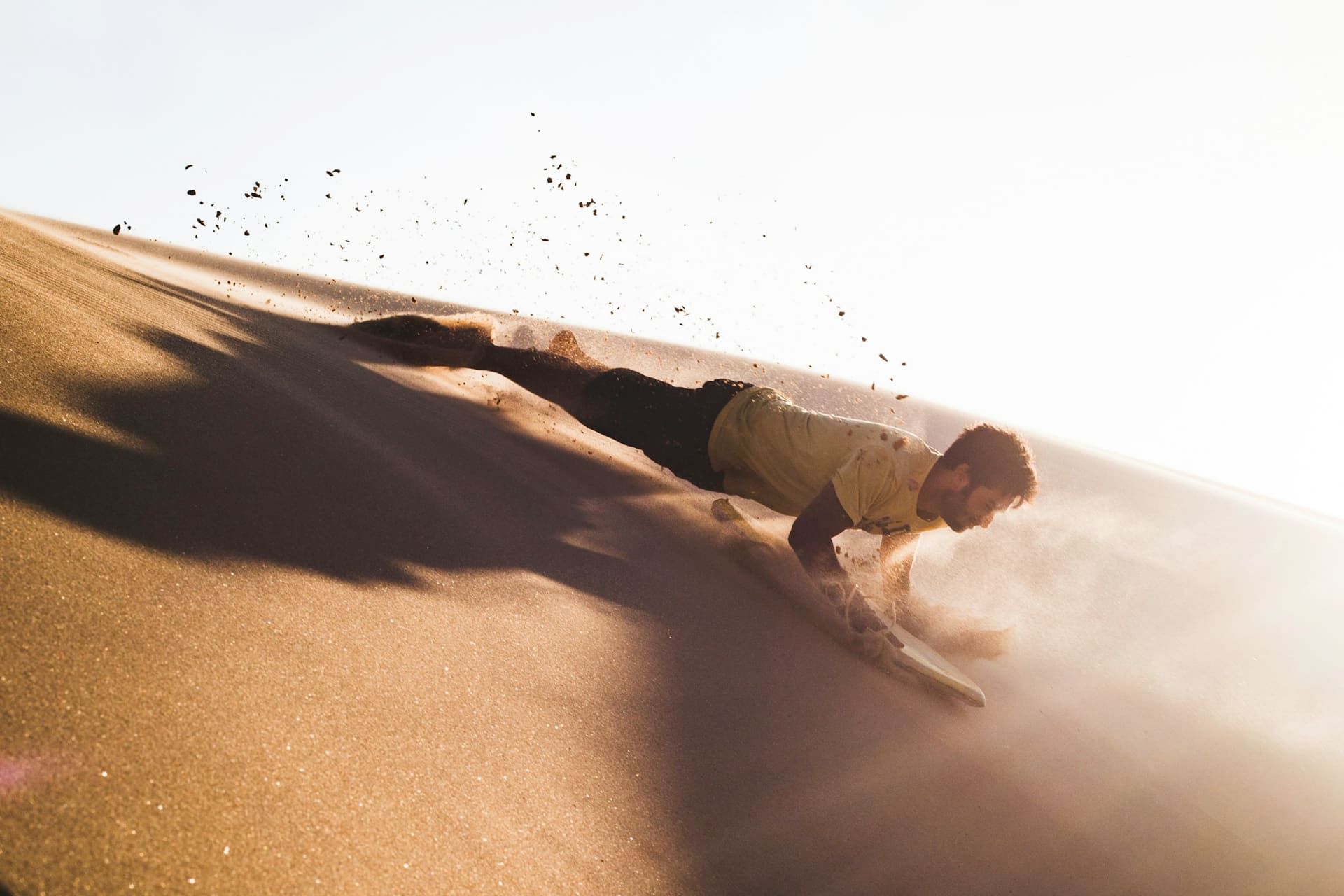
Prone-sled descent on the Lahbab training dune, the standing snowboard stance carving a heel-edge turn on the Big Red slip face, the wind-formed barchan dune geometry that creates the slope, the dry red Lahbab sand grains the wax glides across, and the group on the dune crest waiting their turn on the line.


What the free board, the AED 50 upgrade, and the AED 100 board buy
Sandboarding comes with an equipment ladder of three options across the evening-safari price band. The free board on the AED 149 standard package covers a first-time guest comfortably; the AED 50 upgrade at the premium package earns its price on the second or third run when the better-waxed base lets the standing stance carve cleanly; the AED 100 carbon-fibre option at the VIP safari outperforms a personal snowboard on the same dune. The table below maps the spend.
- Standard plywood board with paraffin wax, supplied free on every AED 99 evening safari. 130 to 155 cm length, basic polyethylene base, re-waxed every 2 to 3 runs by the camp marshal. AED 0
- Better-waxed polyethylene board with thicker wax cycle and a reinforced edge, supplied on premium packages from AED 350. 140 to 160 cm, faster glide on a fresh wax, recommended for guests with snowboard experience. AED 50 upgrade
- Carbon-fibre composite board at the VIP safari from AED 595. 150 to 165 cm, the highest peak speed inside the 40 km/h band, a precision edge that holds carves a personal snowboard misses on dry sand. AED 100 upgrade
- Sit-on plastic sled for children from age 5 and older guests on the gentle training dune. Supplied free across every evening package. AED 0
- Cheap goggles or sunglasses for eye protection on the descent. The camp welcome desk lends a pair on request; bringing your own is the cleaner option. AED 0 (loan)
The upgrade economics are honest. A first-time guest with no snowboard background takes the free board, runs three times, and stops; the AED 50 spend earns nothing extra on the first visit. A repeat guest, a snowboarder, or anyone on the VIP safari spends the AED 50 or AED 100 and earns the longer carve.
Minimum age 5 and the moderate fitness rating
Sandboarding clears the age 5 floor on the sit-down sled stance and the age 8 floor on the standing snowboard stance across BookMySafari fulfilment standards. The age gate reflects balance development rather than safety risk, the sand surface cushions falls across every age band, and the dune slope tops out at 30 degrees on the camp perimeter line. The fitness rating sits in the moderate band: the activity requires a 50-metre walk up the dune face carrying a 4 to 6-kg board, a 5 to 10-second descent, and a short walk back to the queue. Three to four cycles total 15 minutes of low-impact activity.
- Age 5 to 7: prone sit-on sled stance on the camp perimeter training dune with a parent walking alongside on the climb. No standing stance, no edge braking, straight-line descent.
- Age 8 to 12: standing stance on the training dune with a marshal demo at the dune top, fall practice on the first descent, second run with edge braking. Sled stance available on request.
- Age 13 to 65: full standing stance on the standard line, sled stance on request. Premium and VIP packages move to the steeper Lahbab or Big Red face for repeat runs.
- Age 65 and over: sled stance default on the training dune. Guests with reasonable mobility clear the standing stance on the lowest-gradient line at request.
- Pregnant guests: sled stance only on the gentlest slope across all three trimesters. The editorial desk recommends skipping the descent in the third trimester and watching from the dune base.
Safety and the soft-sand fall mechanics
Sandboarding carries a low injury rate on a Dubai desert safari because dry dune sand absorbs roughly 70% of impact load on a fall against roughly 30% on packed snow. The fall mode at the typical 25 to 35 km/h peak reads as a slide rather than an impact, the rider's hip or shoulder contacts the slope, the body skids the remaining 2 to 4 metres of descent, and the run-out flattens before any rotational risk develops. No DET-licensed operator requires a helmet at the standard package; the AED 100 VIP safari on the steeper Big Red face supplies a lightweight helmet on request but does not enforce wear.
Three injury patterns account for nearly every reported sandboard incident across the Lahbab and Big Red operating fleet. The most common is a hand or wrist abrasion on a face-first prone-sled run when the rider drags both hands to brake, recovered by lending a pair of gloves at the camp welcome desk. The second is a heel-side ankle roll on a standing-stance fall when the rider plants a foot to recover balance, the soft sand mitigates the rotation but a guest with prior ankle instability skips the standing stance. The third is sand inhalation on a face-first slip-face fall, the buff or scarf over the mouth and nose eliminates the exposure.
Severe incidents are rare. The camp dispatcher carries a first-aid kit; the licensed paramedic vehicle covers the Lahbab corridor during operating hours. Compare the activity against the canonical Dune bashing on a Dubai desert safari page for the safer-than-dune-bashing comparison, sandboarding sits at the lower-risk end of the evening-safari activity set.
Where sandboarding happens: Lahbab, Big Red, and Al Marmoom
Three dune systems carry the bulk of Dubai sandboarding traffic. The dune choice changes the slope, the run length, the queue size, and the photographic backdrop. The standard evening-safari camp perimeter line sits on a training dune at one of the three; premium and VIP packages move guests to a steeper face inside the same system.
- Lahbab Desert, 45 minutes east of central Dubai. The red-dune system most evening operators use, with a 20 to 30-degree training line at the camp perimeter and a 30 to 40-degree slip face on request. Run length 15 to 30 metres. Highest sandboard traffic across the Dubai operating fleet.
- Big Red dune, 50 minutes east of central Dubai off the Dubai-Hatta road. A single 100-metre dune ridge with the steepest publicly accessible slip face in the emirate. Premium and VIP operators use the face for the AED 50 and AED 100 board upgrades. Run length 30 to 50 metres.
- Al Marmoom Desert Conservation Reserve, 40 minutes south of Dubai. The larger, unfenced reserve home to Arabian oryx and gazelle. Sandboarding here runs on quieter dunes with fewer guests in frame; the run length matches Lahbab at 15 to 30 metres. The conservation rules limit the steeper-face access on the standard package.

From the editorial inbox
A first-timer who went from sled stance to standing stance in four runs
Adi from Tel Aviv messaged the editorial desk on a Tuesday with one question, is sandboarding worth doing if I have never snowboarded? The desk sent the 3-stance briefing, recommended the sled stance for run one and the standing stance for run two, and flagged the 20-degree training dune as the right starting line. Adi cleared a clean sled run on attempt one, fell once on the standing stance on run two, recovered the heel-edge brake on run three, and posted a clip of run four to Instagram before dinner. The free board on the AED 199 evening package covered the four runs end-to-end. Repeatable, named, documented.
- Pre-pickup briefing on WhatsApp 3-stance pdf and dune-line note shared two days before the safari
- Free standard board cleared four runs no AED 50 upgrade required for a first-time guest
- Sled stance on run one, standing on run two the editorial-desk progression that beats a cold standing-stance start
- Run four posted to Instagram before dinner the activity fits inside the 15-minute window without queue pressure
Photography of sandboarding, the three shots at golden hour
Sandboarding photographs well on a Dubai evening safari because the activity coincides with the golden hour between 5:00 PM and 6:30 PM in winter and 6:30 PM and 7:30 PM in summer. The low sun rakes across the dune face at a 10 to 20-degree angle and renders the waxed-board glide as a slow trail of dust against a deep-orange Lahbab grain. Three shot types cover almost every keeper.
- The descent line from the dune base looking up, the rider's silhouette against the dune crest, sand spray at the bottom of the run, golden-hour rim light on the shoulder.
- The crest reaction from the dune top before the run, the rider gripping the board, scanning the line, the Lahbab dune horizon stretching behind for context.
- The fall recovery at the run-out, the spray of sand, the laugh, the board sliding alongside. The most-shared shot type on a typical safari WhatsApp group.
Phone cameras run 60 fps slow-motion on every iPhone from the 11 onwards and every Pixel from the 6 onwards; the slow-motion read of a sandboard descent in golden light is the single best phone shot of a Dubai desert safari. The paid AED 200 to 500 professional photography upgrade earns its price on a single keeper of a heel-edge carve on the steeper Big Red face at the VIP safari; the free board on the standard package is well-covered by a phone slow-motion alone.
5 beginner tips that beat a cold start
Five practical tactics drop the wipe-out rate on a first sandboard descent inside the first 90 seconds at the dune top. Stack any three for a clean run one.
- Start with the sled stance, not the standing stance. Run one on the sled stance teaches the dune line, the speed envelope, and the run-out distance with zero balance load. Switch to the standing stance on run two with the line memorised.
- Goofy or regular, pick before the dune top. Stand on a flat patch of sand at the camp, ask a marshal to push gently from behind; the foot that steps forward to catch balance is the back foot. Lock the stance before walking up the dune to avoid a mid-line switch.
- Heel-edge brake, not the toe-edge brake. A sandboard's slower edge bite on dry sand rewards a wide-open heel-edge stop more reliably than a snowboard. Press the heels into the slope at the run-out and the board decelerates smoothly without a face-first stop.
- Eye on the run-out, not on the feet. The vestibular-visual rule from dune bashing applies, lock the gaze on the flat run-out at the base of the dune; the inner ear tracks the descent and the brain stops fighting the slope.
- Fall sideways, not face-first. The fall mode that hurts least lands the hip on the slope and slides the rest of the run-out. The fall that hurts most lands the knees and palms face-first into the slip face. Trust the slide.
What to wear for sandboarding on a Dubai safari
Sandboarding clothing overlaps the standard evening-safari pack list across most items. The activity adds a specific need for closed footwear, a thin layer over the legs, and eye protection. Pair this with the canonical What to wear on a Dubai desert safari guide for the full evening-safari outfit.
- Closed-toe shoes, sneakers, low-cut hiking shoes, or any sandal with a heel strap. Avoid flip-flops that fly off on the descent.
- Long, light trousers, cotton joggers, light hiking pants, or a maxi skirt. Bare legs on a sled run rub the sand against the calves; long fabric prevents the mild abrasion.
- Sunglasses or cheap goggles, wraparound shades for the standing stance, ski goggles for the carbon-fibre VIP run. The camp welcome desk lends a pair.
- Buff or scarf, over the mouth and nose for the prone-sled run on windy days. Optional on still evenings.
- A second light top, the sand cools by 8 to 12 degrees between sunset and dinner; the layer earns its space inside the camp lounge after the run.
- Skip, white clothing (the sand stains a clean white shirt fast), bulky jackets (over-warm for the climb), expensive watches and jewellery (dust gets everywhere).
Book a Dubai evening safari with sandboarding
Pick a package on the Evening Desert Safari Dubai page and message the booking desk on WhatsApp. The standard AED 199 package includes the free board, the camp-perimeter line, and the prone-sled stance for children. Premium and VIP guests confirm the AED 50 or AED 100 upgrade at booking. Bookings on this page are fulfilled by Velari Tourism L.L.C.
Message the booking desk on WhatsAppFrequently asked questions about sandboarding in Dubai
-
Is sandboarding free on a Dubai desert safari?
Sandboarding is included free on every standard desert safari across DET-licensed operators in Dubai, from AED 149 on the morning package and AED 199 on the evening package. The base ticket covers the board, the paraffin-wax application, the dune-face run, and the camp marshal who supervises the line. The free board on the standard package is the snowboard-style waxed plywood option used on a small 15 to 25-metre training dune at the camp perimeter. Premium evening packages from AED 350 upward upgrade the board to a better-waxed polyethylene base for an extra AED 50, and the VIP safari from AED 595 supplies a carbon-fibre board on a taller 30 to 40-metre dune face for an extra AED 100. The free version is enough for first-timers and children; the upgrades earn their AED on the second or third run when boredom sets in. -
How fast can you go on a sandboard in Dubai?
Peak speed on a Dubai sandboard sits between 25 and 40 km/h on a typical 30-degree Lahbab or Big Red dune face. The number caps lower than snowboarding because dry dune sand carries a kinetic friction coefficient of 0.30 to 0.45 for a waxed sandboard, against 0.05 to 0.10 for a snowboard on packed snow. The friction load slows acceleration, shortens the run, and saturates speed inside the first 5 to 8 seconds of descent. Expert riders on a freshly waxed carbon-fibre board on a 40-degree dune face touch 45 km/h in clean conditions; beginners on a plywood board on a 20-degree slope rarely exceed 20 km/h. The physics caps fall energy too, the sand absorbs roughly 70% of impact load on a fall, which is why no Dubai operator requires a helmet at the standard package. -
Is sandboarding harder than snowboarding?
Sandboarding sits below snowboarding on the technical difficulty curve for a first-time guest on a Dubai desert safari. The lower peak speed (25-40 km/h vs 60+ km/h on a ski slope), the shorter run length (15 to 50 metres vs hundreds of metres), the soft-sand fall surface, and the slower edge response of a waxed board on sand combine to flatten the learning curve. A first-time guest with zero snowboarding experience clears one to two stand-up runs on the AED 149 board inside 10 minutes of arrival at the camp dune. Experienced snowboarders adapt to the slower edge bite quickly; the muscle memory transfers in the second run. The trade-off is that sandboarding never reaches the speed or carving precision of a powder day, so the activity reads as a 10-minute novelty rather than a sport in itself. -
What is the minimum age for sandboarding?
The minimum age for sandboarding on a Dubai desert safari is 5 years for the sit-down sled stance and 8 years for the standing snowboard stance across BookMySafari fulfilment standards. The age floor reflects balance development rather than safety risk, children under 5 lack the postural control to track a moving board on a sloping sand face, even with a parent at the run. The sit-down sled accommodates children from 5 upwards on a 15-metre training dune at the camp perimeter with a parent walking alongside; the standing stance from 8 upwards on a 20 to 30-metre face. No upper age limit applies; guests in their 70s with reasonable mobility clear the sled run without issue. Pregnant guests across all three trimesters skip the standing stance and use the sled stance only on the lowest-gradient dune; the editorial desk recommends the perimeter walk over the run in the third trimester. -
Do I need to know how to snowboard first?
Snowboarding experience is not required for sandboarding on a Dubai desert safari. The camp marshal demonstrates the 3 stances (standing, kneeling, prone sled) in 90 seconds at the dune top before the first run; first-time guests clear the sled stance on run one and the standing stance on run two or three. The standing stance borrows the snowboard goofy-or-regular foot setup and the heel-edge braking technique, but the slower edge bite of a waxed board on dry sand forgives mistakes that would slam a snowboarder on a real slope. Children, older guests, and anyone uncomfortable with the standing stance default to the prone sled, which requires no balance and runs in a straight line. The 5-stage beginner protocol below covers the technique in writing. -
Can I bring my own snowboard?
Bringing your own snowboard to a Dubai desert safari is permitted but rarely beneficial. A standard snowboard with a sintered polyethylene base waxed with cold-temperature paraffin glides poorly on dry dune sand because the base hardness, the edge profile, and the wax formulation are tuned for snow at sub-zero temperatures, not silica grains at 35 to 45 degrees Celsius. The friction coefficient on sand runs 6 to 9 times higher than on snow; a snowboard base unwaxed for sand sticks rather than slides. Dedicated sandboards use a softer polyethylene base, a thicker paraffin-wax application reapplied every 2 to 3 runs, and reinforced edges to resist abrasion from sand grains. The free board on the AED 149 package is purpose-built for the dune face; the AED 100 carbon-fibre upgrade at the VIP safari outperforms a personal snowboard on the same dune. Skip the suitcase weight. -
Will I get sand in my eyes and ears?
Sand exposure on a Dubai sandboard run is moderate and concentrates at the bottom of the descent when the board kicks up a small spray on deceleration. Sunglasses or a pair of cheap goggles eliminate eye exposure; a buff or scarf over the mouth and nose keeps grains out of the airway on windy days. Ear sand is rare on a single 5 to 10-second run and resolves with a tilt and gentle shake at the camp. The Land Cruiser fleet stocks a microfibre towel at the driver door for dust-off after the run; the camp welcome desk supplies bottled water for an eye rinse on the rare deeper exposure. The 25-degree minimum sandboard slope is too gentle to throw sand at speed; the only major exposure risk is a face-first fall on the slip face, which the prone sled stance avoids and the standing stance recovers from inside 2 seconds.