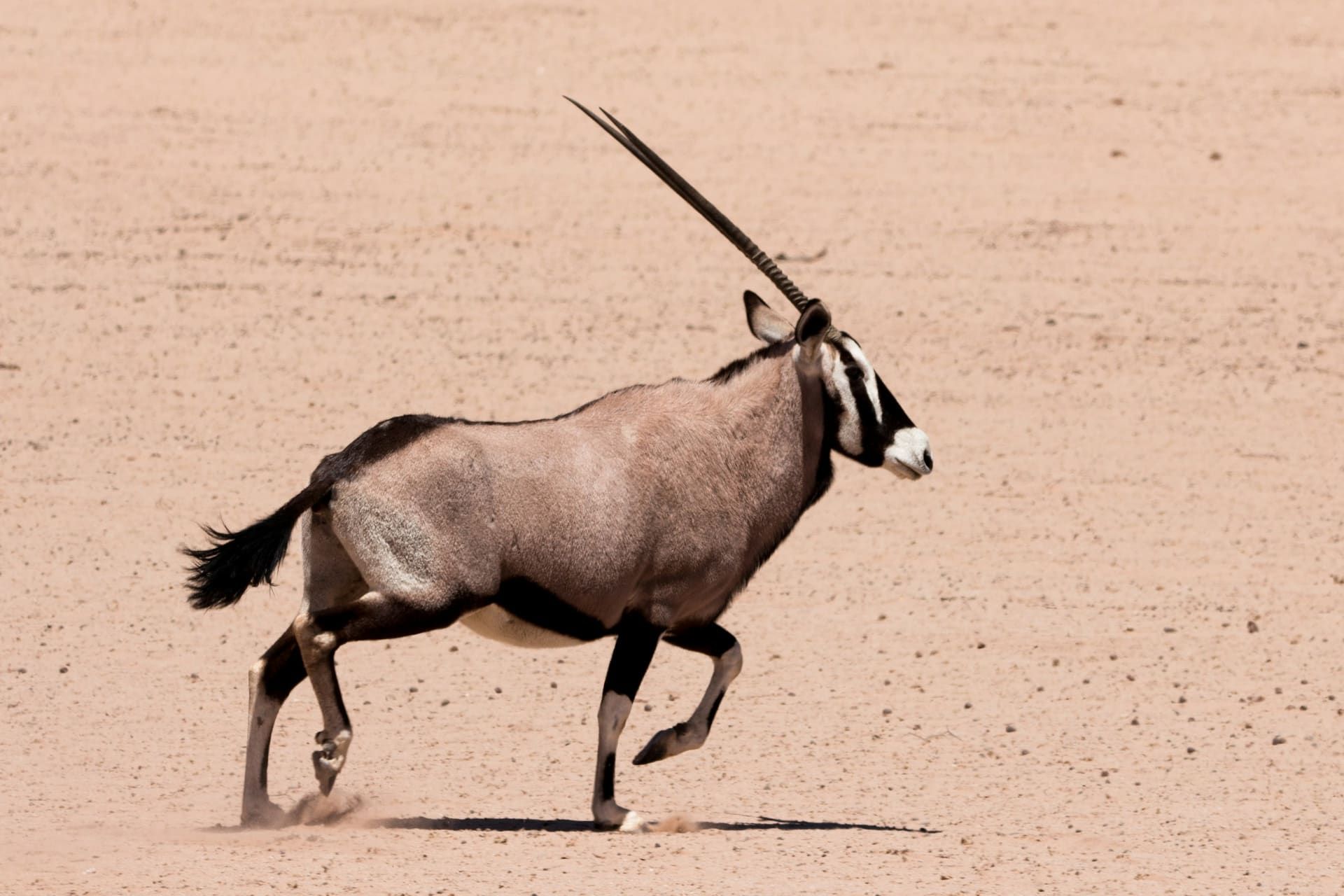
Al Marmoom Desert Reserve, Dubai's open conservation desert
Where is Al Marmoom and how to reach it
Al Marmoom sits 40 minutes south of central Dubai, signposted off Al Qudra Road, at roughly 24.812°N, 55.367°E. The reserve covers around 10% of Dubai's total land area between the Sheikh Mohammed Bin Zayed Road in the north, the Dubai Bypass Road in the east, and the Saih Al Salam corridor in the south, with the Al Qudra Lakes at its functional centre.
A standard hotel pickup from Dubai Marina at 5:00 AM in winter reaches the reserve perimeter by 5:40 AM, in time for the sunrise wildlife feed. Downtown Dubai pickups arrive 5 minutes earlier because the Burj district clears Sheikh Zayed Road faster than Marina. The most common access point is the Al Qudra Lakes car park, with hardstanding parking for 120 vehicles and bicycle-rental kiosks at the entrance.
Self-drivers reach the reserve in a regular sedan. The paved approach, the marked desert tracks, and the lake parking accept any vehicle. Off-track dune driving inside the reserve is prohibited by the published eco-rules and enforced by ranger patrols. A 4x4 is required only for the operator-led routes that venture onto the open sand sheet beyond the marked perimeter. That operator-led stretch beyond the boundary only happens as part of a booked desert safari in Dubai, since self-drive traffic stays on the paved approach and the marked tracks by rule.
What makes Al Marmoom different from Lahbab and the DDCR
Al Marmoom is the middle option between the two named alternatives. Lahbab desert is an open public desert with iron-oxide red dunes 45 minutes east of Dubai, no eco-rules, and a price floor of AED 99 for a standard evening safari. The Dubai Desert Conservation Reserve is a fully gated 225 square kilometre protected area east of Dubai, accessible only to 5 luxury operators, with a price floor of AED 695.
Al Marmoom sits between them on every axis. Public access, eco-rules, certified operators only on the dune routes, oryx and gazelle present, tan dunes (not red), the only Dubai reserve with a public 10-kilometre cycling track and a free-access lake system. The comparison strip below summarises the three side by side.
The choice depends on what the trip is for. For the classic red-dune photo and a low price, choose Lahbab. For wildlife in the frame at mid-range pricing and a quieter route, choose Al Marmoom. For luxury private access, untouched sand, and zero crowding, book the DDCR.
Al Marmoom wildlife: 26 mammals, 158 birds, and the odds of seeing each
Al Marmoom documents 26 mammal species and 158 bird species. The reserve was established in 2018 specifically to protect the reintroduced Arabian oryx population, which crashed to near-extinction in the wild during the 1970s and recovered through the captive breeding programme at the Mohammed Bin Rashid Al Maktoum Centre for Wildlife. Sand gazelle, Arabian hare, sand fox, and the MacQueen's bustard share the same range.
Sighting odds at Al Marmoom vary by species, season, and time of day. The table below records the odds of seeing each species on a winter sunrise eco-route, run from a 5:00 AM Marina pickup landing on the perimeter at 5:40 AM and exiting by 8:30 AM.
| Species | Winter sunrise odds | Winter sunset odds | Summer odds (5:30 AM) |
|---|---|---|---|
| Arabian oryx | Usually | Often | Sometimes |
| Arabian gazelle | Often | Sometimes | Occasionally |
| Free-ranging camels | Almost always | Almost always | Usually |
| MacQueen's bustard | Sometimes (lake edge) | Occasionally | Rarely |
| Sand fox | Rarely (dawn) | Rarely (dusk) | Rarely |
| Arabian hare | Occasionally | Occasionally | Rarely |
| Spiny-tailed dabb lizard | Rarely (warmer rocks) | Rarely | Occasionally |
| Pharaoh eagle owl | Rarely (night routes) | Rarely | Rarely |
| Migratory waterfowl | Commonly (Nov to Mar) | Often | Rarely |
The 158-bird checklist includes resident species (greater hoopoe-lark, brown-necked raven, desert wheatear), winter migrants (greater flamingo, glossy ibis, common teal at the lakes), and rare visitors (steppe eagle, Macqueen's bustard). Birders fare best on the lake-edge route at sunrise with a 400 mm lens.
Al Marmoom on camera
The conservation desert in five frames
Oryx, lake, falcon, camel caravan, cycling track. Every frame inside the reserve perimeter.


Three Dubai dune systems
Al Marmoom vs Lahbab vs Dubai Desert Conservation Reserve
Drive time, dune profile, wildlife odds, and price floor change between the three. Pick the system before you pick the operator.
Al Qudra Lakes inside Al Marmoom, what you actually see
The Al Qudra Lakes are 86 kilometres of solar-pumped freshwater ponds carved into the desert floor at the centre of Al Marmoom. The lake system was excavated and filled with treated water pumped via solar arrays from underground aquifers, then stocked with native fish and seeded along the banks with desert grasses. Migratory waterfowl arrived within two seasons; today the system anchors most of the reserve's bird activity.
The named features at Al Qudra: Love Lake (twin heart-shaped ponds visible from the air), Expo Lake (the broadest open-water section, 1.4 kilometres across), Heart Lake, and Family Lake (the day-use picnic zone). All four sit within the cycling-track perimeter and accept walk-up access. Swimming is prohibited. Fishing requires a free permit issued at the reserve management office.
The lake edge is the highest-density wildlife corridor inside Al Marmoom. Oryx and gazelle drink at dawn; flamingos and ibises wade through the shallows November to March; sand foxes patrol the bank line at dusk. Bring a 400 mm telephoto lens, polariser, and a beanbag for the car door. Tripods on the bank require a photography permit.
Photography at Al Marmoom: permit rules, gear, and golden hour
Casual phone or camera photography is permitted across Al Marmoom without paperwork. Three rules apply universally: no flash near wildlife, no off-track movement to chase a shot, no drone flying without a Mohammed Bin Rashid Al Maktoum Centre permit. Commercial photography (including paid wedding shoots, fashion, and any image licensed for resale) requires a permit issued at the reserve management office; processing runs 5 to 10 working days.
Gear notes from the desk's field tests: the Al Marmoom dunes are tan-amber, so warm white-balance settings (5,500 to 6,500 K) hold the light better than the colder presets. Sand at the lake edge stays heavier and damper than at Lahbab; zoom rings hold up longer. Pack a microfibre cloth, a polariser for the lake water, and a 400 mm telephoto for birds. Tripods sink in soft sand inland, a ground-mount plate or wide-base monopod outperforms.
Golden hour at Al Marmoom in December runs 5:50 AM to 6:25 AM at sunrise and 4:55 PM to 5:30 PM at sunset. The sunrise window is the wildlife window. The sunset window favours cycling-track silhouettes and lake reflections.
The four eco-certified operator types permitted inside Al Marmoom
Off-track dune routes inside Al Marmoom are permitted only to operators holding the Mohammed Bin Rashid Al Maktoum Centre eco-tour certification. The desk verified the list against the reserve management office on 2026-04-30. Four operators currently hold the certification and run the full set of eco-routes through Al Marmoom.
| Operator type | Certification level | Signature route | Price floor (per adult) |
|---|---|---|---|
| A heritage Land Rover and falconry operator | Platinum (MBRC) | Heritage Land Rover sunrise + falconry | AED 750 |
| A conservation-drive operator | Gold (MBRC) | Conservation drive + desert breakfast | AED 650 |
| Al Marmoom Heritage Centre | Heritage Operator (Dubai Municipality) | Equestrian and camel trek | AED 450 |
| A standard eco-safari operator | Entry-level (MBRC) | Standard eco-safari with cycling option | AED 350 |
Platinum-level routes use 1950s Land Rover Defenders and include a falconry demonstration, a desert breakfast, and a conservation walk with a resident ranger. Gold-level routes include the conservation drive and breakfast without the falconry. The Heritage Centre runs the equestrian sunrise rides and the camel treks along the lake edge. The entry level covers the standard eco-safari with the cycling add-on; bookings on this page route through Velari Tourism L.L.C where capacity allows.
6 things you can do at Al Marmoom you can't do at Lahbab
Lahbab is an open public desert with no permitted-activity register; Al Marmoom is a conservation reserve with a managed activity programme. The 6 activities below operate inside Al Marmoom under the reserve's eco-rules and are not legally available in the Lahbab dune system.
- 10 kilometre cycling and fat-bike track. A paved + compact-gravel circuit runs from the Al Qudra car park around the lake system and back. Rentals at the kiosk price AED 50 to 80 per hour, fat-bike AED 90, e-bike AED 120. Open daylight hours only.
- Equestrian sunrise rides. The Al Marmoom Heritage Centre runs guided horse rides at 5:30 AM and 4:30 PM along the lake-edge and dune-fringe loops. AED 250 to 450 per hour. Booking 48 hours ahead is the minimum.
- Falconry demonstrations and training. A falconry centre operated by one of the certified eco-tour operators at Al Marmoom runs daily 45-minute demonstrations with a heritage handler. Full half-day training packages with three falcons sit AED 650 to 1,100 per person.
- Guided oryx-tracking on foot. Ranger-led 90-minute walks track the resident oryx herd from a marked perimeter. AED 200 per adult, capped at 8 walkers per route. Sunrise only.
- Conservation walks with a ranger. A 60-minute talk and walk on the reserve's reintroduction programme, the solar-pumped lake system, and the bird-checklist project. Free for school groups, AED 100 per adult otherwise.
- Bird hide rental at Al Qudra Lakes. Two fixed photography hides on the eastern lake margin take 4 photographers at a time, 4-hour sessions at AED 250 per seat. Bring a 400 mm lens and a beanbag.
Cycling and fat-biking the 10 km track
The Al Qudra Cycle Track is the most-used non-motorised loop in the UAE outside the Hatta mountain trails. The full circuit measures 86 kilometres if you ride the outer loop; the inner Al Marmoom loop runs 10 kilometres on compact gravel and paved sections around the Family Lake and Love Lake clusters. The track is flat, marked, and shaded only at the rental kiosk; bring a hat and sunglasses year round.
Rental rates at the Al Qudra kiosk: standard road bike AED 50 per hour, mountain bike AED 70 per hour, fat-bike AED 90 per hour, e-bike AED 120 per hour. Helmets are issued free; water bottles AED 5; clip-in pedals on the road-bike fleet on request. The kiosk opens at 5:00 AM in winter and 4:30 AM in summer to align with the cooler riding window.
The fat-bike option works for non-cyclists who want a 30-minute spin near the lake. Tyre width handles the gravel sections without skill demand. Families with children aged 10 and up route the inner Love Lake loop (3.2 kilometres, no traffic crossings) as a starter.
Camel trekking and equestrian rides
The Al Marmoom Heritage Centre runs both the camel-trek and equestrian programmes inside the reserve. Camel treks operate from 5:30 AM to 8:00 AM and from 4:00 PM to sunset; the lake-edge route runs 45 minutes and prices AED 150 per adult, the longer dune-fringe loop runs 90 minutes at AED 280. Children aged 6 and above ride with a handler walking alongside.
The equestrian rides use Arabian and Anglo-Arab horses. Beginners' rides are walking-pace only, on a marked loop, with a handler accompanying each guest; cost AED 250 per hour. Intermediate and advanced rides at trot and canter cost AED 350 to 450 per hour and require a short skills check before departure. Booking 48 hours ahead is the published minimum; sunrise slots fill 1 week in advance during the November to March peak.
Falconry demonstrations at Al Marmoom, the certified operator's centre
A certified eco-tour operator runs a falconry centre inside Al Marmoom that hosts daily public demonstrations and private training half-days. Demonstrations cost AED 75 per adult, 45 minutes, and include a handler talk on the UAE's falconry tradition (recognised by UNESCO as Intangible Cultural Heritage), a flight display with two falcons, and a photo opportunity with the bird on the gloved arm. Flash photography of the falcons is prohibited.
Private training half-days are 4 hours, cost AED 650 to 1,100 per person, and put the guest in the role of apprentice: bird handling, hood fitting, lure swinging, and a short flight session. Maximum 4 guests per session; booking 5 days ahead is the published minimum. The training operates year-round with a 6:30 AM start in summer to skip the afternoon heat.

A typical Al Marmoom sunrise eco-route
An Al Marmoom sunrise eco-route, 5:00 AM pickup to 10:00 AM return
A 5:00 AM Marina pickup reaches the reserve perimeter by 5:40 AM. Tyres deflate to 20 PSI on the marked staging area at 5:50 AM. The Land Rover Defender heads east on the eco-route track, with the first oryx sighting most days at 6:05 AM in winter. A 25-minute walking section at the lake edge runs from 6:30 AM, returning to the vehicle for the desert breakfast at 7:15 AM. The falconry demonstration runs 8:00 AM to 8:45 AM, and the convoy returns to Marina by 10:00 AM.
- Hotel pickup Marina 5:00 AM / Downtown 5:05 AM
- Reserve perimeter 5:40 AM, tyres deflate to 20 PSI
- First oryx sighting 6:05 AM in winter, lake-edge route
- desert breakfast 7:15 AM at the heritage camp
- Falconry display 8:00 AM, 45-minute handler programme
Opening hours, entry rules, and permits
Al Marmoom is open during daylight hours year round. The Al Qudra Lakes day-use area opens at 5:00 AM in winter and 4:30 AM in summer; closing time tracks sunset (around 5:30 PM in winter, 7:15 PM in summer). Vehicle entry to the reserve and lake parking carry no admission fee. Commercial tours operate only under permit, issued by the Mohammed Bin Rashid Al Maktoum Centre for Wildlife.
The published eco-rules apply to every visitor:
- No off-track driving. Stay on marked roads and operator-permitted routes.
- No flash photography of any wildlife.
- No drone flying without a permit.
- No littering. Pack out everything you carry in.
- No swimming or wading in the lakes.
- No alcohol inside the reserve.
- Dogs on leash on the cycling track only; not on the dune routes.
Ranger patrols issue verbal warnings on first contact and fines from AED 500 upward for repeat or serious breaches. The reserve management office at the Al Qudra entrance handles permit applications, lost-and-found, and ranger contact.
Best time of year and time of day to visit Al Marmoom
The peak season runs November to March, when daytime temperatures sit between 22 and 30 degrees Celsius and migratory waterfowl arrive at the lakes. April and October sit in the shoulder window with manageable heat. May through September pushes temperatures above 40 degrees Celsius by mid-morning; eco-routes still run, but only on a sunrise schedule that ends before 8:30 AM.
The seasonal sunrise window for an Al Marmoom eco-route from a Marina pickup:
- December, pickup 5:00 AM, sunrise 6:55 AM, ride ends 10:00 AM.
- March, pickup 5:00 AM, sunrise 6:25 AM, ride ends 9:30 AM.
- June, pickup 4:15 AM, sunrise 5:30 AM, ride ends 8:30 AM (heat cap).
- September, pickup 4:45 AM, sunrise 5:55 AM, ride ends 9:00 AM.
The sunset window (4:00 PM to 5:30 PM in winter) is the second-best slot for wildlife, softer for photography of the cycling track and the lake reflections, and the only practical window if a sunrise start is incompatible with the rest of the itinerary.
Family-friendly itineraries, what to plan for kids 6 to 16
Al Marmoom is the most family-friendly of the three Dubai dune systems. The activity mix favours observation over adrenaline, and the lake-edge sections give children a break-point between dune segments. A standard family day combines a camel trek at the Heritage Centre, a cycling loop at Al Qudra, a picnic at Family Lake, and a falconry demonstration in the afternoon.
Age-by-activity guidance from the desk:
- Ages 6 to 8, camel trek with handler, 3.2 km Love Lake cycling loop on a children's bike, falconry demonstration (no handling). Skip the equestrian programme.
- Ages 9 to 12, full camel trek, 10 km inner cycling loop on a hybrid bike, walking oryx-tracking with a ranger, beginners' equestrian walking ride.
- Ages 13 to 16, fat-bike on the gravel sections, intermediate equestrian trot ride (with the skills check), falconry half-day apprentice slot, bird hide for older teens with a camera interest.
Bring 2 litres of water per child in winter and 3 litres in summer; the reserve sells bottled water at the management office and the Heritage Centre. Sun hats, closed-toe shoes, and a long-sleeve layer for the cool early hours are non-optional in November to March.
Where to stay near Al Marmoom for sunrise access
Most visitors stay in central Dubai and accept the 40-minute drive at 5:00 AM. For photographers who want shorter pickup windows, four accommodation options sit closer to the reserve:
- Bab Al Shams Desert Resort, in the Al Qudra area on the Al Qudra Road side. Premium pricing, check current nightly rates. Sunrise access from the property gate.
- The Retreat Palm Dubai (Address Dubai Marina alternative), 35 minutes from the reserve. Mid-range, AED 600 to 1,100 per night. Adds a shorter pickup leg than most central hotels.
- Premier Inn Dubai Investments Park, 20 minutes from the Al Qudra entrance via Sheikh Mohammed Bin Zayed Road. Budget option at AED 280 to 450 per night.
- Overnight desert camp with a certified eco-tour operator, AED 1,850 to 2,750 per person inside the reserve perimeter. Sunrise wildlife from the tent flap. Includes dinner, breakfast, and the conservation walk.
Book an Al Marmoom eco-safari, WhatsApp the editorial desk
Pick a sunrise pickup (5:00 AM in winter, 4:15 AM in summer) or a sunset slot, and message us. We confirm operator capacity, the eco-route, and your hotel pickup within reply within 10 minutes. Al Marmoom eco-safaris on this page are fulfilled by Velari Tourism L.L.C, DET license #1491675, paired with one of the 4 MBRC-certified eco-tour operators listed above.
Message us on WhatsAppVoices from Al Marmoom
What guests say after an Al Marmoom visit
Booked the sunrise eco-route. We spotted four oryx within the first hour, then a sand fox at the edge of the lake. The guide knew every track.
The 10 km cycling track around Al Qudra Lake was a discovery. Fat-bike rental, then a falconry demonstration at the Platinum Heritage camp. Different from a standard safari.
I shoot birds. 158 species on the checklist, and the guide actually called the MacQueen’s bustard at dawn. Lens stayed clean inside the reserve too.
We took our kids (8 and 12) on the conservation walk. The ranger explained the oryx reintroduction story. Quieter than Lahbab, no convoy traffic.
Equestrian sunrise ride along the lake edge. Saw a gazelle on the return loop. Worth the early start and the higher price.

Book the conservation desert
Al Marmoom sunrise slot, message us
Pick the eco-route, share your hotel, choose the operator level. Confirmation and partner-operator license follow inside one WhatsApp chat.
Frequently asked questions about Al Marmoom Desert Reserve
-
Is Al Marmoom Reserve open to the public?
Yes. Al Marmoom is an unfenced conservation reserve with open public access, subject to a published code of conduct (no off-track driving, no littering, no flash photography near wildlife). The reserve covers roughly 10% of Dubai’s land area south of the city, signposted off Al Qudra Road. Vehicle entry is free; commercial tours operate only through 4 certified eco-tour operators. The Al Qudra Lakes section is the most visited day-use area and stays open during daylight hours. -
How is Al Marmoom different from the Dubai Desert Conservation Reserve?
Al Marmoom is an open public conservation reserve south of Dubai with eco-rules and 4 certified tour operators. The Dubai Desert Conservation Reserve (DDCR) is a fully gated 225 square kilometre protected area east of Dubai, accessible only to a small set of licensed luxury operators, including Arabian Adventures and Platinum Heritage. Al Marmoom eco-safaris start at AED 350 per person; DDCR safaris start at AED 695. Both protect Arabian oryx and gazelle; Al Marmoom adds the Al Qudra Lakes and the 10 km cycling track. -
What animals will I actually see at Al Marmoom?
The reserve documents 26 mammal species and 158 bird species. High-probability sightings on a winter sunrise route: Arabian oryx (usually seen), Arabian gazelle (often seen), camels (almost always seen, free-ranging in the reserve), MacQueen’s bustard (sometimes seen near the lakes), and migratory waterfowl November to March. Lower-odds species include sand fox (rarely seen at dusk), Arabian hare (occasionally seen), spiny-tailed dabb lizard (occasionally seen in summer), and Pharaoh eagle owl (rarely seen, mostly at night). The probability table in section 4 below details every species by season and time-of-day. -
Can I drive my own car inside Al Marmoom?
You can drive a regular car on the paved roads and the marked desert tracks of Al Marmoom (Al Qudra Road, the cycling-track service road, and the lake-edge parking areas). Off-track dune driving inside the reserve is prohibited by the published eco-rules. A 4x4 is required only if you join an operator route that ventures onto the sand sheet beyond the marked perimeter; only 4 certified eco-tour operators hold permits for those routes. Self-drive visitors stay on the roads, walk the lake paths, and ride the cycling track. -
Do I need a permit for photography?
Casual hobby photography (phone or camera, no tripod, no flash near wildlife) is permitted across the reserve without paperwork. Commercial photography, drone use, and tripod set-ups inside Al Marmoom require a permit issued by the Mohammed Bin Rashid Al Maktoum Centre for Wildlife at the reserve management office; processing runs 5 to 10 working days. Drones are restricted in most of the reserve owing to bird-strike risk. Flash photography of any wildlife is prohibited everywhere in Al Marmoom and treated as harassment under the eco-rules. -
What time of day is best for wildlife sightings?
The first 90 minutes after sunrise is the highest-probability window for almost every Al Marmoom species. Arabian oryx graze from 5:30 AM to 7:30 AM in winter, gazelle from 5:45 AM to 8:00 AM. Mid-day (10:00 AM to 3:00 PM) sees most mammals lying in shade and is poor for sightings. The 60 minutes before sunset returns oryx and camel activity. Sand fox and Arabian hare are crepuscular and dusk-active. A 5:00 AM operator pickup from Dubai Marina lands you on the reserve perimeter by 5:45 AM, in time for the sunrise feed. -
How much does a guided Al Marmoom safari cost?
Standard Al Marmoom eco-safaris run AED 350 to 600 per adult. Premium packages with falconry demonstrations and conservation walks priced through eco-tour operators in the reserve sit AED 650 to 950 per adult. Private 4x4 eco-routes cost AED 1,800 to 3,200 per vehicle of up to 6 passengers. Cycling rentals at Al Qudra cost AED 50 to 80 per hour separately. Equestrian rides at Al Marmoom Heritage Centre price AED 250 to 450 per hour. Self-drive visitors pay only for fuel and any cycle or kayak rental.