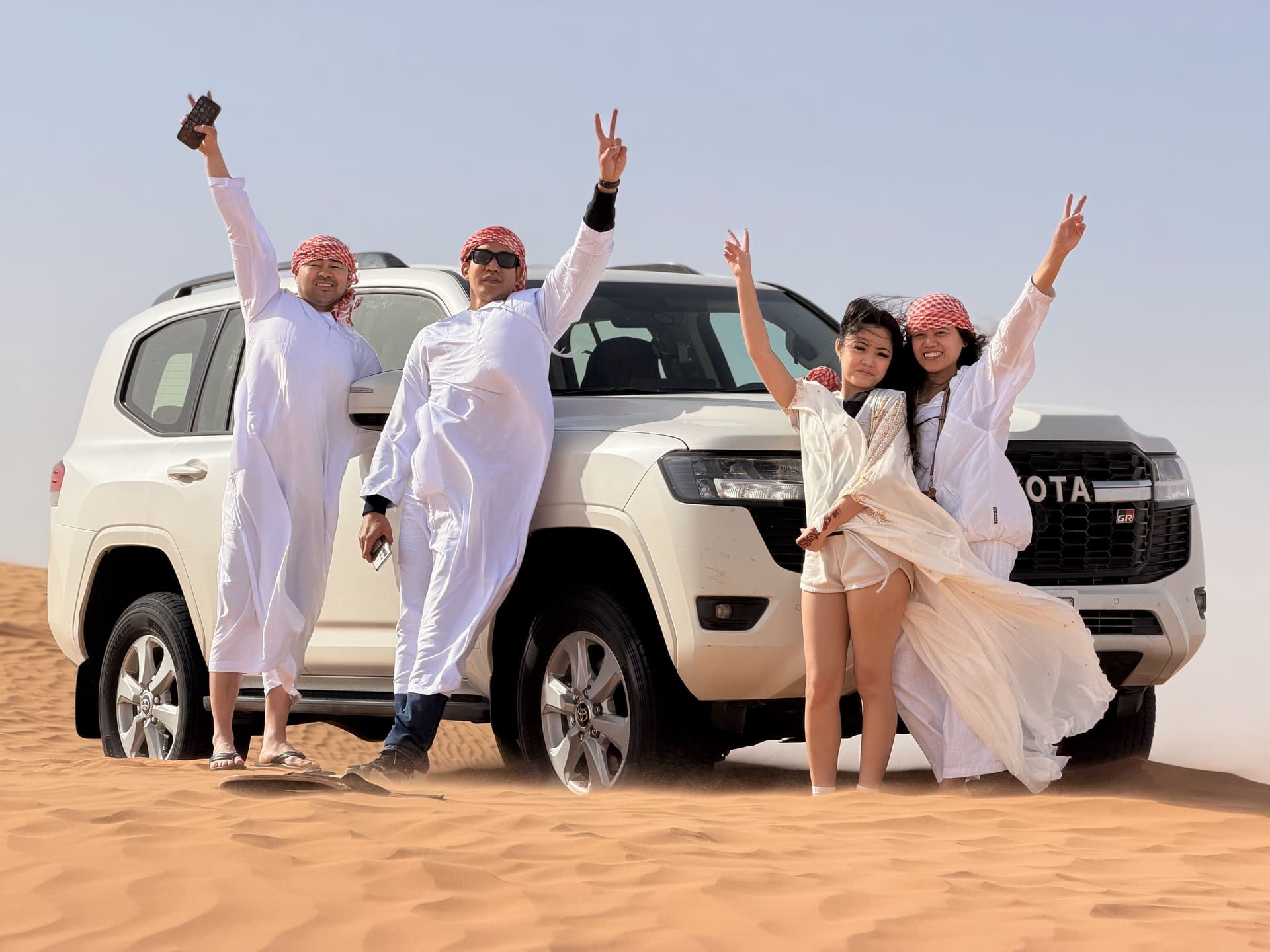
Dune bashing on a Dubai desert safari, how it works
What dune bashing actually is
Dune bashing is the practice of driving a high-clearance 4x4 vehicle at speed across soft sand dunes, tracking ridges and descending faces in controlled manoeuvres. The activity began in the UAE in the 1970s as a Bedouin survival skill, transitioned into a tourist product in the 1990s, and now anchors every commercial Dubai desert safari. The vehicle most often used is a Toyota Land Cruiser 70-series or a Nissan Patrol, both fitted with desert-tuned suspension, a roll cage, and seatbelts at every seat.
The activity has four distinct phases inside the 25-minute driving window: slope descent, side-cant, drop-and-recover, and ridge run. Each phase applies a different acceleration profile to the cabin; the cumulative load is what guests describe as the thrill or the discomfort, depending on the seat and the day. Healthy adults tolerate the entire profile with no after-effect. Guests with disc, sacroiliac, post-surgical, or pregnancy contraindications switch to the perimeter route at the same AED 199 evening package.
The dune system most evening safaris drive into is Lahbab, 45 kilometres east of central Dubai on the E44 Dubai-Hatta Road. Lahbab carries the iron-oxide red sand that defines the marketing photographs every operator runs on its homepage. The sand reads roughly 75°C on a midsummer afternoon and cools to 28°C at sunset. Read the canonical what is a desert safari in Dubai definition for the wider experience surrounding the dune-bashing window.
The 4 manoeuvres explained with peak G-force
A standard dune-bashing run covers four distinct manoeuvres in a 25-minute window. Peak G-force varies by manoeuvre. The breakdown below gives a guest the honest acceleration profile before the convoy leaves the hotel forecourt; no Dubai operator publishes this map today.
-
Slope descent
2.0 G peakThe Land Cruiser crests a dune ridge and descends the leeward face at a controlled speed. Vertical load through the chassis peaks at 2.0 G on the steepest descents at Big Red. Healthy adults read this as a fairground-style stomach drop. The driver brakes mid-descent to control the recovery; nose-down posture and a soft-eyed stare at the horizon reduce nausea risk.
-
Side-cant
2.5 G peakThe vehicle holds an angled traverse across the face of a dune, leaning the cabin roughly 30 degrees off vertical. Lateral G-force peaks at 2.5 G. The seatbelt anchorage carries most of the load; guests with neck or shoulder issues switch to the second-row middle seat or the perimeter route. Side-cant lasts seconds, not minutes.
-
Drop-and-recover
3.0 G peakA steep descent immediately followed by acceleration up the next dune. Combined vertical and forward acceleration peaks at 3.0 G. This is the manoeuvre that produces the audible reaction inside the cabin. Drop-and-recover sits at the intensity ceiling for guests with disclosed back or neck conditions; the editorial recommendation is to ask the driver to skip it.
-
Ridge run
3.5 G peakThe Land Cruiser tracks the spine of a long dune ridge at speed. The vehicle sways along the crest, producing a sustained lateral and vertical oscillation. Peak G-force hits 3.5 G on the longest ridge at Big Red. Ridge run is the visual signature of the Dubai dune-bashing photograph; the driver runs one to two ridges across the 25-minute window depending on conditions and the guest reaction.
The 25-minute driving window sequences these manoeuvres in roughly three to four repetitions, interleaved with low-speed transit between dunes. A premium package extends the window to 35 minutes and adds a second ridge run on request. A moderate-intensity request drops the drop-and-recover and the ridge run; the slope descent and the side-cant remain. Tell the driver before launch; the routing adjusts at zero cost. The same four-phase sequence appears on nearly every desert safari Dubai package sold as a standard evening safari.
Vehicles, tyre PSI, and suspension specification
A dune-bashing Land Cruiser carries seven engineering modifications on top of the showroom specification. The combination is what separates a road-tuned 4x4 from a desert-certified one. A vehicle that lacks any single modification fails the DET 6-month inspection and loses its certification until the issue is remedied.
- Toyota Land Cruiser 70-series or Nissan Patrol Y61, the two UAE-certified dune-bashing platforms. Mid-2010s onwards. Maximum 5 years on the commercial roster.
- Internal roll cage welded to the chassis. Side-impact, rollover, and top-load tested. Adds roughly 80 kilograms to the curb weight.
- Three-point seatbelts on every seat, including the second-row middle seat and the third-row jump seats. Five-point harnesses on the premium package.
- Tyres deflated to 15-18 PSI for the dune segment. The road pressure of 35 PSI bites into the soft sand and digs in; the deflated tyre spreads the contact patch and floats over the surface. Reinflation happens at the camp on a portable compressor.
- Desert-tuned damper rates, roughly twice the road specification. The standard road damper buckles under repeated 0.6 G vertical loads across a 25-minute run.
- Reinforced sump guard and rocker rails. The dune crest grazes the underside on every descent; an unprotected sump punctures inside one season.
- GPS tracker, fire extinguisher, and cabin first-aid kit. The tracker sends live location to the operator dispatch desk every 30 seconds.
The seven modifications cost roughly AED 28,000 to install on top of a new Land Cruiser GR Sport. The economics explain why an unlicensed dune driver running a road-stock vehicle is a financial and a safety risk. Pair the vehicle credentials with the are Dubai desert safaris safe in 2026 safety guide before booking.
RTA Safari Driving Permit, how to verify the driver before pickup
The Roads and Transport Authority issues the Safari Driving Permit to drivers who pass a desert-driving practical and theory exam on top of a UAE driving license. The permit is a physical plastic card, valid two years, photographed front and back on the driver's phone. A safety-first guest verifies the permit before pickup using the four-step flow below.
-
Send a WhatsApp message 24 hours before pickup.
Template: "Hi, please share the driver's RTA Safari Driving Permit photo and the vehicle plate number before pickup. Thanks." A reputable operator replies within ten minutes with the artefacts attached.
-
Check the permit expiry on the card photo.
Valid permits print the expiry date in the bottom-right corner. The permit is valid two years from issue. Expired permits are an immediate red flag; ask the operator to reassign the booking to a different driver.
-
Confirm the driver name matches the permit and the booking.
The permit prints the driver's full name and Emirates ID number. The name should match the WhatsApp message and the driver who arrives at the hotel forecourt. Mismatches are a contractual issue; the operator reassigns or refunds.
-
Ask for the vehicle dune-bashing inspection date.
DET standards require Land Cruisers under 5 years old and a 6-month inspection cycle. Acceptable pattern: "a 2023 Land Cruiser GR Sport with its plate number and an inspection date inside the last 6 months." BookMySafari sends both artefacts on every WhatsApp confirmation.
The verification flow takes under ten minutes and screens out the unlicensed end of the Dubai dune-driving market in one move. A driver who declines to share the permit photo is a driver to avoid. The licensed operator behind this platform, Velari Tourism L.L.C (DET license #1491675), shares the artefacts on every booking by default, before payment.
25 minutes of dune bashing, the honest duration disclosure
The Dubai marketing line "1 hour of dune bashing" reflects the elapsed time at the dune edge, not the actual driving time. Honest breakdown: 25 minutes of off-road driving sits inside a 65-minute elapsed window at the dune system. The rest is tyre deflation, briefing, photo stops, and the sunset wait. The table below maps the elapsed minutes line by line.
| Phase | Elapsed time | What happens |
|---|---|---|
| Tyre deflation | 5 min | Drivers deflate from 35 PSI to 15-18 PSI on a portable compressor. |
| Driver briefing | 3 min | Seatbelt check, manoeuvre catalogue, stop-signal explanation. |
| Slope descent + side-cant set 1 | 6 min | Two slope descents and one side-cant traverse across the first ridge. |
| Drop-and-recover set | 5 min | Two drop-and-recover manoeuvres on the steepest faces at Big Red. |
| Ridge run | 4 min | One sustained ridge run along the longest dune crest. |
| Slope descent + side-cant set 2 | 6 min | A second round of slope descents and side-cant traverses. |
| Cool-down transit | 4 min | Low-speed transit between manoeuvre sets. Total driving: 25 minutes. |
| Sunset photo stop | 15 min | High-ridge photo stop. Tyres remain deflated. Convoy regroups. |
| Re-inflation + transit to camp | 12 min | Tyres re-inflate at the camp edge. Total elapsed: 65 minutes. |
The 25-minute figure is the editorial honest disclosure. A premium package extends the driving segment to 35 minutes on request, with an additional ridge run. A moderate-intensity request shortens the segment to 15 minutes, with slope descents and side-cant only. The AED 199 perimeter route skips the segment entirely. Set the expectation before pickup; BookMySafari confirms the chosen intensity on the WhatsApp ticket.
The dune line in detail
Five frames from the dune line, Land Cruiser to golden hour
Land Cruiser cresting Lahbab, the convoy tracking a single line, the quad-bike circuit running alongside, the white Patrol paused between sets, and golden hour from the highest ridge.


Which dune system your safari drives into: Lahbab, Al Awir, or DDCR
Dubai operators run dune bashing into three distinct dune systems east and south of the city. The choice changes the drive time, the dune profile, the wildlife in view, and the price floor. Most evening safaris use Lahbab; premium packages split between Al Awir and the Dubai Desert Conservation Reserve.
- Lahbab red dunes, 45 minutes east of central Dubai on the E44 Dubai-Hatta Road. Iron-oxide red sand. Public-access desert with no environmental restriction on driving lines. The setting for 80%+ of standard-package dune-bashing runs. Big Red, the tallest dune in the system, reaches 90 metres. Visit our Lahbab desert location guide for the full geography.
- Big Red dune (Al Hadab), the photogenic giant inside Lahbab. Hosts the longest ridge run on the standard evening route. The Big Red dune location page covers the topography and the photo angles in detail.
- Al Awir desert, 35 minutes east of central Dubai. Mixed red-and-white dune system, less photogenic than Lahbab but quieter on a high-volume weekend. Used by morning safaris and by operators routing around Lahbab traffic.
- Dubai Desert Conservation Reserve (DDCR), 50 minutes east of central Dubai. 225 square kilometres of protected desert. Vehicle count capped; driving lines pre-approved by conservation officers. Restricted to a small set of licensed luxury operators. The dune-bashing intensity sits one notch below Lahbab on conservation grounds; the trade is wildlife visibility (oryx, gazelle, desert fox) instead.
Intensity standard · what changes
The BookMySafari dune-bashing standard vs the typical operator floor
Six verifiable claims a guest can confirm on WhatsApp before payment. Anything below this line is a tariff red flag and a safety risk.
UAE dune-bashing safety record
Serious incidents on the licensed dune-bashing fleet are rare. Most reported incidents fall into three categories: motion sickness is the dominant one, followed by mild back strain and, least common, minor vehicle contact during convoy spacing. Serious injury inside a DET-licensed safari is statistically rare; the regulatory floor catches most failure modes upstream of the dune line.
The Roads and Transport Authority publishes annual aggregate data on safari-vehicle incidents inside the licensed scheme, and reportable incidents on the regulated fleet stay rare. The unlicensed end of the market is the actual risk vector: tourist injuries in Dubai dune-bashing accidents reported in 2020 to 2024 concentrate on unlicensed drivers running unmodified vehicles outside the operator permit. The single most important safety decision a guest makes is choosing a DET-licensed operator. Read the are Dubai desert safaris safe in 2026 safety floor before paying.
Five reasons to skip dune bashing and take the perimeter route
Five guest profiles take the AED 199 no-dune-bashing perimeter route at the same evening package. Disclose the condition on WhatsApp before payment; the substitution costs nothing and never requires a justification.
- Pregnancy past week 12, dune-bashing G-forces unsuitable for the second and third trimester on operator medical advice. Pair the perimeter route with the desert safari motion sickness guidance for first-trimester guests with a sensitive stomach.
- Back pain, disc issues, recent spinal surgery, repeated 0.4-to-0.6 G vertical loads aggravate the condition across a 25-minute run.
- Severe motion sensitivity, vestibular-visual mismatch produces nausea inside the first three minutes. Ginger tablets and second-row seating reduce the risk; the perimeter route is the safe default.
- Recent ear infection or surgery (under 6 weeks), pressure changes on ridge descents aggravate the condition. Postpone or skip the segment.
- Children under 4, stay at the desert camp during the dune-bashing segment under camp-host supervision, free on the tariff. Children aged 4 to 11 ride the segment at parental discretion with a seatbelt on every seat.
The substitution is the editorial position, not a liability shield. A safety-first operator honours the request without invoicing, without arguing, and without making a guest justify the choice at the dune edge.
What to wear and bring on a dune-bashing run
Dune bashing is a 25-minute kinetic activity inside an air-conditioned cabin. The dress code stays practical, not adventurous. The list below covers the five wear-and-bring items that change the experience; the rest is decorative.
- Closed-toe shoes, sand surface temperature hits 75°C between 12:00 and 4:00 PM in summer. Sandals burn skin in seconds on the photo stop.
- Loose long trousers or a maxi dress, the cabin is air-conditioned but the photo stops are not. Loose fabric also reduces lap-belt friction on the side-cant manoeuvre.
- A light scarf, useful on windy dune-bashing windows. A folded scarf also doubles as a horizon-stare anchor for motion-sensitive guests.
- Sunglasses, the iron-oxide red sand reflects bright in late-afternoon light. Polarised lenses reduce glare on the ridge run.
- Power bank and a small camera, phone batteries drain fast on the dune line. A 5,000 mAh power bank covers the full 65-minute window. Avoid carrying bulky bags inside the cabin.
The desert safari safety guide covers the wider wardrobe and packing notes (medication, hospital card, motion-sickness tablets) that apply across every dune-bashing booking.

A driver, a Land Cruiser, an open dune line
Permits and inspections behind the Lahbab convoy
Drivers on the Lahbab convoy route hold the RTA Safari Driving Permit on top of a UAE driving license, and their Land Cruisers clear the 6-month dune-bashing inspection on schedule. Guests on the BookMySafari fulfilment fleet ride with drivers of this credential profile by default.
- RTA Safari Driving Permit card photographed and shared on WhatsApp before payment
- Experienced on the Lahbab route years of dune-driving history; reportable incidents on the fleet are rare
- 6-month vehicle inspection cycle roll cage, seatbelts, tyres, suspension, fire extinguisher audited
- Tyre PSI protocol 35 PSI to 15-18 PSI deflation at the dune edge, reinflation at the camp
Photography during dune bashing: the in-cabin window and the sunset photo stop
Dune-bashing photography splits into two windows: in-cabin during the driving segment, and on-ridge during the sunset photo stop. The in-cabin window is kinetic, the on-ridge window is golden-hour studio light. Five tactical notes cover the practical photography decisions.
- Lock the phone in landscape for in-cabin shots. Auto-rotate misbehaves on the side-cant manoeuvre and the ridge run.
- Shoot 0.5x ultra-wide on the iPhone for the dune-line interior. The wider field captures the slope angle and the cabin rake; 1x flattens the visual drama.
- Use video, not stills, in-cabin. Stills miss the kinetic moment; 4K video captures the manoeuvre and lets you grab a frame later.
- Save the stills for the sunset stop. The 15-minute window on the high ridge is the photogenic centre of the entire evening. Golden hour at Lahbab falls between 4:45 PM (December) and 6:50 PM (June).
- Tip the driver for the convoy shot. AED 50 buys a five-vehicle convoy framing on the dune crest. The driver positions the vehicles; you shoot from the high ridge.
Dune-bashing bookings · real guests
What guests said about the dune-bashing run
Reviews pulled from TripAdvisor, Google, and the BookMySafari WhatsApp inbox. Names abbreviated, country preserved. Each review covers a specific dune-bashing scenario.
Asked the driver for his RTA permit number before pickup. He sent the card photo on WhatsApp in two minutes. The ridge-run manoeuvre is genuinely intense, exactly the 3.5 G they describe on the page.
I wanted dune bashing without the marketing fluff. The 25-minute number is accurate. The driver explained each manoeuvre before starting, slope descent first, then the drop-and-recover. Felt safe the whole time.
My partner is 22 weeks pregnant. We took the no-bashing perimeter route at the same AED 199 tier. Driver dropped us at the desert camp directly and rejoined the convoy. Zero awkward conversation.
Booked the premium tier for the intensity. The driver ran the ridge-run twice on request. Tyres deflated to 16 PSI, reinflated at the camp. Six guests in the Land Cruiser, all seatbelts checked before launch.
Took my 9-year-old. The driver dialled the intensity down for our run, kept the side-cant under 2 G, and skipped the drop-and-recover. She loved it. A nervous parent can ask for the moderate route at no penalty.
Get motion sick on cruise ships. Pre-loaded with ginger tablets the driver supplied. Sat in the second row. Stared at the horizon. Walked out of 25 minutes of dune bashing with zero nausea. Practical advice that worked.
Standard, premium, and luxury dune-bashing intensity compared
The dune-bashing intensity ladder runs three steps. Standard at AED 149-249, premium at AED 350-500, and luxury at AED 695+. The price ladder maps to driver experience floor, vehicle specification, and the manoeuvre set delivered inside the 25-minute window.
- Standard evening (AED 149-249), 25-minute driving window, four manoeuvres, shared Land Cruiser with up to six guests. Driver experience floor of 5 years. The dominant package; covers the typical first-time visitor.
- Premium evening (AED 350-500), 35-minute driving window on request, additional ridge run, premium Land Cruiser GR Sport with private majlis seating at the camp. Driver experience floor of 8 years. Suits guests who want the intensity dialled up.
- Luxury heritage (AED 695+), Land Rover Defender or DDCR Land Cruiser, 6-guest cap, conservation-led routing. Driver experience floor of 10 years with DDCR certification. The trade is intensity for wildlife visibility and routing exclusivity.
The choice is intensity vs context. Booking the standard Evening Desert Safari Dubai package delivers the full dune-bashing experience at the AED 199 floor; the premium package adds a ridge run and majlis seating; the luxury package swaps intensity for conservation and wildlife.
When the AED 199 perimeter route is the better booking
The AED 199 no-dune-bashing route exists at the same evening package as the standard dune-bashing safari. The driver collects you from your hotel, drives 45 minutes to the dune system, drops you at the desert camp via the perimeter track, and rejoins the convoy for dinner. The camel ride, the BBQ buffet, falconry, henna, tanoura, and the fire show remain on the itinerary. No upcharge, no refund deduction, no awkward conversation at the dune edge.
Five guest profiles routinely book the perimeter route: pregnancy past week 12, recent spinal surgery, severe motion sensitivity, recent ear infection, and parents of children under 3. The substitution is also the right call on a low-energy day; the dune-bashing segment is high-effort kinetic activity, and skipping it preserves the dinner and the performances. Book the dedicated Dubai desert safari without dune bashing package or message the editorial desk to switch a standard booking before pickup.
Book a dune-bashing safari on WhatsApp
Pick the intensity level above and message us. We confirm the driver's RTA Safari Driving Permit number, the vehicle inspection date, and your hotel pickup within reply within 10 minutes. Bookings on this page are fulfilled by Velari Tourism L.L.C, DET license #1491675.
Message us on WhatsAppFrequently asked questions about dune bashing in Dubai
-
Is dune bashing safe in Dubai?
Dune bashing in Dubai is safe when the operator holds a current DET license, the driver carries an RTA Safari Driving Permit, and the Land Cruiser clears the 6-month dune-bashing inspection. Reportable incidents on the licensed safari fleet are rare. Acceleration forces peak at 3.5 G on the ridge-run manoeuvre, which feels intense but stays inside the comfort band for healthy adults. Motion-sensitive guests, pregnant guests past the first trimester, and guests with recent back surgery switch to the AED 199 perimeter route at the same evening package. -
How long does dune bashing actually last?
Dune bashing on a standard Dubai evening safari lasts 25 minutes of actual off-road driving. The marketing line "1 hour of dune bashing" reflects the elapsed time at the dune edge, which includes tyre deflation (5 minutes), driver briefing (3 minutes), three to four manoeuvre sets across 25 minutes, the sunset photo stop on a high ridge (15 minutes), and re-entry to the convoy. Premium packages extend the driving segment to 35 minutes on request. Listings promising a 60-minute experience are quoting that elapsed window, not the drive. The honest editorial position: 25 minutes at the wheel is the standard, this site quotes it plainly, and you ask for more if the intensity suits you. -
What is the maximum G-force during dune bashing?
Maximum G-force during dune bashing in Dubai peaks at 3.5 G on the ridge-run manoeuvre, where the Land Cruiser tracks the crest of a dune at speed. A standard slope descent sits around 2 G. A side-cant (vehicle held at angle) reads 2.5 G. A drop-and-recover (steep descent followed by acceleration up the next dune) reads 3 G. Healthy adults tolerate these loads. Repeated 0.4-to-0.6 G vertical loads through the lumbar spine across 25 minutes aggravate disc, sacroiliac, and post-surgical conditions; the perimeter route at the same AED 199 package is the editorial recommendation in those cases. -
Can pregnant women do dune bashing?
Pregnant women in the first trimester travel on the dune-bashing segment at moderate intensity with obstetrician clearance. Pregnant women past week 12 take the AED 199 no-dune-bashing route at the same evening package; the dune-bashing G-forces are unsuitable for the second and third trimester on operator medical advice. The substitution costs nothing. The driver collects you, drops you at the desert camp directly, and rejoins the convoy for the dinner segment. Camel rides, the BBQ, falconry, and henna remain safe throughout pregnancy. -
What is the minimum age for dune bashing in Dubai?
Dune bashing is recommended from age 3 onwards on the standard evening safari, with parental discretion. Children under 4 stay at the desert camp during the dune-bashing segment under camp-host supervision, and the BookMySafari tariff carries them free. UAE traffic law requires a child safety seat for every child up to 4 years old, supplied free when the age is declared at booking. Children aged 4 to 11 use the second-row seat with the standard three-point seatbelt. Children with recent ear infection, recent surgery, or active asthma skip the bashing segment and join the convoy at the camp via the perimeter route. -
Will I get motion sick during dune bashing?
Roughly one in eight first-time guests reports mild nausea on a 25-minute dune-bashing run. Five preventive tactics reduce the risk significantly: eat lightly two hours before pickup, take a ginger tablet from the Land Cruiser glovebox thirty minutes before the dune segment, sit in the second row rather than the third-row jump seats, stare at the horizon (not the dashboard) during manoeuvres, and ask the driver to leave the dune line if two interventions fail inside the first three minutes. The perimeter route is available at zero cost. -
Can I sit in the front seat during dune bashing?
The front passenger seat is reserved for the driver-assistant role on most Dubai operator tariffs. Booking the front seat on a private safari is straightforward; on a shared safari the seat rotates to the largest guest by safety policy. The front seat carries the most lateral acceleration on side-cant manoeuvres and the steepest sightline on ridge runs, so motion-sensitive guests avoid it. Guests with neck issues take the second row by default. Confirm seating preference on WhatsApp before pickup; the BookMySafari fulfilment fleet honours requests on a first-asked basis. -
What if I want to stop mid-bashing?
Telling the driver to stop ends the dune-bashing segment immediately. The Land Cruiser parks on the nearest stable ridge, the driver checks on every guest, and the convoy routes the vehicle to the perimeter track. No question, no penalty, no upcharge, no awkward conversation at the dune edge. The camp dinner, the camel ride, the falconry, and the live performances remain on the itinerary. Motion sickness, mild back strain, panic, or simply "I am done" all trigger the same response. Safety-first operators expect a stop request on roughly one in twelve trips.
Ready when you are
Dune bashing, honestly disclosed. Answers in ten minutes.
WhatsApp the editorial desk. We share the driver's RTA Safari Driving Permit photo, the vehicle inspection date, and the chosen intensity level before you pay.