Lahbab vs Al Marmoom safari, Dubai's two dune systems compared
The 30-second verdict, who books Lahbab and who books Al Marmoom
The 30-second answer routes by what the photograph and the day are for, rather than by personal preference. The decision matrix below scores both systems across 9 criteria, but the shortlist of routings covers most bookings.
- You want the iconic red-dune sunset photograph
- You are a family on an AED 600 ceiling
- You came for the BBQ + cultural-show evening
- You are a first-time visitor with the postcard brief
- You came to see the Arabian oryx on a Dubai safari
- You shoot wildlife with a 400 mm telephoto lens
- You want a certified eco-tour rather than a dune-bash
- You travel with kids who want cycling and falconry
Side-by-side spec sheet, Lahbab vs Al Marmoom on 7 attributes
A side-by-side spec sheet covers the seven attributes that move the dune-system decision. Pricing references the 2026 standard package for an evening safari at Lahbab desert and a sunrise eco-route at Al Marmoom Reserve booked through the BookMySafari editorial desk.
| Attribute | Lahbab desert | Al Marmoom Reserve |
|---|---|---|
| Drive time from Dubai Marina | 45 minutes east on the E44 (Hatta Road) | 40 minutes south on Al Qudra Road |
| Dune profile | Iron-oxide red, 60 to 100 metre crests (Big Red) | Tan-amber, 20 to 50 metre crests, mixed sand sheets |
| Access status | Open public desert, no eco-rules | Conservation reserve, open with eco-rules |
| Wildlife sighting odds (winter) | Falcon at the camp, camels at the eastern edge | Arabian oryx usually seen, gazelle often, 158 bird species |
| Best slot of the day | Sunset 4:50 PM to 5:25 PM (December) | Sunrise 5:50 AM to 6:55 AM (December) |
| AED price floor 2026 (standard package) | AED 99 (budget shared evening) | AED 350 (Eco-Route Pilot sunrise) |
| AED price ceiling 2026 (luxury) | AED 500 (private 4x4 with chef-curated BBQ) | AED 750 (heritage Land Rover + falconry operator) |
Two faces of the Dubai desert
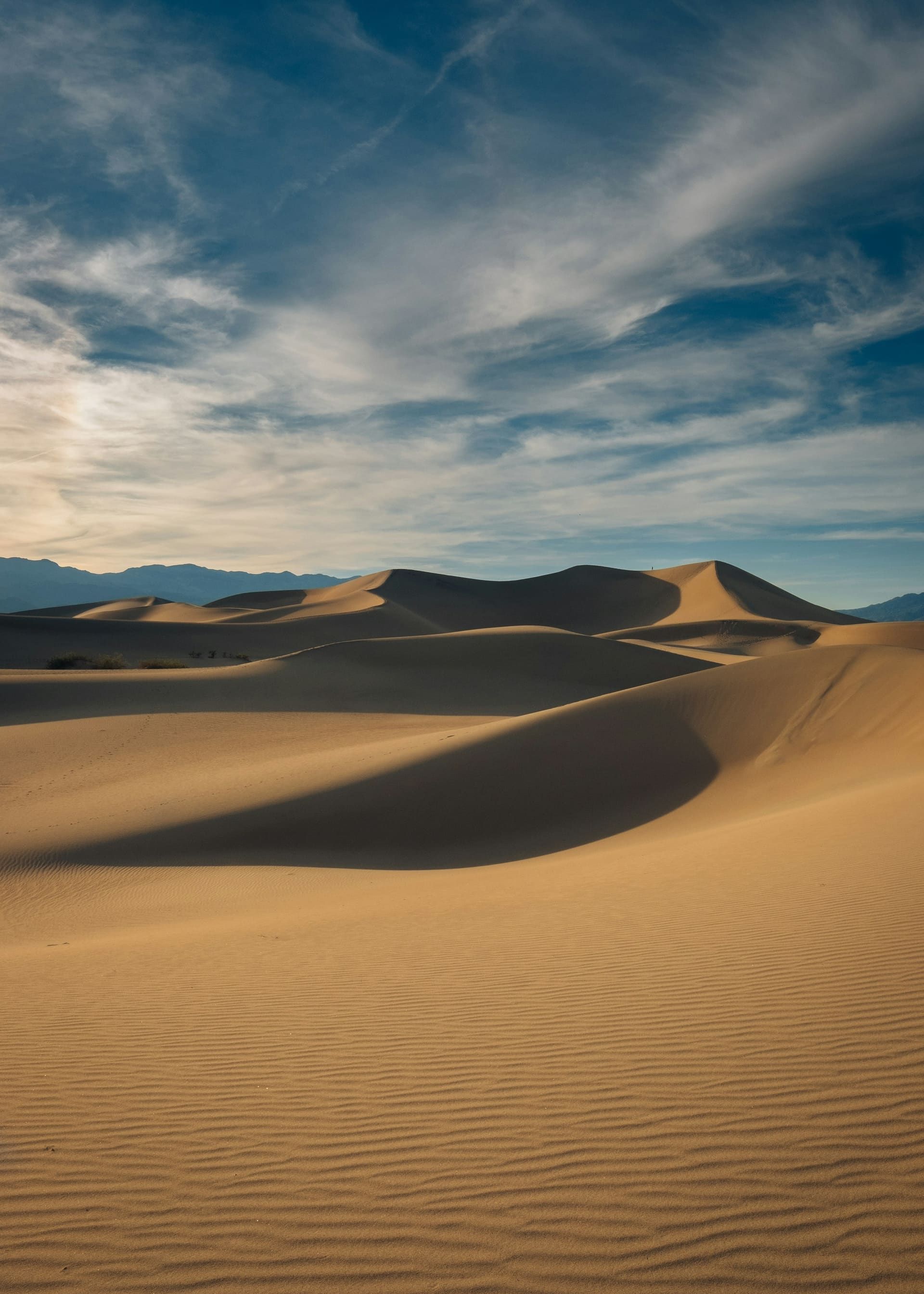
Red Lahbab dunes and tan Al Marmoom sand sheets
Iron-oxide red on Big Red, Arabian oryx grazing inside Al Marmoom, a Land Cruiser cresting Lahbab, the Al Qudra cycling track at sunrise, and a camel caravan on a Dubai dune ridgeline.


Lahbab vs Al Marmoom · what changes
The 7 attributes that move the dune-system decision
Side-by-side at the standard 2026 package. The dune system you pick changes the photograph, the wildlife, the AED outlay, and the slot of the day.
Drive time, 45 minutes east vs 40 minutes south
The two dune systems sit on opposite radial corridors out of central Dubai. Lahbab is 45 minutes east on the E44 (Dubai-Hatta Road), reached via Sheikh Zayed Road south, passing the Last Exit Al Khawaneej service area 10 minutes before the dune edge. Al Marmoom is 40 minutes south on Al Qudra Road, reached via Sheikh Mohammed Bin Zayed Road, with the Al Qudra Lakes car park as the most common access point.
Downtown Dubai pickups arrive at either system 5 to 10 minutes earlier than Marina pickups because the Burj district clears Sheikh Zayed Road faster than the Marina exit. A standard winter pickup window: 3:00 PM from Marina for a Lahbab evening safari (dune edge at 3:50 PM), or 5:00 AM from Marina for an Al Marmoom sunrise eco-route (perimeter at 5:40 AM). The 5-minute drive-time gap is operationally irrelevant; the corridor choice (east versus south) is the actual decision driver.
Sand colour, iron-oxide red versus tan-amber
Lahbab sand carries a coating of iron oxide on its quartz grains, the same chemistry that turns rust orange-red on steel. The coating formed over hundreds of thousands of years as the grains weathered out of iron-bearing rock in the Hajar mountains and blew westward on the prevailing Shamal wind. At the low-angle hour around sunset, the iron-oxide coating reflects the warm light into a deep red-orange that no other Dubai dune system matches.
Al Marmoom sand carries less iron oxide and reads tan-amber even at golden hour. The conservation reserve sits south of Dubai on a different sand-supply corridor, with the grains drifting in from the south rather than the east. The colour palette favours the cooler tones of sunrise rather than the warmer tones of sunset, which aligns conveniently with the wildlife window that runs the same sunrise hour. If the photograph the trip is for is the iconic warm-tone Dubai dune frame, the choice is Lahbab. If the photograph is a tan-amber sand sheet at dawn with an oryx in the foreground, the choice is Al Marmoom.
Dune heights, 60 to 100 metres versus 20 to 50 metres
Big Red on the Lahbab system rises 60 to 100 metres above the surrounding sand sheet and is the most photographed dune crest in the UAE. The south-facing lee slope drops into a sand bowl used as the standard dune-bashing finish line, and from the top of the crest on a clear evening the Dubai skyline shows on the western horizon and the Hajar mountains break the eastern one. The Devil's Spine, Camel Crossing dune, and the Lahbab Bowl deliver further scale at 30 to 50 metres each.
Al Marmoom crests sit on average 20 to 50 metres above the reserve floor. The dunes are lower, gentler, and spread across longer sand sheets rather than concentrated into a single dramatic ridge. The lower profile suits the conservation routing because vehicles and walkers traverse the reserve without the steep climbs that compress wildlife into narrow corridors. The trade-off is the photographic scale: the Lahbab dunes overwhelm the frame; the Al Marmoom dunes recede behind the wildlife and the lakes.
AED pricing compared, what the AED 251 entry gap buys at Al Marmoom
The Lahbab entry level prices at AED 99 on the budget shared evening safari; the Al Marmoom entry level prices at AED 350 on the entry-level eco-safari operator's sunrise route. The AED 251 gap is the largest single decision pivot for budget-conscious bookings and represents the most asked question at the editorial desk. The breakdown below traces what the gap actually buys against the Lahbab equivalent.
| Option | Lahbab AED | Al Marmoom AED | What the gap buys at Al Marmoom |
|---|---|---|---|
| Budget shared | AED 99 | n/a | No budget package inside the conservation reserve. |
| Entry level | AED 99 (evening) | AED 350 (sunrise eco) | MBRC eco-certification + certified ranger + wildlife reliability. |
| Standard package | AED 199 (BBQ + shows) | AED 450 (Heritage Centre camel/equestrian) | Al Qudra Lakes access + 10 km cycling track + Heritage Centre setup. |
| Mid package | AED 250 (private evening) | AED 650 (conservation-drive operator) | Conservation drive + desert breakfast + ranger commentary. |
| Premium package | AED 350 (VIP camp) | AED 750 (heritage Land Rover + falconry operator) | 1950s Land Rover Defender + falconry demonstration + conservation walk. |
| Luxury ceiling | AED 500 (private 4x4) | AED 750+ (heritage Land Rover + falconry operator, premium) | Identical ceiling; Al Marmoom adds the certified eco-operator framing. |
The AED 251 gap at the entry level covers three specific add-ons that Lahbab cannot match: the MBRC conservation levy that funds the Arabian oryx reintroduction programme, the certified eco-guide trained on the 26 mammal and 158 bird species checklist, and the wildlife sighting reliability that requires a managed reserve to deliver. If the trip is for the iconic dune photograph and the BBQ-camp evening, the AED 99 Lahbab package covers it. If the trip is for the oryx and the conservation experience, the AED 350 floor is the entry price for that experience.
Wildlife, none reliably at Lahbab versus 158 bird species at Al Marmoom
Lahbab is a public desert, not a fenced or managed conservation area, so wildlife sightings happen by chance rather than by design. The species most commonly photographed at Lahbab are the trained Arabian falcon on the operator handler's gloved arm, the grazing camels at the paddocks on the eastern edge near Al Madam, and occasional Arabian gazelle at the dune fringes at dawn. The Arabian oryx, reintroduced after near-extinction in the 1970s, lives only inside the fenced reserves (Al Marmoom and the Dubai Desert Conservation Reserve) and is not present at Lahbab.
Al Marmoom documents 26 mammal species and 158 bird species centred on the reintroduced Arabian oryx population. On a winter sunrise eco-route from a 5:00 AM Marina pickup, free-ranging camels are almost always in frame, Arabian oryx usually seen, Arabian gazelle often, migratory waterfowl often from November to March, MacQueen's bustard sometimes at the lake edge, and sand fox rarely at dawn or dusk. If wildlife in the photograph is a hard requirement, Al Marmoom is the only routing that delivers it reliably.
Eco-rules, open public desert versus conservation reserve
Lahbab carries no eco-rules. Off-track dune driving runs on any line the operator picks, dune-bashing routes change weekly with the wind, and the camp footprints expand or contract with the evening volume. Dubai Police patrol Lahbab Road and fine vehicles blocking the recovery lane, but inside the dunes the operator has full latitude on the route, the speed, and the convoy size.
Al Marmoom carries a published eco-code enforced by ranger patrols. No off-track driving outside marked routes, no flash photography of any wildlife, no drone flying without an MBRC permit, no littering, no swimming in the lakes, no alcohol inside the reserve, and dogs only on the cycling track. Verbal warnings on first contact, fines from AED 500 upward for repeat breaches. Off-track routes inside the reserve are permitted only to the four MBRC-certified operators. The eco-rules deliver the wildlife reliability the standard Lahbab format cannot match; the trade-off is operator latitude and the speed of a standard dune-bashing run.
Photography, iconic dune versus wildlife portfolio
Lahbab and Al Marmoom deliver two different kinds of photographs rather than better or worse versions of the same one. Lahbab is the iconic-photograph destination: the warm-tone sunset dune on Big Red or the Devil's Spine, the wind-rippled iron-oxide ridges, the silhouette of the camel caravan against the orange sky, the Land Cruiser cresting a 60-metre lee slope. What it delivers is one frame, repeated across the trip, executed at sunset.
Al Marmoom is the portfolio-depth destination: the Arabian oryx at the dawn feed, the MacQueen's bustard called by the ranger at the lake edge, the migratory waterfowl on the Al Qudra Lakes between November and March, the falconry handler at a certified operator's centre, the 10 km cycling track silhouette at sunrise, the dune-edge camel caravan with a 400 mm lens compression. What it delivers is five to seven frames, captured across one sunrise route, with cleaner air and softer light than the evening equivalent. A two-day trip that books Lahbab on the first evening and Al Marmoom on the third sunrise hands back both portfolios in one Dubai stay.
Family-friendliness, Lahbab BBQ format versus Al Marmoom activity mix
Lahbab suits families on a budget and families with kids who want the dune-bashing thrill and the cultural-evening lineup. The AED 99 budget package and the AED 199 standard package keep a family of four under AED 600 for the evening, the dune bashing dials down on request for children under 6, and the BBQ camp covers the dinner question. The camel ride at the camp runs 5 to 10 minutes for any child aged 6 and up.
Al Marmoom suits families who want more than dune bashing on the day. The activity mix layers the 10 km Al Qudra cycling and fat-bike loop, a 45 to 90 minute camel trek at the Heritage Centre, an equestrian sunrise walking ride for beginners, a falconry demonstration at a certified operator's centre, a ranger conservation walk on the oryx reintroduction programme, and a picnic at Family Lake inside the lake cluster. Total AED outlay rises against the Lahbab equivalent, but the day stretches from 5:00 AM sunrise to a 1:00 PM family lunch with five distinct activity blocks.
Operator choice, five DET operators at Lahbab versus four MBRC-certified at Al Marmoom
Lahbab opens to all five major DET-licensed operators across every price level, including Velari Tourism L.L.C (DET #1491675) and a mix of hotel-affiliated, standard-package, and budget-package operators. Pickup windows run between 2:45 PM and 4:00 PM in winter on the standard evening package, with dune-bashing entry slots split between the Lahbab Bowl (south face of Big Red), the Devil's Spine ridge approach, the north face of Big Red, the Camel Crossing dune approach, and a shared late convoy on the Lahbab Bowl. Budget to luxury packages all operate.
Al Marmoom restricts off-track dune routes to four operators holding Mohammed Bin Rashid Al Maktoum Centre for Wildlife eco-tour certification, including a heritage Land Rover and falconry operator (Platinum level), a conservation-drive operator (Gold level), Al Marmoom Heritage Centre (Heritage Operator level), and an entry-level eco-safari operator. The certification gates the route options, the camp infrastructure inside the reserve, and the ranger-guided programming. Budget operators do not run inside the reserve; the AED 350 entry level is structurally the floor.
The decision matrix, 9 criteria scored out of 10
The decision matrix scores both systems across 9 criteria. Lahbab wins dune height, sand colour, AED price, photography results, and operator choice. Al Marmoom wins drive time, wildlife sighting odds, eco-rules and conservation framing, and family-friendliness with kids 6 to 11. The overall tally: Lahbab 69 of 90, Al Marmoom 67 of 90. The decision is close on the score and decisive on the routing, pick by what matters to your trip, not by tally.
| Criterion | Lahbab | Al Marmoom | Note |
|---|---|---|---|
| Drive time from Dubai Marina | 7/10 | 8/10 | Al Marmoom is 5 minutes closer at 40 minutes south; Lahbab is 45 minutes east. |
| Dune height and dramatic profile | 10/10 | 5/10 | Big Red rises 60 to 100 metres; Al Marmoom crests sit 20 to 50 metres on average. |
| Sand colour saturation at golden hour | 10/10 | 6/10 | Iron-oxide red versus tan-amber. Lahbab carries the iconic Dubai dune palette. |
| AED price at the entry level | 10/10 | 5/10 | Lahbab AED 99 floor versus Al Marmoom AED 350 floor, a AED 251 gap on the budget package. |
| Wildlife sighting odds on a guided route | 3/10 | 10/10 | Arabian oryx usually seen on a winter sunrise and 158 bird species inside Al Marmoom only. |
| Eco-rules and conservation framing | 3/10 | 10/10 | Open desert with no rules vs MBRC-certified conservation reserve with ranger patrols. |
| Photography results | 9/10 | 8/10 | Lahbab wins the iconic dune photo; Al Marmoom wins a wildlife and lake portfolio. |
| Family-friendliness with kids 6 to 11 | 7/10 | 9/10 | Al Marmoom adds cycling, equestrian, falconry, and a conservation walk that Lahbab lacks. |
| Operator choice and price spread | 10/10 | 6/10 | Lahbab opens to all five DET operators across every price level; Al Marmoom limits to four MBRC-certified operators. |
| Total out of 90 | 69 | 67 | Decisive on routing, close on the tally. |
4 scenarios where Lahbab is the right answer
Four traveller scenarios route to the Lahbab system rather than the Al Marmoom default. Each pairs a specific persona with the reason Lahbab wins on the day.
Big Red at sunset is the postcard Dubai dune frame
Lahbab carries the iron-oxide red dunes that headline almost every Dubai desert safari photograph published online. A standard 3:00 PM Marina pickup reaches the dune edge by 3:50 PM, dune bashing runs to 4:25 PM on the south face of Big Red, and the sunset ridge stop on the Devil’s Spine lands the photograph between 4:50 PM and 5:25 PM in December. The Al Marmoom equivalent does not deliver the same colour or scale.
Two adults plus two children under the AED 600 ceiling
A standard-package evening safari at Lahbab prices from AED 149 per adult on the budget shared vehicle and AED 199 on the standard shared. Two adults plus two children at the child rate on the AED 149 morning standard package comes in under AED 450 for the family. The Al Marmoom equivalent at AED 350 per adult exceeds AED 1,400 for the same group before any operator upsell.
The iron-oxide signature reads deepest at 4:50 PM in December
The Lahbab sand grains carry an iron-oxide coating that reflects the low-angle sunset light into a deep red-orange that no other Dubai dune system matches. The richest saturation runs 4:50 PM to 5:50 PM in December and 6:20 PM to 7:20 PM in June. Wind-rippled crests on Big Red and the Devil’s Spine hold the colour longest. Al Marmoom is a sunrise destination for cooler tan-amber tones.
The full evening cultural lineup runs from 6:30 PM at the camp
Lahbab desert camps run the full evening cultural lineup from 6:30 PM: tanoura, belly dance, fire show, henna, falcon photography, and the BBQ buffet with lamb, chicken, kebabs, and biryani. Al Marmoom routes through ranger-guided eco-experiences with desert breakfasts and falconry training rather than the evening dinner-show format that travellers flew to Dubai for.
4 scenarios where Al Marmoom is the only right answer
Four traveller scenarios route to Al Marmoom with no Lahbab substitute. Each pairs a specific persona with the reason Al Marmoom wins on the day.
Arabian oryx are usually seen on a winter sunrise route
Al Marmoom documents 26 mammal species and 158 bird species centred on the reintroduced Arabian oryx population. On a winter sunrise route, oryx are usually seen, gazelle often, MacQueen’s bustard sometimes at the lake edge, and free-ranging camels almost always. Lahbab is an open public desert with no oryx population; the dune ridges deliver no wildlife in the frame.
MBRC-certified operators and ranger-led conservation routes
Al Marmoom restricts off-track dune routes to four operators holding Mohammed Bin Rashid Al Maktoum Centre for Wildlife eco-tour certification, including a heritage Land Rover and falconry operator, a conservation-drive operator, Al Marmoom Heritage Centre, and an entry-level eco-safari operator. The certified routes include the conservation walk, ranger-guided oryx tracking, and a desert breakfast under the reserve’s published eco-rules. Lahbab is unregulated and runs no comparable conservation programming.
Five distinct setups inside a single Al Marmoom morning
Al Marmoom hands a photographer five distinct setups inside a single morning: the Arabian oryx herd at the dawn feed, migratory waterfowl on the Al Qudra Lakes between November and March, the falconry handler at a certified operator’s centre, the 10 km cycling track silhouette at sunrise, and the dune-edge camel caravan. The Lahbab system delivers one setup repeatedly: the red dune at sunset.
Al Marmoom layers a family day beyond the dune-bashing format
Al Marmoom layers a family day across the 10 km Al Qudra cycling and fat-bike loop (AED 50 to AED 120 per hour at the kiosk), a 45 to 90 minute camel trek or equestrian sunrise ride (AED 150 to AED 450), a falconry demonstration with a heritage handler (AED 75 per adult), and a ranger conservation walk (AED 100 per adult). Lahbab carries none of these; the booking is the standard dune-bashing + BBQ-camp format only.

The do-both approach
Book the Lahbab evening on day one and the Al Marmoom sunrise on day three
A two-or-three-day Dubai trip routes both dune systems inside one booking window without compression. Day one: Lahbab evening safari from a 3:00 PM Marina pickup, sunset photograph on the Devil's Spine ridge at 4:50 PM in December, BBQ buffet at the desert camp, drop-off by 9:30 PM. Day two rests. Day three: Al Marmoom sunrise eco-route from a 5:00 AM Marina pickup, reserve perimeter at 5:40 AM, Arabian oryx and gazelle sightings on the lake-edge route, desert breakfast at 7:15 AM, falconry demonstration at 8:00 AM, drop-off by 10:00 AM. Two different deserts, two different photographs, one combined AED outlay between AED 449 and AED 1,250 per adult depending on the package mix.
- Day 1 Lahbab evening sunset ridge, BBQ camp, cultural shows
- Day 3 Al Marmoom sunrise oryx, gazelle, falconry, lake-edge route
- Combined AED outlay AED 449 to AED 1,250 per adult, both systems
- Routes through one chat editorial desk confirms both inside one WhatsApp thread
Real guests · both dune systems
What guests said after booking Lahbab, Al Marmoom, or both
Six reviewers across Lahbab evening and Al Marmoom sunrise bookings, pulled from TripAdvisor, Google, and the BookMySafari WhatsApp inbox. Names abbreviated, location preserved.
Booked Lahbab for the photo we have been chasing since landing in Dubai. The sunset on Big Red turned the dunes that ridiculous red. The 45-minute drive was worth every dirham of the AED 199 standard tier.
Did the Al Marmoom sunrise eco-route after the desk talked us out of Lahbab for wildlife. Four oryx in the first 90 minutes, a sand fox at the lake edge, and a MacQueen’s bustard called by the ranger. AED 750 felt fair.
Family of four. We picked Lahbab on the AED 149 morning standard because Al Marmoom at AED 350 per adult would have doubled the bill. The kids loved Big Red. We will save Al Marmoom for the wildlife trip next year.
I shoot birds. 158 species on the Al Marmoom checklist, and the ranger actually called the migratory flamingos at dawn over the Al Qudra lakes. Lens stayed cleaner than any session I have done at Lahbab.
We did both on the same trip. Lahbab on the first evening for the dune-bashing and the sunset, Al Marmoom on the sunrise of day three for the oryx. Two different deserts. The desk routed both bookings inside one WhatsApp chat.
Cultural evening was the priority. Lahbab desert camp covered the tanoura, the fire show, the BBQ, and the henna inside one window. Al Marmoom does not run the evening format the same way.
WhatsApp the editorial desk for a dune-system brief
Message the BookMySafari booking desk on WhatsApp with the photograph the trip is for, the AED ceiling per adult, and the traveller mix. We route to the right dune system (Lahbab, Al Marmoom, or the do-both itinerary), the right package, and confirm the exact pickup time for your hotel zone inside a single chat. Reply within 10 minutes. Bookings on this page are fulfilled by Velari Tourism L.L.C, DET license #1491675, paired with an MBRC-certified eco-operator on the Al Marmoom routing.
Message us on WhatsAppFrequently asked questions about Lahbab vs Al Marmoom safaris
-
Is Lahbab or Al Marmoom better for a first desert safari?
Lahbab suits 7 out of 10 first-time visitors to Dubai because the iron-oxide red dunes, the Big Red ridge, the standard evening BBQ camp lineup, and the AED 99 price floor pack the canonical Dubai desert experience into one 6-hour window. Al Marmoom suits the remaining first-timers when wildlife in the frame, an eco-experience, or a photography-depth portfolio outranks the iconic sunset photograph. The 9-criteria decision matrix above scores the trade-off; Lahbab wins 5 criteria and Al Marmoom wins 4. -
Where can I see oryx on a Dubai desert safari?
Arabian oryx live inside the two fenced or managed conservation areas south and east of Dubai: Al Marmoom Desert Conservation Reserve (open public with eco-rules, 4 certified eco-tour operators) and the Dubai Desert Conservation Reserve (DDCR, gated, 5 luxury operators). Al Marmoom oryx are usually seen on a guided winter sunrise eco-route. Lahbab is an open public desert with no oryx population; the species was reintroduced into managed reserves only after the 1970s near-extinction. A 5:00 AM Marina pickup on an Al Marmoom sunrise route lands the perimeter by 5:40 AM in time for the dawn feed. -
Are Lahbab safaris cheaper than Al Marmoom?
Yes. A standard-package Lahbab evening safari prices from AED 149 on the budget shared vehicle and AED 199 on the standard shared in 2026. An Al Marmoom sunrise eco-route prices from AED 350 per adult on the entry-level eco-safari operator, AED 450 on Al Marmoom Heritage Centre camel and equestrian programmes, AED 650 on the conservation-drive operator, and AED 750 on the heritage Land Rover and falconry operator. The AED 251 gap between the entry levels buys the MBRC eco-certification, the certified ranger, and the wildlife sighting reliability that Lahbab cannot offer. -
Why does Al Marmoom cost AED 250+ more than Lahbab?
The AED 251 gap between the Lahbab AED 99 entry level and the Al Marmoom AED 350 entry level covers three specific add-ons. First, the MBRC eco-tour certification levy and ranger fee that funds the Arabian oryx reintroduction programme. Second, a certified eco-guide trained on the 26 mammal and 158 bird species checklist, rather than a standard dune-bashing driver. Third, the wildlife sighting reliability: oryx usually seen on a winter sunrise route is operationally expensive to deliver against the unmanaged Lahbab dune surface. The AED gap also unlocks the Al Qudra Lakes, the conservation walk, and the certified-operator camp at no further charge. -
Can I drive my own car to both?
You can drive a regular sedan to the asphalt road edge of Lahbab off the E44 and to the paved roads and lake parking inside Al Marmoom off Al Qudra Road. Off-road driving onto the dunes themselves requires a 4x4 with low-range, deflated tyres, and recovery gear at Lahbab; off-track dune driving inside Al Marmoom is prohibited by the published eco-rules regardless of vehicle. Self-drivers stay on the roads at Al Marmoom and walk the lake paths or ride the cycling track; at Lahbab, a licensed operator pickup is the safer call unless the driver dune-bashed within the past 6 months. -
Which is better for sunset photography?
Lahbab wins sunset photography by a clear margin. The iron-oxide sand grains reflect the low-angle sunset light into a deep red-orange that no other Dubai dune system matches; the richest saturation runs 4:50 PM to 5:50 PM in December and 6:20 PM to 7:20 PM in June, with Big Red and the Devil’s Spine ridge holding the colour longest. Al Marmoom is a sunrise destination: the tan-amber sand reads coolest at dawn, the wildlife window aligns with the same 5:30 AM to 7:30 AM hour, and the Al Qudra Lakes deliver mirror reflections under sunrise rather than sunset light. Pick Lahbab for the sunset glow and Al Marmoom for the sunrise wildlife frame.
