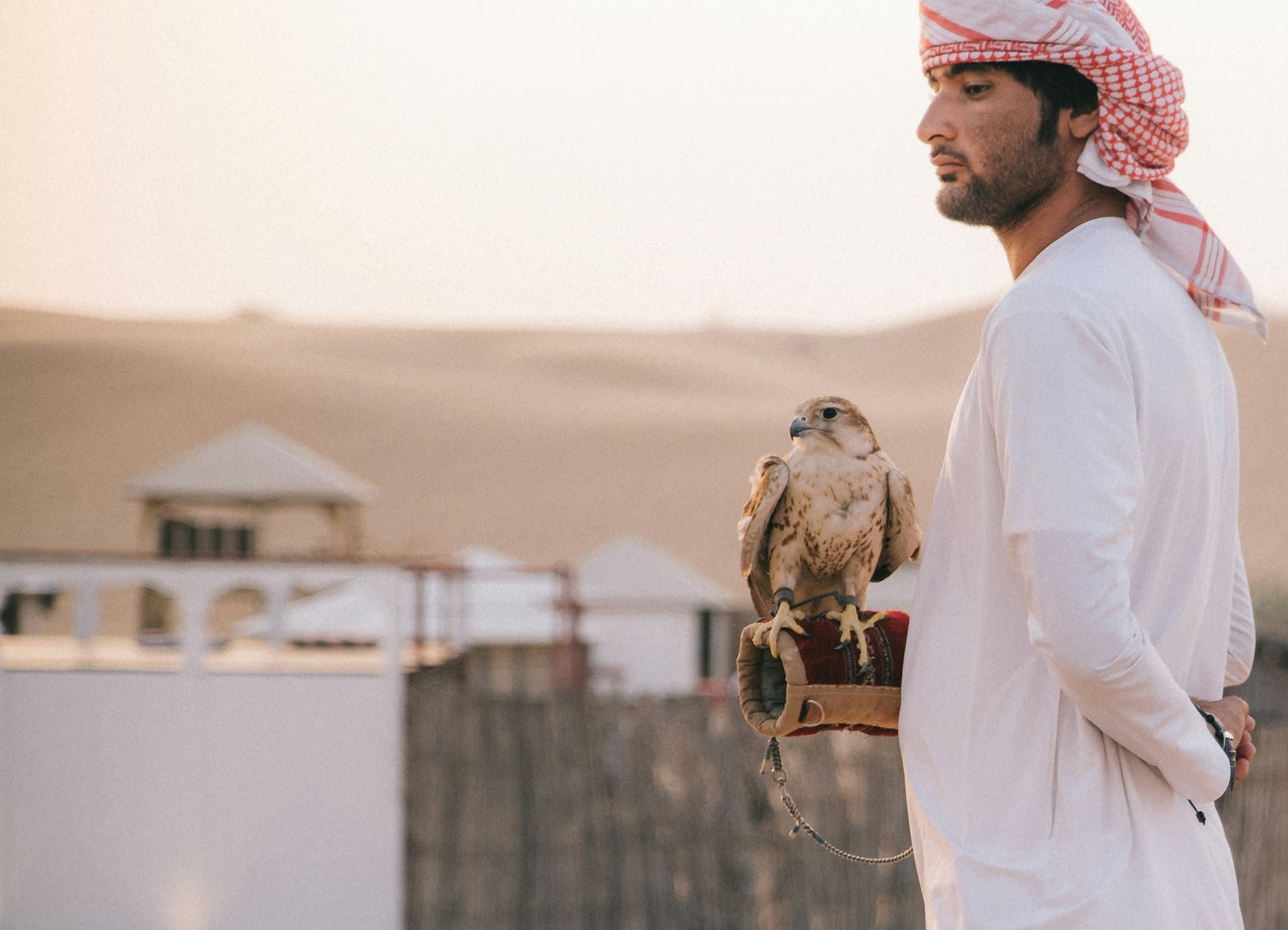
Falconry on a Dubai desert safari, UNESCO heritage explained
What falconry on a safari actually is
Falconry on a Dubai desert safari is the live, supervised display of a trained working falcon at a camp photography station, plus an optional private session on the luxury package that adds a flown-to-fist demonstration. The standard slot runs eight to twelve minutes per camp evening and rotates through a queue of guests.
The bird is an adult peregrine or saker conditioned to human presence and weighed in at 600 to 1,000 grams that day. The handler, sometimes referred to as the falconer or by the Arabic al-saqqar, wears a kandura, carries a leather mangalah glove on the left arm, and works with two pieces of falconry equipment in clear view: the burqu (the leather hood that calms the bird) and the jess straps that secure the falcon to the fist between flights. Telemetry beacons on the saker tail signal the bird to a master falconer at distance and appear on the luxury package.
The display works because the falcon is a heritage entity in the UAE rather than a performance prop. Sheikh Zayed declared falconry the national sport in the 1970s, founded the Abu Dhabi Falcon Hospital in 1999, and pushed UNESCO toward the 2010 inscription. The bird on the glove at your camp evening is, in legal and cultural terms, the same animal that flies in the Sheikh Zayed Falcon Release Programme each season. The standard display already runs at the camp photography station on this desert safari in Dubai, with the private flown-to-fist session reserved for the luxury package.
The 3 falcon species used on a Dubai safari
Three falcon species do almost all the work at Dubai safari camps. Each has a distinct weight band, role in the hunting heritage, and price level in modern UAE practice.
- Peregrine falcon (Falco peregrinus), the most common camp bird. Working weight 600 to 800 grams. The peregrine holds the recorded animal speed record at a 320 km/h stoop dive. Compact, fast, and the easiest bird for a first-time visitor to hold on the glove. Standard at the AED 50 photo stop.
- Saker falcon (Falco cherrug), the UAE national bird. Working weight 900 to 1,300 grams. Larger, heavier on the glove, with longer endurance and the historic hunting bird for the houbara bustard hunt. The saker is the prestige bird at luxury camps and the species most often flown in the Sheikh Zayed Falcon Release Programme.
- Gyr-peregrine hybrid, a captive-bred cross between the Arctic gyrfalcon (Falco rusticolus) and the peregrine. Working weight 1,100 to 1,400 grams. Combines gyrfalcon size and cold-weather hardiness with peregrine speed. Appears at the top level of luxury private sessions and at competitive racing meets. Rarely seen at a standard camp.
A pure gyrfalcon (no peregrine cross) is uncommon at safari camps. Pure gyrs handle the UAE summer heat poorly; the hybrid is the working-bird compromise. Asking the handler which species sits on the glove that evening reads as informed and almost always opens a short conversation about training and feeding.
UNESCO 2010 listing, the multi-nation context
UNESCO inscribed falconry, a living human heritage on its Representative List of Intangible Cultural Heritage in 2010, the second cultural tradition listed globally after the Mevlevi Sema ritual of Turkey. The original inscription named 11 co-applicant states: the UAE, Belgium, the Czech Republic, France, Mongolia, Morocco, Qatar, Saudi Arabia, South Korea, Spain, and Syria.
The roster expanded through later sessions of the UNESCO Intergovernmental Committee. Hungary, Austria, Pakistan, Portugal, Italy, Germany, Kazakhstan, Ireland, the Netherlands, Poland, Kyrgyzstan, and Slovakia all joined the entry by 2021. The current listing covers 18 nations and remains one of the broadest multi-nation cultural-heritage entries on the UNESCO list.
The UAE led the diplomatic push behind the 2010 listing. The dossier credited falconry for active transmission across generations, deep community identity weight, and a documented corpus of training methods, equipment vocabulary, and quarry tradition. The inscription reads falconry as a living social practice, not a museum tradition, which mirrors the desert-rooted reality on the ground in Dubai. For broader context on the deeper heritage underneath, see the Bedouin culture in the UAE guide.
UAE falconry law: the three documents every legal falcon carries
UAE federal law treats falconry as regulated wildlife custody rather than informal pet ownership. Three documents accompany every legally held falcon in the country, and a licensed handler at a safari camp produces them on request.
- Falcon passport, a green booklet issued by the Ministry of Climate Change and Environment. Records the bird species, ring number, microchip ID, owner, and travel history. The UAE became the first state to issue a passport for a captive raptor in 2002. The Sheikh Zayed Falcon Release Programme verifies every passport before a release flight.
- Microchip implant, a subcutaneous PIT chip inserted between the shoulder blades. Mandatory under federal wildlife regulations. The chip number cross-references the passport ring number and the CITES paperwork.
- CITES travel papers, the Convention on International Trade in Endangered Species permits the bird carries on any cross-border flight. Most working UAE falcons travel during the houbara hunt season to Morocco, Pakistan, or Central Asia, and the CITES papers move with them. Etihad and Emirates both cabin-board falcons on UAE-departing flights under this regime.
A handler unable to produce any of the three documents is operating outside the federal framework. At a DET-licensed safari camp the paperwork is held with the camp manager and shown on the casual request of a curious guest. Visible documentation is the cleanest single indicator that the falcon on the glove is a legally held heritage animal rather than an undocumented prop. For the related conservation context see the Desert wildlife UAE guide.
Master falconer, credentials and training
The handler at a Dubai safari camp is either an apprentice handler (one to three seasons on the glove) or a master falconer (five-plus seasons, flown houbara hunts in season). Master falconers earn a Ministry-issued endorsement on the falcon passport that apprentices do not.
A working-season cycle runs August moult through April. The bird trains over six to eight weeks of incremental flights, short fist hops first, then the lure, then a free flight on a long line, then a closed-circuit free flight. By season opening the falcon stoops to the lure on command and recalls to the glove from 300 metres. At the camp the same bird performs an abbreviated version of that training cycle for the guest audience.
The Emirates Falconers' Club, founded in 2001 and based in Abu Dhabi, runs the credentialing track for working handlers. The club also coordinates the international falconry festival every four years on the Liwa fringe, where handlers from the 18 UNESCO-listed nations gather for a five-day exchange.
AED 50 photo stop vs AED 300 luxury private session
The two falconry options on a Dubai desert safari are priced separately and deliver materially different experiences. The headline difference is time, attention, and the species of bird on the glove.
- AED 50, standard photo stop. Included inside most evening safari packages at no additional charge, or charged as a stand-alone add-on at AED 50 per guest. One peregrine, one shared handler, one queue position, 60 seconds on the glove with two to three photographs. The bird stays hooded for most of the slot; the handler pulls the hood for one open-eye frame.
- AED 300 to AED 450, luxury private 30-minute session. Books one master falconer and one trained bird (saker or gyr-peregrine hybrid) for a half-hour block. Includes glove handover, a flown-to-fist demonstration on a 50-metre lure line, an unhooded close-up frame, and informal time to ask species and law questions. Group size 1 to 4 guests. Available at the luxury desert safari Dubai package and at the conservation-camp package inside the Dubai Desert Conservation Reserve.
The AED 250 difference between the two options buys solo time with the falconer, a heavier and more dramatic bird on the glove, and the absence of a queue behind you. Booking the luxury session in advance is the difference between a calm half-hour and a no-show; same-day bookings work only on weekday evenings outside the December peak.
Sheikh Zayed Falcon Release Programme and the Abu Dhabi Falcon Hospital
The Sheikh Zayed Falcon Release Programme is the largest captive-falcon rewilding effort in the world. Launched in 1995 by the Environment Agency Abu Dhabi, the programme has released over 2,100 falcons back to the wild across Kazakhstan, Iran, and Pakistan by 2024. The release ceremony is held annually in late spring on the Liwa fringe; tagged saker falcons are flown free with tracking telemetry attached.
The programme reads as the most visible UAE answer to the conservation concern that captive falconry, run badly, depletes wild populations. UAE captive-breeding programmes now produce roughly 4,000 chicks a year, and the release initiative returns adults that have completed a heritage-display role.
The Abu Dhabi Falcon Hospital sits inside the same conservation ecosystem. Founded by Sheikh Zayed in 1999, the hospital treats over 11,000 falcons annually as the global reference clinic for raptor medicine. It runs visitor tours weekdays at 10:00 and 14:00, which sits well alongside a Dubai safari trip for guests with a deeper interest. The related camel riding on a Dubai desert safari activity covers the second living-heritage layer at the camp.
5 photography tips for falcon close-ups
The falcon photo is the single most-shared image from a Dubai safari evening. The lighting, the speed of the slot, and the bird's small head movements make it a harder frame than guests expect.
- Stand with the sunset at your back. The handler positions you facing the camera, but you can step a quarter-turn during the unhooded frame. Light onto the bird's eye, not into the lens.
- Pre-set your phone shutter speed at 1/500 or faster. The falcon turns its head every 1 to 2 seconds. A slower shutter blurs the eye, which is the entire point of the portrait.
- Hold the glove arm parallel to the ground. The falconer corrects most tilted arms, but starting flat saves time inside the 60-second window. Elbow tucked, wrist firm.
- Ask the handler for the unhooded frame at the end. The bird is calmer after the first 30 seconds. Open-eye shots come out better at second 45 than at second 5.
- Keep your free hand low and still. The falcon reads waving hands as erratic and may bate (flap) off the fist. A still pose holds the bird and the photograph.
Children and falconry, safety considerations
Children encounter the falconry station as the most memorable single activity of a Dubai desert safari evening. The handler adapts the demonstration to the age and confidence of the child.
- Ages 6 and over hold the glove themselves with a parent or guardian standing immediately behind the elbow. The handler keeps one hand on the bird and one hand on the child for the full slot.
- Ages 3 to 5 join the frame from the parent or guardian lap. The bird sits on the adult arm; the child sits in front. No separate glove is offered.
- Infants and toddlers (under 3) are not placed in the immediate frame. The handler reads small unpredictable movement as a bird-spooking risk and keeps the falcon hooded only.
- School-age children at the luxury session get more out of the longer format. The flown-to-fist sequence and the lure-line demonstration hold attention for the full 30 minutes in a way the standard 60-second photo does not.
Falcon dander and allergic reactions at the photo station
Falcon plumage carries microscopic feather dust and dander that triggers allergic reactions in roughly one in 500 visitors. The reaction is typically mild, sneezing, itchy eyes, brief throat irritation, and resolves within 30 minutes of moving away from the bird. A small subset of guests with severe bird-protein allergy report stronger symptoms.
Guests with asthma, severe hay fever, or a known bird allergy stand clear of the falcon station and watch the demonstration from 5 metres back. The visual experience holds at that distance; the close-up photograph is the part that requires direct proximity. Carry an antihistamine in the safari bag if you have any history of bird-related reaction.
Booking lead-time for luxury private sessions
Standard falconry photo stops require no separate booking, they come bundled inside the evening safari and run on the camp schedule. The luxury private 30-minute session is the one that needs lead time, and the lead time varies sharply by season.
- November to March (peak season). Book the private session 5 to 7 days ahead. Weekend evenings (Friday and Saturday) sell out 10 days ahead. The luxury desert safari Dubai package bundles the session with private vehicle pickup and skip-the-queue camp entry.
- April to May, October (shoulder). Two to three days ahead is normally enough. Weekday evenings often confirm same-day.
- June to September (low season). Same-day bookings confirm reliably. Camp temperatures cross 40°C, which limits the bird-on-glove window to the post-sunset slot; the handler reschedules a daylight booking to evening on most summer days.
Heritage and conservation packages at the Dubai Desert Conservation Reserve require longer lead times, the DDCR caps daily camp capacity, and the falconry slot is attached to a fixed two-vehicle convoy. Confirm seven to ten days in advance year-round for DDCR camp routings.
WhatsApp the desk for a falconry-focused safari brief
Message the desk for a falconry-focused evening safari brief, saker or gyr-peregrine hybrid on the glove, master falconer for the full 30 minutes, DDCR routing rather than Lahbab. Reply within 10 minutes. Bookings on this page are fulfilled by Velari Tourism L.L.C, DET license #1491675.
Message us on WhatsAppThe falcon, in five frames
A Dubai falconry stop, frame by frame
Peregrine on the mangalah glove at sunset, the saker held in an open palm near the Saluki Centre, the unhooded portrait at Bab Al Shams, the yellow-rimmed eye of the Sheikh Zayed release programme bird, and the hooded saker between flights.


Heritage activities
A 2-to-3 minute hold with a master falconer is the photograph guests remember
The falconry photo stop is the highest-rated single moment on a Dubai evening safari, ahead of the dune-bashing ridge run and the camel walk at the camp. The bird is calm, the handler narrates the species and the federal paperwork, and the 2-to-3 minute hold on the gauntlet leaves room for one structured portrait and one open-eye frame. The same handler crew often works the Saluki Centre photography slots the following morning.
- Master falconer credentialing Ministry-endorsed falcon passport, five-plus seasons, houbara hunt experience
- Saluki Centre and Bab Al Shams pairing Camp falcon stop plus the Al-Faqr falcon center pairs into a heritage half-day
- Federal paperwork on request Falcon passport, microchip number, and CITES papers held in the camp kit bag
- Photo set across golden hour Hooded portrait, open-eye unhooded close-up, and an arm-handover frame inside the same window
Photo stop vs private session
What the private falconry session adds over the standard photo stop
Six verifiable claims a guest can confirm on WhatsApp before payment. The luxury package buys solo time with a master falconer, a heavier bird on the glove, and the federal paperwork handed over without prompt.
Conservation context
The Sheikh Zayed Falcon Release Programme has rewilded over 2,100 captive falcons since 1995
The Environment Agency Abu Dhabi runs the largest captive-falcon rewilding effort in the world. Tagged saker falcons fly free across Kazakhstan, Iran, and Pakistan each spring under telemetry tracking. The Abu Dhabi Falcon Hospital, the global reference clinic for raptor medicine, treats over 11,000 birds a year and runs visitor tours weekdays at 10:00 and 14:00. The bird on the glove at your camp is in legal and cultural terms the same animal that flies in the release ceremony each season.
- Sheikh Zayed Falcon Release Programme Over 2,100 captive sakers returned to the wild since 1995, tagged with telemetry
- Abu Dhabi Falcon Hospital Global reference clinic, 11,000 falcons treated annually, founded 1999
- Captive-breeding backstop UAE programmes produce roughly 4,000 chicks a year to ease wild-population pressure
- Visit-Dubai heritage pairing Add a hospital tour or a Saluki Centre stop to extend the falconry day
Falconry bookings · real guests
Reviews from guests who came for the falcon photograph
Reviews pulled from TripAdvisor, Google, the BookMySafari WhatsApp inbox, and one email letter. Names abbreviated, country preserved. Each review covers a specific falconry scenario at the standard or the luxury package.
Booked the luxury private session at Bab Al Shams. The master falconer walked us through the saker passport and the microchip number before the first flight. Thirty minutes felt like ten. The bird recalled to the glove from 50 metres on a single whistle.
Stood at the standard photo stop with my two kids. The handler hooded the peregrine while the youngest sat on my lap, then lifted the hood for the open-eye frame at the end. Sixty seconds, two clean portraits, no rush. Best AED 50 of the trip.
Asked the falconer about the gyr-peregrine hybrid the camp uses on weekends. He pulled the passport from the kit bag and walked through the breeder, the moult date, and the houbara season travel record. The conversation alone was worth the booking.
Photographer brief. Wanted the unhooded close-up at golden hour. Master falconer at the Al-Faqr center positioned the saker against the dune and held the bird still for a full minute. Got the eye-detail frame I came for on the first attempt.
Combined the camp falcon photo stop with the Saluki Centre visit the next morning. Same handler crew, same calm bird-on-glove protocol. My nine-year-old held the gauntlet with the falconer guiding the elbow. She still talks about that 2 to 3 minute hold a year later.
I came for the peregrine demonstration and stayed for the conservation story. The handler talked through the Sheikh Zayed Falcon Release Programme during the slot, then handed me the binder of past release certificates. Heritage tourism done right.
Frequently asked questions about falconry on a Dubai desert safari
-
Is falconry safe for tourists on a desert safari?
Falconry on a Dubai desert safari is safe under the supervision of a licensed handler. The bird on display is an adult working falcon, hooded between flights, conditioned to human presence, and never released over a guest crowd. The handler places the bird onto a leather glove on your forearm, and the glove itself protects against the talons. Standard demonstrations run for one to two minutes per guest at the photography station. Children under 6 are seated on a parent or guardian during the photo. Allergy-prone guests stand clear of the bird; the dander and microscopic feather particles trigger reactions in roughly one in 500 visitors. -
Can I hold a falcon on a Dubai desert safari?
Holding a falcon is the core of the falconry photo stop. The handler hands you a leather glove (the mangalah), positions the bird on the gauntlet, and steps aside for the 30 to 60 second portrait. The bird stays hooded for most of the photo to keep it calm; the handler removes the hood for one short open-eye shot at the end. The standard package includes this photo at no extra charge in evening safari packages. For a longer experience, the luxury private session books a master falconer for 30 minutes, with a flown-to-fist demonstration, glove handover, and a single saker or gyr-peregrine hybrid as the bird. -
How much does a private falconry session cost?
A private 30-minute falconry session at a Dubai luxury camp costs AED 300 to AED 450 per group of 1 to 4 guests. The price includes one master falconer for the full half hour, one trained bird (saker or gyr-peregrine hybrid), glove handover, flown-to-fist demonstration on a long lure, and a structured photo set. The standard photo stop at a regular evening safari costs nothing extra inside the package; it is one bird, one glove, and a 60-second portrait per guest in a queue. The AED 250 difference between the two options buys solo time with the falconer, a longer bird-on-fist experience, and the right to ask species and law questions without rushing the queue. -
Why is falconry UNESCO heritage?
UNESCO inscribed falconry on its Representative List of Intangible Cultural Heritage in 2010, citing a 4,000-year continuous practice across the Middle East, Central Asia, and Europe. The UAE was among the 11 original co-applicant states and led the diplomatic push under Sheikh Mohammed bin Zayed. The listing was expanded to 18 nations by 2021, making falconry one of the broadest multi-nation entries on the UNESCO list. Falconry passed the UNESCO criteria for active transmission across generations, community identity weight, and a documented heritage corpus. The 2010 inscription reads falconry as a living social practice rather than a museum tradition, which mirrors the desert-rooted reality of the UAE today. -
Are the falcons treated well?
Working falcons in the UAE are among the most regulated captive birds in the world. Federal law requires a microchip implant, a falcon passport issued by the Ministry of Climate Change and Environment, and CITES travel papers for every bird in private ownership. The Abu Dhabi Falcon Hospital treats over 11,000 birds a year as the global reference clinic. Working birds at safari camps are weighed daily (a healthy peregrine sits at 600 to 800 grams), fed quail or pigeon, and rotated through 90-minute display shifts to prevent stress. The hood is a calming tool, not a punishment; a hooded falcon enters a low-stimulation rest state similar to sleep. Birds visibly out of condition do not appear on the glove of a licensed handler. -
Can children participate in falconry demonstrations?
Children aged 6 and over can hold the falcon on the glove with a parent or guardian standing immediately behind. The handler keeps a hand on the bird and on the child for the full duration. Children under 6 join the photo from the parent or guardian lap rather than holding the glove themselves; the bird is positioned on the adult arm. The luxury private session is suitable for families with children aged 8 and over, where the longer format and the flown-to-fist sequence add an engagement payoff beyond a photo. Camps decline the demonstration for infants and toddlers; the bird reads sudden small-child movement as unpredictable and stays hooded only. -
What is the difference between peregrine and saker falcon?
The peregrine (Falco peregrinus) and the saker (Falco cherrug) are the two most common species at a Dubai desert safari. The peregrine is the faster bird, its 320 km/h stoop dive is the highest-recorded animal velocity, and the most common photo-stop bird at standard camps, with a 600 to 800 gram working weight. The saker is the UAE national bird, larger at 900 to 1,300 grams, with longer endurance and the historic Bedouin hunting bird for the houbara bustard. The saker holds heavier on the glove and is the preferred bird at luxury private sessions and at the Sheikh Zayed Falcon Release Programme. A gyr-peregrine hybrid combines the gyrfalcon size with peregrine speed and appears at the upper level of private session bookings.