Dubai desert safari during pregnancy, trimester-by-trimester
The 30-second answer, is it safe?
A Dubai desert safari is safe in pregnancy on the perimeter route with three conditions met. Condition one: your obstetrician has cleared short overland travel inside the gestational week of the booking. Condition two: the dune-bashing segment is removed, the camel ride stays at walking pace, and the heat protocol is honoured. Condition three: you are not carrying one of the five medical conditions listed below that override the no-bashing route entirely.
The perimeter route reaches the same desert camp as the standard convoy via a smooth 12-minute extension along the desert track. The dinner, the falconry, the camel walk, the henna, the tanoura, and the saluki photo opportunity stay exactly the same. The AED 199 evening package price stays exactly the same. BookMySafari confirms the substitution in writing on WhatsApp before payment; the fulfilment partner is Velari Tourism L.L.C, operated by Velari Tourism L.L.C (DET #1491675), the Dubai-licensed tour operator behind this platform.
First trimester decisions (weeks 1 to 12)
The first trimester carries two specific safari considerations: morning sickness and the higher background miscarriage rate. Neither makes a desert safari unsafe on the perimeter route; both shape the booking choices. Morning sickness peaks around weeks 6 to 10 and resolves for most pregnancies by week 13. The background miscarriage rate sits at roughly 10 percent of known pregnancies (ACOG), with RCOG citing 1 in 5 for no apparent reason (RCOG), across the first trimester regardless of activity; a perimeter-route safari does not measurably move the number, and no operator can offer that as a refund condition.
Editorial recommendations for first-trimester bookings: take the cooler morning safari window from October to April, eat a light breakfast two hours before pickup, accept the ginger tablets at the Land Cruiser, sit in the second row, and confirm the perimeter substitution before payment. Hydration matters more in pregnancy than out of it; the camp stocks unlimited cold water at the welcome desk and the dinner zone, and electrolyte sachets are free on request. Skip the dune-bashing segment as a default position even if your obstetrician technically clears it; the marginal risk is not worth the marginal adrenaline.
Second trimester decisions (weeks 13 to 26), the safest window
The second trimester is the safest and most comfortable window for a Dubai desert safari. Morning sickness has resolved for most pregnancies. Energy levels recover. The bump is large enough to be visible but small enough to keep seated travel comfortable; relaxin has begun softening pelvic ligaments without yet causing the late-stage hip discomfort. Most international flights still accept pregnant guests without a doctor note across this window, and the camp staff are not yet operating in the heightened-caution mode that governs late-trimester bookings.
The second-trimester safari plan: perimeter route by default, camel walk at the cameleer's lead, the dinner at the chair option rather than the floor cushion, and the falconry slotted between the henna and the BBQ to break up the seated stretch. desert camp bathroom intervals open every 60 to 90 minutes for second-trimester guests, the same cadence carried at the welcome desk. Hydrate aggressively, the AED 5 per litre extra bottled-water tariff at most operators is waived on every BookMySafari booking through the summer months. Wear closed-toe shoes; the sand surface temperature reaches 75°C between 12:00 and 4:00 PM from May through September.
Third trimester decisions (weeks 27 onwards), most operators decline
Third-trimester safari bookings sit on a sliding scale of operator acceptance. From week 27 to week 32, most DET-licensed operators accept the booking on the perimeter route with an obstetrician note. From week 32 to week 36, acceptance varies operator-by-operator and tends to require both the note and a chaperoned travel companion. From week 36 onwards, most operators decline because the preterm-labour risk has crossed into a window where a camp-to-A&E ambulance run becomes time-sensitive. The Lahbab corridor is remote, and the nearest A&E is Rashid Hospital.
BookMySafari accepts third-trimester bookings up to week 34 on the perimeter route, with an obstetrician clearance letter dated inside 14 days of the booking and a travel companion confirmed at the time of booking. The DHA-licensed midwife emergency contact is printed on the WhatsApp confirmation alongside the camp dispatch number. The sand-free low-back chair is reserved at the dinner majlis. Camel ride at this gestation stays available at walking pace for guests cleared specifically for it; many late-trimester guests substitute an extended falconry slot. Past week 34, the editorial recommendation is to postpone, the desert will still be there in three months.
Trimester-by-trimester matrix, what is safe, what to swap
The matrix below distils what each trimester changes for a Dubai desert safari booking. Read across the row for the activity, down the column for the trimester, and the cell tells you the editorial position with the substitution.
| Activity | T1 (1 to 12) | T2 (13 to 26) | T3 (27+) |
|---|---|---|---|
| Dune bashing | Skip, perimeter route | Skip, perimeter route | Skip, perimeter route |
| Camel walk | Safe with OB clearance | Safe with OB clearance | Safe to week 32 with note |
| Camel trot | Skip | Skip | Skip |
| Quad bike, sandboarding | Skip | Skip | Skip |
| desert dinner | Safe | Safe | Safe, chair option |
| Falconry, henna, tanoura | Safe | Safe | Safe |
| Summer afternoon pickup | Avoid, morning safari | Avoid, morning safari | Avoid entirely |
| Overnight in the desert | Discuss with OB | Acceptable with note | Postpone |
The matrix reflects the editorial position at BookMySafari in 2026. Every cell assumes an uncomplicated pregnancy with OB-GYN clearance. A high-risk pregnancy, recent bleeding, or any of the five medical conditions listed below overrides the matrix entirely.
The no-dune-bashing AED 199 route, what changes
The no-dune-bashing route changes three things about the standard evening safari: the driving line, the pickup-to-camp duration, and the seating posture in the Land Cruiser. Everything else, the camp, the dinner buffet, the welcome dates and Arabic coffee, the falconry, the camel walk, the henna, the live shows, the saluki photo, the pickup window, the AED 199 price, stays exactly the same.
The driving line skips the high dunes at Lahbab and crosses to the camp on the perimeter track. Total drive time extends from 45 minutes to 57 minutes, all of it smooth desert road. The Land Cruiser stays at 18 PSI tyre pressure rather than deflating to dune-bashing spec, which keeps the ride firm but predictable. The driver maintains a steady 50 km/h across the desert track, avoiding the 0.4 to 0.6 G vertical loads of the dune segment. BookMySafari logs the substitution at the booking stage; you do not negotiate at the dune edge while the rest of the convoy waits.
Camel rides during pregnancy, gentle walk versus trot
A camel ride at walking pace is the editorial recommendation across all three trimesters for an uncomplicated pregnancy with OB-GYN clearance. A camel trotting is not safe at any trimester, full stop. The distinction matters because some camp cameleers default to a brief trot for the photographer's sake; pregnant guests ask for the walk at the lead and the cameleer keeps it.
The mechanics, based on operator route data rather than a published clinical study: the camel walks at roughly 4 km/h on a lead rope held by a trained cameleer. The saddle pitches forward-and-back at a gentle cadence of about once per second, softer than a city taxi ride and substantially softer than a horse trot. Mount and dismount happen with the camel kneeling, so the rider steps on rather than swings a leg over. The saddle height at the standing point is roughly 2 metres, similar to a tall stool; vertigo-sensitive guests skip the ride at no penalty. Pregnancies with cervical insufficiency (RCOG), placenta previa (RCOG), recent bleeding, or multiple gestation (ACOG) skip the camel ride and substitute an extended falconry slot or a second henna session at the same price point.
Motion sickness amplification, what changes hormonally
Pregnancy amplifies motion sickness through three independent mechanisms. Progesterone slows gastric emptying, which extends the dwell time of food in the stomach. Higher levels of human chorionic gonadotropin shift the chemoreceptor trigger zone toward nausea. Relaxin and shifting cardiovascular volume affect inner-ear fluid dynamics, which increases the vestibular sensitivity that drives travel-induced nausea. The combined effect, based on operator booking-feedback data rather than a published clinical study: roughly 7 in 10 motion-sensitive guests report worse symptoms in the first trimester than at baseline.
BookMySafari's pregnancy motion-sickness protocol: ginger tablets stocked in the Land Cruiser glovebox, a soft-eyed stare at the horizon during the perimeter drive, no heavy lunch within two hours of pickup, second-row seating with the centre seatbelt routed below the bump, electrolyte sachets at the camp. Scopolamine patches are contraindicated in pregnancy and are never offered. Promethazine, doxylamine, and ondansetron are prescription antiemetics with pregnancy-class profiles your obstetrician reviews; discuss any antiemetic with your obstetrician before travel, they are not stocked on the Land Cruiser. The single most reliable preventive remains skipping the dune-bashing trigger entirely, which the perimeter route does by default.
Heat protocol during pregnancy, May to September is harder
Heat tolerance drops during pregnancy. Core body temperature runs somewhat higher than baseline through the second and third trimesters, and the cardiovascular load of regulating to ambient heat is meaningfully higher; discuss your own heat tolerance with your obstetrician if you have a cardiac or blood-pressure condition. The Lahbab basin touches 47°C in the shade between May and September, and the sand surface reads 4 to 6 degrees hotter at midday. A pregnant guest faces real heat-stroke risk on a summer afternoon pickup without mitigation.
The summer heat plan: shift the pickup window to 5:00 PM rather than 3:00 PM so the perimeter drive lands closer to sunset. Cardiac-medication and pre-eclampsia-screening guests travel on the cooler morning safari from October to April; summer afternoon bookings are discouraged. Wear loose cotton, closed-toe shoes, a wide-brim hat, and factor-50 sunscreen reapplied at the camp. The shaded majlis runs sprayed-mist fans; unlimited cold water sits at the welcome desk, the dinner zone, and the camel station. Electrolyte sachets are free on request. Current ACOG guidance on exertion in pregnancy uses the talk test rather than a fixed heart-rate ceiling, meaning you should be able to hold a conversation without gasping (ACOG); if your pulse stays noticeably elevated at rest for more than 10 minutes or you cannot talk normally, alert the camp host, rest in the air-conditioned Land Cruiser cabin, and mention the episode to your obstetrician.
Hydration, the AED 5 per litre tariff and the refill rules
Hydration baseline for a pregnant guest at a Dubai desert safari sits at 2.5 to 3 litres across the 4-hour evening window, a general heat-climate hydration target rather than a pregnancy-specific clinical figure; ask your obstetrician for a target suited to your own health history. Most operators stock complimentary mineral water at the welcome desk and charge AED 5 per litre for additional bottled refills. BookMySafari waives the per-litre tariff for every disclosed pregnancy booking through the summer months between May and September; refills are unlimited and the camp staff watch the glass.
The refill rules at the camp: water bottles are stationed at the welcome desk, the dinner zone, and the camel station. The Land Cruiser carries a 6-litre cooler with chilled bottles for the return drive. Electrolyte sachets are free on request from the camp host and the driver; they pair with the bottled water for sodium-and-potassium balance. Hot mint tea is available across the evening; coffee is decaffeinated by default in the pregnancy package. The dinner buffet salts are restrained, and the chef offers a low-salt alternative to the grilled chicken on a 24-hour advance request for pre-eclampsia-screened guests.
Bathroom access at the desert camp
desert camp bathroom facilities are a recurring question in the pregnancy inbox and the honest answer matters. The Lahbab camp fulfilled by Velari Tourism L.L.C stocks two female cubicles with a bidet hose, a grab rail, and toilet paper restocked every hour across the evening operating window. The cubicles connect to a flush plumbing system, not a chemical-toilet drum; the camp draws water from a desert-borehole tank refreshed weekly. Soap and paper hand towels sit at the wash basin; no automated dryers because the dust load makes them unreliable.
Bathroom intervals on the perimeter route: one stop at pickup, one optional roadside stop at the desert track midpoint, then unlimited cubicle access at the camp for the 2.5-hour dinner window. The return drive is 35 minutes door-to-door; second-trimester guests typically clear the return without a stop. Third-trimester guests share the gestational week on WhatsApp so the driver plans an extra perimeter stop on request. The cubicles accept service-animal access for guests travelling with assistance dogs; the camp host coordinates ahead of time on a 24-hour advance request.
5 medical conditions that override the no-bash route, see your OB-GYN
The five conditions below override the perimeter-route booking. If any one applies, postpone the safari and rebook after delivery. A perimeter-route safari is not a clinical intervention; the conditions below require the absence of overland travel rather than the substitution of a smoother route. Disclosure to BookMySafari triggers a full refund or open credit on the strength of an obstetrician note dated inside 30 days of the booking.
-
Placenta previa or low-lying placenta
A placenta covering or sitting within 2 cm of the internal cervical os carries a bleeding risk that any overland travel can trigger (RCOG). The diagnosis usually arrives at the 20-week anomaly scan. Postpone the safari, rebook after delivery, and confirm the follow-up scan before any travel decision, discussed with your obstetrician.
-
Recent vaginal bleeding or threatened miscarriage
Bleeding inside the last 14 days, regardless of the trimester, is treated by the BookMySafari editorial desk as a contraindication for overland travel and a desert safari specifically; this window is an operational policy rather than a fixed clinical rule, and RCOG advises that any recent vaginal bleeding should be discussed with your midwife or doctor before flying or travelling (RCOG). The desert temperature, the dehydration risk, and the distance from a maternal-care facility together extend the window of clinical exposure. Wait until your obstetrician has cleared the bleed event and confirmed a follow-up scan.
-
Hyperemesis gravidarum requiring admission
Hyperemesis gravidarum, severe pregnancy nausea and vomiting that occurs in up to 3 percent of pregnancies and can require hospital admission for IV fluid or antiemetic therapy (ACOG), is not safari-compatible if admission has been required. The motion-sickness amplification described above lands on a guest already operating outside the homeostatic envelope. Rebook in the second trimester after the hyperemesis has resolved with your obstetrician's clearance.
-
Multiple gestation (twins, triplets, higher)
Twin and higher-order pregnancies carry a higher baseline preterm-labour risk, more than half of all twins are born preterm (ACOG), that tightens across the second trimester and accelerates in the third. The combination of elevated risk and the Lahbab-corridor paramedic response distance pushes the editorial position to postpone. Single-gestation pregnancies follow the trimester matrix; multiples postpone; discuss travel plans with your obstetrician regardless.
-
Cervical insufficiency or cerclage in place
Short cervix, cervical cerclage, or any history of cervical insufficiency is treated by the BookMySafari editorial desk as a contraindication for vibration-loading travel; a cervical stitch is placed specifically to reduce the risk of the cervix opening too soon and causing an early birth or late miscarriage (RCOG). The perimeter route is smoother than the dune-bashing line but it is not a vibration-free clinical baseline. Postpone the safari and rebook after delivery on your obstetrician's all-clear.
Four things BookMySafari does for a disclosed pregnancy booking
Most safari operators in Dubai accept pregnancy bookings on paper and reroute on the dune edge under pressure. BookMySafari runs a different operating procedure for every disclosed pregnancy, starting from the WhatsApp message that opens the booking. Four operational differences make the practical difference on the day.
-
1. No-upcharge perimeter reroute, confirmed in writing
The AED 199 evening package is the AED 199 evening package whether you take the dune line or the perimeter route. Competing operators charge AED 250 to AED 400 for the substitution or refuse outright. BookMySafari confirms the perimeter route in writing before payment.
-
2. Ginger tablets stocked in every glovebox
Crystallised-ginger tablets and electrolyte sachets sit in every Land Cruiser glovebox. Pregnancy motion-sickness amplification is a known phenomenon; pretending the standard mineral water covers it is an operational gap most operators have not closed.
-
3. DHA-licensed midwife emergency contact for late-trimester bookings
From week 27 onwards, the WhatsApp booking confirmation prints the camp dispatch number alongside a Dubai Health Authority-licensed midwife emergency contact. The midwife coordinates with the camp host on arrival and stays on standby for the 4-hour evening window.
-
4. Sand-free low-back chair reserved at the dinner majlis
Floor cushions are picturesque and uncomfortable past week 20. Every disclosed pregnancy booking includes a low-back chair on a textile mat, swept clear of sand, reserved at the dinner majlis. Standing up from the cushion at 24 weeks does not belong in a relaxed evening.
Pregnancy in practice
What the perimeter-route desert evening actually looks like
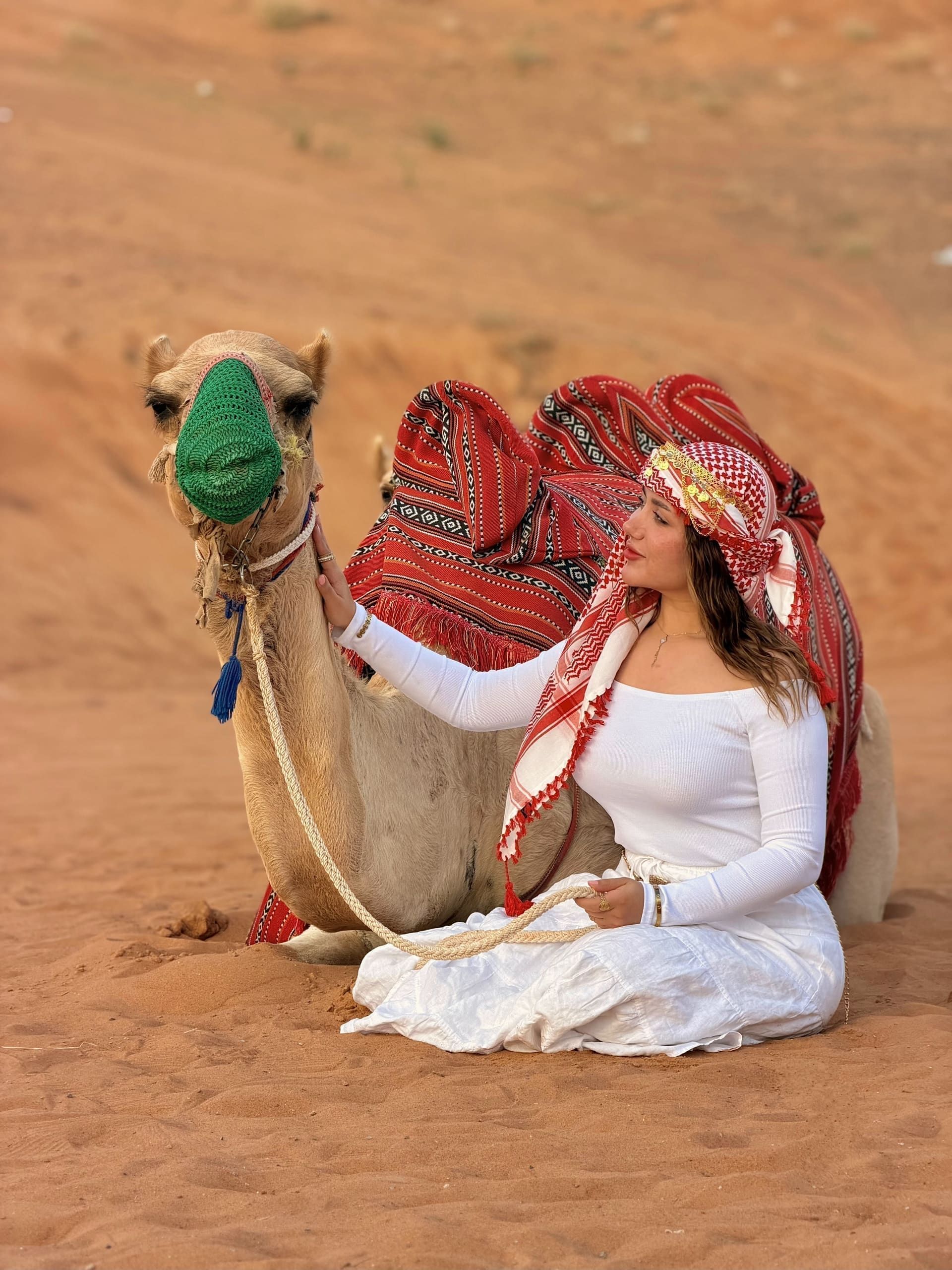
Low-vibration Land Cruiser cabin, sand-free seating at the dinner majlis, gentle dune profile on the perimeter line, falconry at the table, and the camel-walk lead-rope rhythm pregnant guests rebook for.


A second-trimester evening
How a guest at 22 weeks ran the evening on the perimeter route
Hannah travelled at 22 weeks from Manchester with her husband and a five-year-old. The booking moved through WhatsApp in twelve minutes: trimester disclosed, perimeter route confirmed in writing, sand-free chair logged at the dinner majlis, falconry slot extended to cover the camel-ride substitution. The Land Cruiser collected the family from Downtown at 4:45 PM; the perimeter drive took 55 minutes door-to-camp. Camel walk at the cameleer's lead, henna for both, BBQ at the chair option, falcon on the leather glove before the tanoura. Hannah's email arrived 36 hours later: 'No upcharge, no awkward conversation at the dune edge, no fuss.' That is the operating standard the pregnancy booking is meant to deliver.
- 22 weeks gestation second-trimester sweet spot, OB-GYN clearance letter on file
- AED 199 evening package perimeter substitution confirmed at the same price before payment
- Sand-free chair at the dinner majlis low-back chair on a textile mat, reserved for the pregnancy
- Falconry extension doubled-up slot covering the camel-ride alternative for a vertigo-sensitive guest
OB-GYN clearance, what your doctor will ask
Obstetrician clearance is a 10-minute conversation rather than a clinical hurdle. The doctor asks the same five questions across every Dubai-bound pregnant patient: gestational week at the time of travel, current pregnancy status (singleton or multiple), any flagged conditions on the antenatal record, current medications, and the activity profile of the planned booking. Bring the AED 199 evening package's inclusions list to the appointment; the perimeter substitution and the no-trot camel-ride policy answer most of the activity-side questions.
Carry the clearance letter on the day of pickup along with your hospital card. A standard clearance letter names the gestational week, confirms uncomplicated singleton status, flags any condition the safari should accommodate, and clears short overland travel inside a dated window. BookMySafari does not require the letter for first and second trimester bookings; it is recommended for third-trimester guests and mandatory from week 27 onwards on the fulfilment-partner policy. The letter remains a personal record and is not stored in the booking system after the trip.
Pregnancy booking · what changes
7 differences between a pregnancy-aware booking and a typical operator
Seven verifiable differences a pregnant guest checks on WhatsApp before payment. The pattern below separates a thought-through pregnancy booking from a tariff that pretends pregnancy is just a substitution.
Insurance and the emergency contact chain
Travel insurance for a Dubai desert safari during pregnancy splits into two policy questions. Question one: does the policy cover pregnancy-related medical events at the destination? Most international travel insurance covers standard maternal care up to week 36, with an exclusion for elective procedures and a higher excess on cross-border evacuations. Question two: does the policy include desert 4x4 activities as a hazardous-activity rider? The perimeter route is not classified as dune bashing under most policies; confirm the classification with your insurer in writing before travel.
A licensed paramedic vehicle covers the Lahbab corridor during operating hours. The nearest A&E is Rashid Hospital; Mediclinic City Hospital and the City Hospital maternity unit sit on the Dubai inner-city side. BookMySafari prints the camp dispatch number on every WhatsApp confirmation; late-trimester guests receive the additional DHA-licensed midwife contact. Share the obstetrician's name and the hospital card with your travel companion before pickup so the dispatch desk can route the maternal-care line directly if needed.
WhatsApp the editorial desk, share your trimester before paying
Send your trimester, gestational week, and any flagged condition on WhatsApp before payment. The editorial desk confirms the perimeter substitution in writing, logs the sand-free chair, prints the camp dispatch number on the confirmation, and adds the DHA-licensed midwife contact for late-trimester bookings. Bookings on this page are fulfilled by Velari Tourism L.L.C (DET #1491675), the Dubai-licensed tour operator behind this platform. The perimeter route is RTA-compliant and confirmed in writing before payment.
Message the booking desk on WhatsAppPregnancy bookings · real guests
Reviews from pregnant guests who tested the perimeter route
Reviews pulled from TripAdvisor, Google, and the BookMySafari WhatsApp inbox. Names abbreviated, country preserved. Each review covers a specific trimester and substitution scenario.
I was 22 weeks. BookMySafari confirmed the perimeter route in writing before I paid. The driver took me straight to the camp, the falcon demonstration came to our table, and the camel walked, never trotted. The whole experience felt thought-through.
First trimester, dreadful morning sickness, second time pregnant. The driver had ginger tablets and a cold ginger ale in a cooler bag. Tiny detail. Made the difference between an okay evening and a beautiful one.
My OB cleared me for short overland travel at 30 weeks. I asked for a midwife emergency contact and BookMySafari printed a DHA-licensed midwife number on the booking. No drama, just professional preparation.
Booked for my wife at 18 weeks. The chair option at the dinner majlis, the sand-free mat, the perimeter route, every request honoured without a price bump. Other operators quoted me AED 350 for the same substitution.
Doctor said no after my early bleed at 11 weeks. BookMySafari refunded inside 24 hours on the strength of the doctor note. Rebooked for after the baby. That kind of treatment earns repeat business.
Twin pregnancy, 19 weeks, my obstetrician was firm: no camel ride. The team swapped the camel for an extended falconry slot and a henna session. No fuss, no upcharge, no awkward conversation at the camp.

Pregnancy-friendly desert evenings
Trimester-aware booking. Answers in ten minutes.
WhatsApp the editorial desk with your trimester and gestational week. The perimeter route, the sand-free chair, the ginger tablets, and the camp dispatch number all confirmed before you pay.
Frequently asked questions about Dubai desert safari during pregnancy
-
Can I do a Dubai desert safari while pregnant?
A Dubai desert safari is safe during pregnancy on the no-dune-bashing AED 199 route across the first and second trimesters, provided your obstetrician clears short overland travel (RCOG). Third trimester from week 27 onwards requires individual clearance and discussion with your obstetrician; many operators decline bookings after week 32, a cutoff informed by RCOG guidance that most obstetric emergencies occur in the first and third trimester (RCOG). Dune bashing, quad biking, and camel trotting are off the table at every trimester. Camel walking, desert dinner, falconry, henna, and the live shows remain safe across all three trimesters. Share your trimester on WhatsApp before payment; BookMySafari confirms the perimeter substitution in writing at the same AED 199 price point. -
Which trimester is safest for a desert safari?
The second trimester (weeks 13 to 26) is the safest window for a Dubai desert safari. Morning sickness has typically resolved by week 13, the pregnancy is stable, energy levels recover, and the bump has not grown large enough to make seated travel uncomfortable. First trimester (weeks 1 to 12) is safe on the perimeter route but morning sickness, fatigue, and the higher miscarriage baseline (roughly 1 in 10 known pregnancies per ACOG, with RCOG citing 1 in 5 for no apparent reason (RCOG)) make it less comfortable. Third trimester (weeks 27 onwards) carries fatigue, swelling, heat sensitivity, and a higher risk of preterm labour, which is why most operators set a cutoff between week 32 and week 36; discuss the specific cutoff with your obstetrician. -
Will dune bashing harm my baby?
Dune bashing applies repeated 0.4 to 0.6 G vertical and lateral acceleration through the abdomen and pelvis for 20 to 25 minutes, based on operator route-monitoring data rather than a published clinical study. No randomised study links a single dune-bashing session to miscarriage, placental abruption, or preterm labour, because no ethics committee would approve the trial. The mechanism of harm is plausible enough that every Dubai obstetrician asked privately answers the same way: skip it. The editorial position at BookMySafari is identical. The no-dune-bashing perimeter route delivers the same camp, the same dinner, the same falconry, the same camel ride at a walk, at the same AED 199 price point. -
Can I ride a camel while pregnant?
A camel ride at walking pace is safe across all three trimesters for an uncomplicated pregnancy with OB-GYN clearance. Based on operator route data, the camel walks at roughly 4 km/h on a lead rope; the saddle pitches gently and the load on the lumbar spine sits below a city taxi ride. Trotting is not safe; ask the cameleer to keep the walk. Mount and dismount happen with the camel kneeling. Pregnancies with placenta previa (RCOG), recent bleeding, cervical insufficiency (RCOG), or multiple gestation (ACOG) skip the ride at no penalty; the team substitutes an extended falconry slot or a henna session at the same price point. -
What if I get motion sickness during pregnancy?
Pregnancy amplifies motion sickness through a combination of higher progesterone, slower gastric emptying, and altered vestibular sensitivity. Based on operator booking-feedback data rather than a published clinical study, roughly 7 in 10 motion-sensitive guests report worse symptoms during the first trimester than at baseline. BookMySafari stocks ginger tablets and electrolyte sachets in the Land Cruiser glovebox. The perimeter route by default skips the dune-bashing trigger. Scopolamine patches are contraindicated in pregnancy and are not used. Promethazine, doxylamine, and ondansetron are prescription antiemetics with pregnancy-class profiles your obstetrician reviews; discuss any antiemetic with your obstetrician before travel. Eat lightly two hours before pickup; stare at the horizon; sit in the second row, not the back. -
Does BookMySafari refund a pregnancy-related cancellation?
Yes. BookMySafari refunds in full or issues an open credit valid for 18 months when a pregnancy-related medical event prevents travel and a doctor note dated inside 30 days of the booking accompanies the cancellation. Covered events include hyperemesis, threatened miscarriage, placenta previa, vaginal bleeding, preeclampsia screening, cervical shortening, and any obstetric admission. The 50 percent cancellation fee in the standard terms is waived on production of the note. Email hi@bookmysafari.ae or send the note on WhatsApp; the refund clears inside 24 hours on the original payment method. -
Do I need a doctor's note to book?
A doctor's note is not required to book a Dubai desert safari while pregnant; it is required if the obstetrician has placed any travel restriction on the pregnancy and recommended at every stage past week 27. Carry the note on the day of pickup along with your hospital card and a one-line summary of your trimester, gestational week, and any flagged condition. BookMySafari prints the in-camp dispatch number and the DHA-licensed midwife contact on the WhatsApp confirmation for late-trimester bookings. The fulfilment partner (Velari Tourism L.L.C, DET license #1491675) accepts the booking on the basis of guest disclosure plus the perimeter-route substitution.