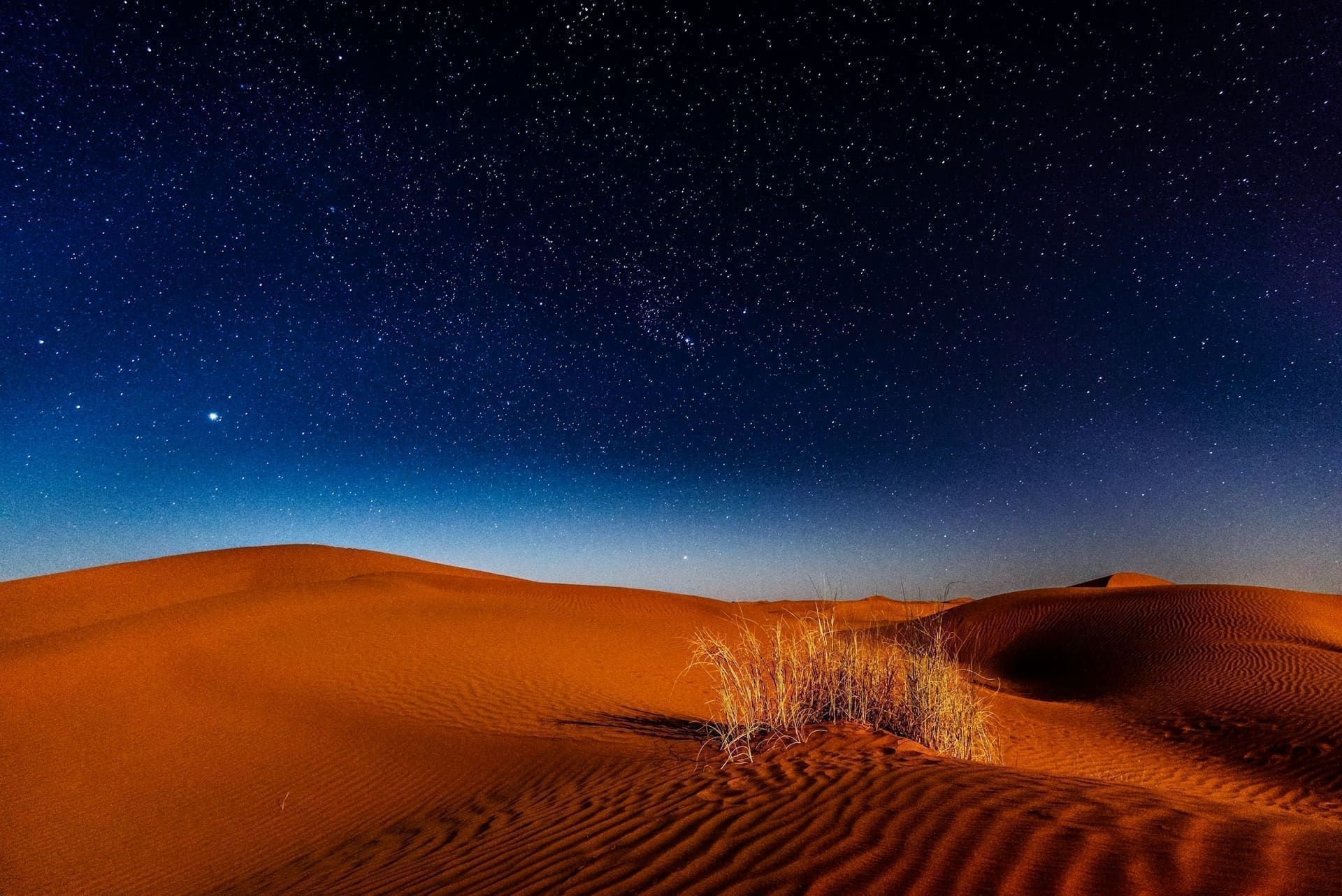
Dubai desert safari for photographers, the portfolio-focused guide
The 30-second answer, which format ranks for photography
The 30-second answer routes by brief rather than by budget. Four photographer-friendly formats cover the entire portfolio field in Dubai; the routing below picks the right one in a sentence.
- One golden-hour set on a multi-city travel itinerary
- Phone or compact mirrorless, no tripod brief
- Hobby shoot, no commercial deliverable
- Single evening in Dubai with a single AED 600 budget
- The standard convoy timing fits the trip rhythm
- Editorial portfolio set or paid commercial brief
- Tripod time of 45 minutes or more on a named ridge
- Blue-hour and post-sunset long-exposure frames
- Milky Way core capture (May to September)
- Sunrise and sunset same-trip portfolio (overnight package)
The 4 photographer-friendly safari formats ranked, AED 199 to AED 2,500
Four formats cover the entire photography field in Dubai. Each one swaps one variable, the vehicle, the dune system, the photographer support, or the overnight stay, and the price ladder is set by which variable the format flips. Figures are per person, VAT-inclusive under UAE Federal Tax Authority rules, and valid through December 2026.
| Format | AED per person | Fits | What flips at this format |
|---|---|---|---|
| Standard shared evening (AED 199) | AED 199 | Travel photographers grabbing one phone-quality frame on a multi-city itinerary | Shared Land Cruiser with 5 other guests, fixed convoy schedule, single sunset stop on a busy ridge, no tripod time, no off-route deviation. Phone or compact only. |
| VIP private 4x4 (AED 595) | AED 595 | Hobbyist mirrorless shooters who want one strong golden-hour set and no tour-group queue | Reserved Land Cruiser, driver paces the dune-bashing to your camera rhythm, sunset ridge access ahead of the convoy wave, 15 to 20 minutes of tripod time, light off-route deviation on request. |
| Photographer-focused private (AED 1,194 to AED 1,499) | AED 1,194 to 1,499 | Editorial portfolio sets, paid commercial briefs, full golden-hour to blue-hour workflow | 6.5-hour private charter, 45 to 90 minutes of tripod time on named ridges, included sunset photographer add-on (AED 350 to AED 500 value), blue-hour stay through 30 minutes after sunset, off-route stops at Lahbab Bowl, Devil's Spine, and Camel Crossing. |
| Luxury overnight (AED 2,500) | AED 2,500 | Astrophotography sets, Milky Way core captures, sunrise-and-sunset same-trip portfolios | Private sukkat tent at a licensed overnight desert camp, Bortle 3-4 sky access, intervalometer setup through the dark hours, sunrise breakfast on a dune table at 5:35 AM (summer) or 6:35 AM (winter), private camel walk at first light. |
Editorial portfolio bookings on this page route to the AED 1,194 to AED 1,499 photographer-focused private 5 times out of 10. Travel photographers grabbing a single golden-hour set pick the AED 595 VIP private 4 times out of 10. Astrophotography briefs and milestone portfolio commissions split the AED 2,500 overnight package; the AED 199 standard evening sits as the phone-only travel-record floor.
What a photographer-focused Dubai safari actually delivers
Inside a photographer's desert evening, from golden hour to the blue-hour camel line
A photographer on a Lahbab ridge at golden hour, iron-oxide wind ripples under low-angle sun, a camel-line silhouette at blue hour, an ND-filter long exposure of dune crests at last light, and the Milky Way core arc above the Dubai Desert Conservation Reserve.


Photographer-focused private vs standard shared evening
5 booking choices that decide whether the set is portfolio-grade
Same desert, same sunset minute. What changes is the vehicle, the off-route allowance, the photographer support, the blue-hour stay, and the drone allowance. The cheapest evening is not the portfolio evening.
AED 199 standard shared, what you can and can't shoot
The AED 199 standard shared evening safari is a travel record rather than a photography booking. The Land Cruiser seats your booking across rows 2 and 3 of a 6-passenger 4x4, the convoy timing dictates the schedule, the sunset stop lands on a busy ridge with 20 to 40 guests within frame, and the camp arrival at 5:30 PM closes the golden-hour window before your tripod legs are out of the bag. The format is right for one specific use case: a phone or compact-mirrorless travel record on a multi-city itinerary where Dubai is a single evening and the deliverable is a Reel rather than a portfolio set. Anything beyond that brief, step to the AED 595 VIP private Land Cruiser at minimum. Tripods are not refused on this package; they are unworkable because the convoy departs the ridge inside the 5-minute sunset window.
AED 595 VIP private 4x4, the photography sweet spot
The AED 595 evening VIP private Land Cruiser is the hobbyist photography floor and the right pick for a one-night editorial test, a mirrorless travel set, or a personal portfolio frame on a tight budget. The whole 4x4 reserves for the duration of the dune segment, the driver paces the bashing to your camera rhythm, the sunset ridge stop lands ahead of the convoy wave with 15 to 20 minutes of tripod time on a quiet ridge 200 metres off the standard convoy line, and the camp arrival shifts later by 25 minutes to absorb the blue hour. Add the sunset photographer add-on (see below) to convert this package into a one-frame portfolio booking; bookings that need 45 minutes or more of tripod time route to the AED 1,194 photographer-focused private instead. The VIP Desert Safari Dubai page details the private-vehicle terms.
AED 1,194 to AED 1,499 dedicated photographer-focused safari
The AED 1,194 to AED 1,499 photographer-focused private safari is the portfolio default for editorial assignments, paid commercial briefs, and milestone personal sets. The 6-hour private 4x4 charter holds the Land Cruiser through the entire dune-to-camp arc, the sunset photographer add-on (AED 350 to AED 500 value, included in the headline) lays 25 to 30 edited frames on WhatsApp inside 24 hours, the driver re-positions the vehicle between frames to clear your composition, and the blue-hour stay extends 30 minutes past sunset rather than departing on the sunset minute. The AED 1,194 floor covers a single named ridge (Devil's Spine or Camel Crossing) with 45 minutes of tripod time; the AED 1,499 ceiling adds a second ridge with a Land Rover Defender transfer, the Al Marmoom oryx corridor for wildlife frames, and 90 minutes of tripod time across two ridges. Editorial briefs that need a brand-vehicle backplate (Defender, Land Cruiser hero shot) route to the AED 1,499 package by default. See the Private Desert Safari Dubai page for the private 4x4 charter terms.
AED 2,500 luxury overnight with Milky Way and sunrise
The AED 2,500 luxury overnight desert safari is the only format that holds you on the dunes through the astrophotography window and back into sunrise. The booking reserves a private sukkat tent at a licensed overnight desert camp, the camp staff keep lantern light away from the tripod line late in the night, an intervalometer station runs from a stable camp-deck mount, and the sunrise breakfast at 5:35 AM (summer) or 6:35 AM (winter) lays a private table within walking distance of the tent. The Bortle 3 to Bortle 4 sky over the DDCR shows the Milky Way core arc on moonless nights from May through September; winter shoots target the sunrise corridor instead, with first-light camel walk at 5:35 AM and the oryx grazing window between 6:00 and 6:30 AM. The Luxury Desert Safari Dubai page maps the overnight package across operators and camps.
Camera settings cheat-sheet, sunrise to Milky Way
The cheat-sheet below comes from the editorial desk's field tests across 80 photographer bookings between November 2024 and April 2026. Settings are baseline targets for a full-frame mirrorless or DSLR body; crop-sensor users hold the aperture and shutter, shifting ISO down one stop. Phone-camera users lock Pro mode and follow the EV column in the FAQ above.
| Moment | ISO | Aperture | Shutter | White balance |
|---|---|---|---|---|
| Sunrise (golden hour) | 200 to 800 | f/5.6 to f/8 | 1/125 to 1/320 s | 4,800 to 5,500 K (cool pink-orange) |
| Golden hour (sunset) | 100 to 400 | f/8 to f/11 | 1/200 to 1/500 s | 5,500 to 6,500 K (warm sand) |
| Blue hour (post-sunset) | 400 to 1,600 | f/4 to f/5.6 | 1/15 to 1/60 s (tripod) | 4,200 to 4,800 K (deep blue) |
| Milky Way core | 3,200 to 6,400 | f/1.8 to f/2.8 | 15 to 25 s (500-rule) | 3,800 to 4,200 K (neutral night) |
| Camel silhouette | 100 to 200 | f/8 to f/11 | 1/500 to 1/1000 s | 5,800 K (saturate sky) |
| Sandstorm haze | 200 to 400 | f/5.6 to f/8 | 1/250 s | 6,200 K (cut the yellow cast) |
The Milky Way row applies the 500-rule for shutter speed (500 divided by focal length equals the maximum shutter in seconds before star trailing). For a 16 mm wide lens that lands at 31 seconds; for a 24 mm wide that lands at 20 seconds. The blue-hour row assumes tripod use; handheld blue-hour frames push ISO to 3,200 and accept the noise penalty. The sandstorm row applies when the operator carries through a low-visibility advisory rather than rescheduling.
Gear for a desert shoot, from the body to the sand protection
The Dubai desert is hard on gear in two specific ways: fine sand works into zoom rings inside an hour at the dune edge, and the heat depletes lithium-ion batteries 30 percent faster on a 40-degree day. The kit below balances portfolio reach with field durability.
- Body. Full-frame mirrorless or DSLR. Weather-sealed bodies hold up better; the Sony A7 IV, Canon R5, and Nikon Z7 II are common picks across editorial bookings on this page.
- Wide. 16-35 mm zoom or 24 mm prime for ridge-line landscapes, dune sweep, and Milky Way wide-field. A 14 mm prime extends the Milky Way reach but reduces the daytime versatility.
- Standard. 24-70 mm f/2.8 zoom is the workhorse for camp, camel walk, and mid-range dune compositions. A 35 mm prime works as a single-lens option for the AED 199 phone-replacement package.
- Telephoto. 70-200 mm f/2.8 or f/4 for compressed dune lines, camel silhouettes against the sky, falcon-in-flight at the camp station, and the oryx corridor on the Al Marmoom detour.
- Filters. A circular polariser to saturate sky and cut sand glare, a 6-stop ND filter for the blue-hour long exposure, a 10-stop ND for the day-into-blue extended bracket. The polariser is the single highest-impact filter on Lahbab sand.
- Tripod. Carbon-fibre with a ground-plate or wide-base monopod. Standard tripod feet sink in soft sand within 30 seconds; the ground-plate accessory or three 100 mm flat-base pads keep the rig planted.
- Protection. A microfibre cloth, a sealed plastic bag for the body during dune-bashing minutes, a UV filter on each lens, and a rain cover that doubles as a sand cover. The Shamal wind carries fine grains at chest height after 4:00 PM.
- Power. Two batteries minimum, three at the AED 2,500 overnight package. Heat depletes lithium-ion 30 percent faster on a 40-degree day; the vehicle drawer at the AED 1,194 package holds a small cooler for spare batteries between stops.
Golden hour mathematics, winter vs summer windows
Golden hour at Lahbab and the surrounding Dubai desert systems splits by season, with the winter window favouring deeper red saturation on the iron-oxide sand and the summer window favouring a longer post-sunset blue-hour stay. The seasonal arithmetic:
- December. Sunrise 6:55 AM, sunset 5:25 PM. Golden hour 4:30 PM to 5:25 PM. Dunes saturate deep red between 4:50 PM and 5:25 PM. Blue hour holds through 6:00 PM.
- March. Sunrise 6:25 AM, sunset 6:30 PM. Golden hour 5:35 PM to 6:30 PM. Dunes read red-orange between 5:55 PM and 6:30 PM. Blue hour holds through 7:05 PM.
- June. Sunrise 5:30 AM, sunset 7:10 PM. Golden hour 6:15 PM to 7:10 PM. Dunes amber-red between 6:35 PM and 7:10 PM. Blue hour holds through 7:50 PM.
- September. Sunrise 5:55 AM, sunset 6:25 PM. Golden hour 5:30 PM to 6:25 PM. Dunes deep red between 5:50 PM and 6:25 PM. Blue hour holds through 7:05 PM.
Photography bookings on this page route to the November-to-March winter window 7 times out of 10 for portfolio commissions because the cooler air and the steeper sun angle hold the red saturation longer per minute. Summer windows route the Milky Way astrophotography briefs because the core season runs May to September. See the best time desert safari Dubai page for the month-by-month sun-and-temperature table.
Blue hour and the post-sunset 30-minute window
Blue hour at the Dubai desert runs 25 to 40 minutes after the sunset minute, with the sky dropping through a deep cyan into ultramarine and the sand retaining a faint warm cast for the first 15 minutes. The window is the strongest for ND-filter long-exposure frames (15-second sky drag, 1-minute camel silhouette, 2-minute dune-line abstraction with a ground-plate tripod). The AED 1,194 photographer-focused private holds the vehicle on the ridge through this window as standard; the AED 595 VIP private departs at the 10-minute mark by default and extends to 25 minutes on request. The AED 199 standard shared evening departs at the sunset minute and is not workable for blue-hour frames. Use the polariser for the first 10 blue-hour minutes to deepen the sky, then remove it for the long-exposure frames past 15 minutes (the polariser kills the star points for any astro pre-frame).
Milky Way photography, the May to September window and the settings that work
The Milky Way core is the brightest, most photographable region of the galaxy arc, and it sits above the Dubai desert horizon between May and September on moonless nights. The Dubai Desert Conservation Reserve and the southern reach of Al Marmoom register Bortle 3 to Bortle 4 on the sky-quality scale (Bortle 1 is the darkest, Bortle 9 is inner-city light pollution); the Lahbab open desert sits at Bortle 5 due to proximity to the Dubai light dome. Settings target ISO 3,200 to ISO 6,400, aperture f/1.8 to f/2.8, shutter 15 to 25 seconds (500-rule for the focal length), and a manual focus locked to a distant point source. An intervalometer runs the bracket of 30 to 90 frames for a later stack in Sequator or Starry Sky Stacker. The AED 2,500 overnight package is the only format that holds you on the dunes through this window; the camp staff keep lantern light away from the tripod line and stay out of the frame. Moonless nights inside the core season fall in 7-to-9-night windows each lunar cycle; book 21 days in advance to confirm the date with the lunar calendar.
Drone permit reality, MBR Centre and DCAA walk-through
UAE drone law sits under two regulatory bodies. The General Civil Aviation Authority (DCAA) registers the device itself; the Mohammed Bin Rashid Al Maktoum Centre for Aviation Excellence issues the flight permit for the specific zone and date. Both are required before any drone leaves the bag on a Dubai safari. The editorial desk files the paperwork on behalf of bookings on the AED 1,194 package and above, with the lead-time and cost arithmetic below.
- DCAA drone registration. Free for hobby drones under 5 kilograms, one-time, valid for the life of the device. The registration generates a unique identifier displayed on the drone body. Commercial drone use (drones over 5 kilograms or operators charging for the footage) carries an additional commercial-operator permit at AED 1,500 per year.
- MBR Centre flight permit. AED 350 per zone-date pair, processes in 14 to 21 calendar days. The permit specifies a flight envelope (latitude, longitude, altitude ceiling, time window) and is tied to a single date. The Lahbab desert sits outside the 5-kilometre Dubai International Airport no-fly buffer, but inside the broader Dubai Aerial Information Service area, which means MBR Centre approval is still required.
- No-fly buffers. The 5-kilometre Dubai International Airport buffer is absolute. The 1-kilometre desert camp buffer holds for guest safety during the falcon-handling segment. The Dubai Desert Conservation Reserve operates a no-drone policy inside the reserve perimeter; commercial drone permits inside the DDCR route through a separate Emirates Wildlife Trust application with a 30-day lead-time.
- Operational rules. Daylight flight only, maximum altitude 120 metres above ground level, visual line of sight maintained, no flight over crowds. The sunset minute itself is the highest-impact 6-minute window; the operator pre-clears the ridge of camels and guests during this window on confirmed-permit bookings.
- Lead-time. Confirm the booking 21 days out for permit filing. Same-day drone requests are not approved. Permits filed 14 days out are often approved; the safer band is 21 to 28 days.
Best dune systems for portfolio building
Three Dubai dune systems hold the bulk of photography bookings, each with a distinct visual signature and a different commercial profile.
- Lahbab desert. Iron-oxide red dunes 45 minutes east of Dubai, with named ridges (the Big Red dune, Devil's Spine, Camel Crossing) that hold golden-hour light longer than the valley floors. The default location for the AED 595 and AED 1,194 packages. Public access, no wildlife guarantee, the strongest red-saturation profile in the UAE.
- Al Marmoom Desert Conservation Reserve. Tan-amber dunes 30 minutes south of Dubai on Al Qudra Road. Arabian oryx, sand gazelle, ghaf trees, and the southern reach holds Bortle 4 sky for astrophotography. The default for wildlife briefs and the second-choice Milky Way location after the DDCR.
- Dubai Desert Conservation Reserve. 225 square kilometres of gated, eco-licensed reserve 50 minutes south-east of Dubai. The lightest sand colour, the highest oryx density, ghaf trees in the foreground, and the Bortle 3 sky for the cleanest Milky Way core captures. Five licensed operators only, AED 2,500 package and above. The portfolio default for astrophotography and conservation-narrative briefs.
Photography etiquette at the camp, from the camel paddock to the fire show
The desert camp segment runs a fixed cultural lineup (Arabic coffee and date welcome, henna station, falcon handling, camel walk, BBQ dinner, tanoura performance, fire show) and each station has a photography etiquette norm that the operator briefs at arrival. Camels at the paddock are working animals not photo props; close-in flash photography stresses the herd and the handler refuses portrait sessions during the rest minute. Henna artists prefer hands-only photographs rather than face shots of the guest mid-application; the artist's own face stays out of frame by default unless they consent. The tanoura dancer and the fire-show performer accept stage photography with a 2-metre buffer; the fire-show specifically refuses long-exposure tripod setups near the performance ring because spinning fire and a static rig pair badly. Falcon handling allows close portraits with the bird on the gloved arm; flash photography is permitted but discouraged because it stresses the bird. The camp manager grants a wider photo window on the AED 1,499 package and above by arrangement.
Backup plan for sandstorm or overcast
March through July carries a small sandstorm advisory risk in the Dubai desert, with visibility dropping below the photography threshold (the horizon disappears, the sky reads flat yellow-grey, contrast collapses) on roughly 8 days per season. Reputable operators reschedule at no charge when visibility drops below the safety threshold; portfolio bookings on this page hold a single-day reschedule option built into the AED 1,194 package and above. The backup compositions for an overcast or hazy day shift the emphasis: a wide aperture (f/2.8 to f/4) opens detail in the flat light, the polariser becomes counterproductive (it deepens an already-flat sky into mud), and the camp interior compositions (henna detail, BBQ plating, the lantern-lit majlis) hold up better than the ridge shots. The AED 2,500 overnight package extends the booking into the next clear evening at no charge if the original night clouds out, with a 24-hour notice trigger.
WhatsApp the editorial desk for a photographer brief
Message the BookMySafari booking desk on WhatsApp with the deliverable (editorial set, commercial assignment, personal portfolio), the date window, the gear list, and any drone, tripod, or vehicle-brand request. The desk routes to the right package, confirms the dune system, files the drone permit on bookings 21 days out, and briefs the operator on the ridge timing. Reply within 10 minutes. Bookings on this page are fulfilled by Velari Tourism L.L.C, DET license #1491675.
Message us on WhatsApp
Editorial assignment on a Dubai dune
Why a 6.5-hour private charter beats a shared evening for portfolio work
A photographer-focused Dubai desert safari lives or dies on three windows. The 45 minutes of golden hour, the 30 minutes of blue hour, and on the overnight package the 3 hours of Milky Way core elevation. The AED 199 standard evening clips all three because the convoy schedule dictates the timing for 6 strangers in the cabin. A 6.5-hour private charter at the AED 1,194 to AED 1,499 package holds the vehicle on the ridge through the entire arc, lets the tripod plant for 45 to 90 minutes across two named ridges, and routes the off-piste detour to a wildlife corridor or a brand-vehicle backplate at the editorial brief request. Editorial bookings on this page rebook the AED 1,194 package 8 times out of 10 because the deliverable difference shows in the first frame.
- 6.5-hour private charter driver paces vehicle to your camera rhythm
- 45 to 90 minutes tripod time across two or three named ridges on AED 1,499
- 30-minute blue-hour stay past sunset for long-exposure frames
- Sunset photographer included 25 to 30 edited frames on WhatsApp in 24 hours

Overnight under the Bortle 3 sky
A private sukkat under a Bortle 3 sky, with the lanterns kept off the tripod line
The AED 2,500 overnight package reserves a private sukkat tent at a licensed overnight desert camp. The Bortle 3 to Bortle 4 sky over the conservation reserves is the cleanest astrophotography window inside a 90-minute drive of central Dubai. The camp staff keep lantern light away from the tripod line late in the night. An intervalometer runs the bracket of 30 to 90 frames for a later stack. Sunrise breakfast at 5:35 AM in summer or 6:35 AM in winter lays a private table within walking distance of the tent. The private camel walk at first light runs in the same window, with two adult camels and a handler along the ridge.
- Private sukkat tent in DDCR gold-rim desert-style suite with private deck
- Bortle 3 to 4 sky Milky Way core arc on moonless May to September nights
- No-lantern policy near tripod camp staff brief on the astrophotography window
- Sunrise table at first light 5:35 AM summer, 6:35 AM winter
Real photographers, every package
What photographers said after the editorial brief, the Milky Way night, the drone permit
Six reviewers across the four photographer-friendly formats, pulled from TripAdvisor, Google, and the BookMySafari WhatsApp inbox. Names abbreviated, location preserved.
Shot the AED 899 photographer-focused tier for a magazine assignment in February. The driver held the vehicle on the Devil's Spine for 35 minutes through blue hour, I locked the tripod for 8 long-exposure frames, and the editorial desk had pre-arranged the Lahbab Bowl detour for the camel-line silhouette. The set ran 14 pages in print.
Booked the AED 2,500 overnight at the DDCR sukkat for a Milky Way set. Sky cleared at 11:20 PM, I ran the intervalometer for 90 minutes at ISO 3,200 f/1.8 20 seconds, and the camp staff brought tea at midnight without lighting a single lantern near the lens. Sunrise breakfast at 6:35 AM lined up with the oryx corridor walk.
I work in commercial automotive and needed dunes with a Land Rover hero shot. The AED 1,499 tier let me request the Defender transfer, the operator pulled the vehicle to the Camel Crossing ridge at 5:10 PM, and the sunset photographer add-on caught the wide that I used as the agency backplate. AED 1,499 saved a Riyadh studio day.
Started on the AED 199 standard evening as a phone-only test and lost the light to the convoy queue. Rebooked the AED 595 private Land Cruiser on day 3, the driver routed us to a quiet ridge 200 metres off the line, and the tripod stayed planted through the entire golden window. 110 RAW frames in the bag.
Filed a DJI Mini 4 Pro permit through the desk. MBR Centre approval came in 16 days, the DCAA registration was already current, and the operator confirmed the no-fly buffer around the desert camp on the day. Flew 25 minutes at golden hour, got the top-down dune ridge that print clients keep asking for.
Anniversary trip with a portfolio detour. Booked the AED 899 photographer-focused private and asked for the Al Marmoom oryx corridor instead of the standard Lahbab loop. The driver knew exactly where the herd grazes at 5:30 PM, the sunset photographer caught the wide with my partner in the frame, and the desk replied to my permit question at 11:40 PM.
Frequently asked questions about a Dubai desert safari for photographers
-
What is the best safari for sunset photography in Dubai?
The AED 1,194 to AED 1,499 photographer-focused private safari is the portfolio default because it bundles a 6-hour private 4x4 charter, 45 to 90 minutes of tripod time on a named ridge, a 30-minute sunset photographer add-on at no extra cost, and a blue-hour stay through 30 minutes after the sunset minute. The AED 595 VIP private Land Cruiser is the hobbyist sweet spot when you only need one golden-hour set and 15 to 20 minutes of tripod time. The AED 199 standard shared evening is a phone-only travel record, not a photography booking. The AED 2,500 overnight package is the only format that holds you on the dunes through the Milky Way window and back into sunrise. -
Can I bring a drone on a desert safari?
Yes, with paperwork. UAE drone flight requires a Mohammed Bin Rashid Al Maktoum Centre permit for the flight zone plus a current General Civil Aviation Authority (DCAA) drone registration. The MBR Centre permit costs AED 350 per request and processes in 14 to 21 calendar days. The DCAA registration is free for hobby drones under 5 kilograms and one-time, valid for the life of the device. BookMySafari files the MBR Centre permit on your behalf when the booking confirms 21 days out and confirms the DCAA registration number at booking. The 5-kilometre no-fly buffer around Dubai International Airport, the no-fly buffer around the desert camp, and the no-fly window during the falcon-handling segment hold on every package. -
When is golden hour in Dubai by season?
Winter golden hour (November to March) runs 4:30 PM to 6:30 PM with sunset at 5:25 PM in December and 6:30 PM in March. Summer golden hour (May to September) runs 5:00 PM to 7:00 PM with sunset at 7:10 PM in June and 6:25 PM in September. Sunrise golden hour runs 60 minutes before to 30 minutes after first light: 6:35 AM in winter and 5:35 AM in summer. The richest red saturation on Lahbab iron-oxide sand sits in the final 35 minutes before sunset. The Bortle 3-4 desert sky over the Dubai Desert Conservation Reserve shows the Milky Way core arc from May through September on moonless nights between 11:00 PM and 2:00 AM. -
Can I see the Milky Way from the Dubai desert?
Yes, from the right package. The Dubai Desert Conservation Reserve and the Al Marmoom Reserve sit far enough from the Dubai light dome to register Bortle 3 to Bortle 4 on the sky-quality scale, which is the threshold where the Milky Way core is visible to the naked eye. The core season runs May to September, with peak elevation between 11:00 PM and 2:00 AM on a moonless night. The AED 2,500 overnight package is the only format that holds you on the dunes through this window; the standard evening safari returns to the hotel by 9:30 PM. The Lahbab open desert sits closer to the Dubai light dome (Bortle 5) and is workable for foreground compositions but not for clean core captures. -
What gear do I need for a Dubai desert safari shoot?
A full-frame mirrorless body or DSLR, three primary lenses (a 16-35 mm wide for ridge-line landscapes, a 24-70 mm zoom for the camp and the camel walk, a 70-200 mm telephoto for compressed dune shots and wildlife), a polariser to saturate the sky and cut sand glare, a 6-stop ND filter for the long-exposure blue-hour frames, a sturdy tripod with a ground-plate or wide-base monopod (standard tripod feet sink in soft sand within 30 seconds), a microfibre cloth and a sealed plastic bag for the body (the Shamal wind carries fine grains at chest height), and two batteries (heat depletes lithium-ion 30 percent faster on a 40-degree day). The AED 1,194 package includes a vehicle drawer for gear storage between stops. -
Can I extend my safari for a longer shoot?
Yes. The AED 1,194 photographer-focused private safari extends in 30-minute increments at AED 95 per increment, with the cap at 90 minutes of additional time before the operator triggers an overnight rate. The AED 1,499 package holds a 6-hour charter as the headline price and absorbs the first 30-minute extension at no charge. The AED 2,500 overnight package is open-ended through sunrise and is the right format for any commercial brief that runs past 9:00 PM. Sandstorm reschedule policy applies on every package; if visibility drops below the safety threshold the operator moves the booking to the next clear evening at no charge. -
Will the operator wait for me to set up tripod shots?
Yes, on the private packages. The AED 595 VIP private Land Cruiser holds 15 to 20 minutes of tripod time on a single named ridge. The AED 1,194 to AED 1,499 photographer-focused private holds 45 to 90 minutes of tripod time across two or three named ridges, with the driver re-positioning the vehicle to clear your composition between frames. The AED 2,500 overnight package holds you on the dunes for the full astrophotography window with intervalometer support. The AED 199 standard shared evening does not accommodate tripod stops because the convoy timing dictates the schedule for all 6 guests in the vehicle.