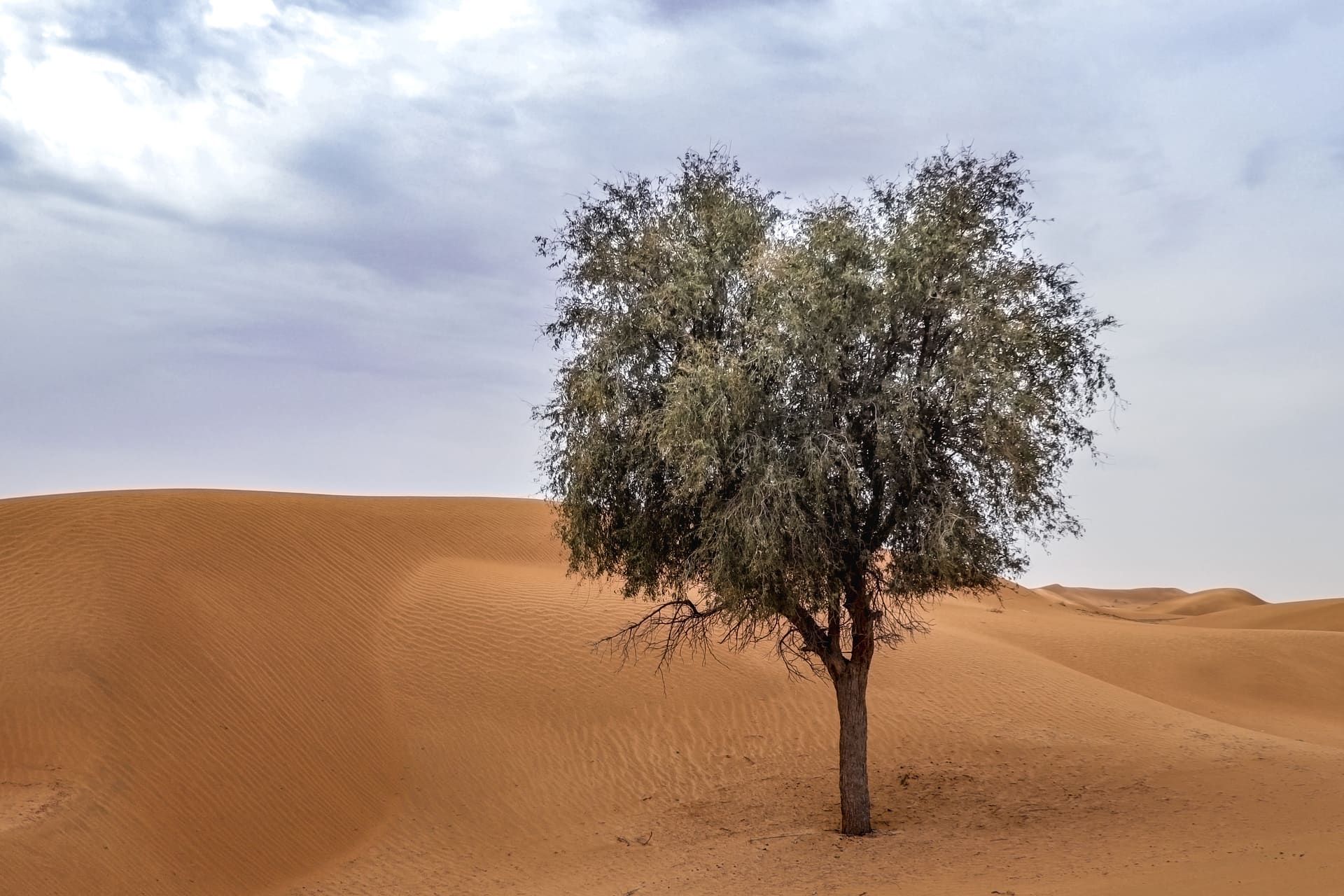
Plants of the UAE desert and when they flower
Most UAE plants live in the mountains, not on the dunes
More than half of the UAE's native plants grow in its mountain regions, which cover less than 5% of the country. That share comes from Feulner (2023), as cited by Sakkir and colleagues in a 2025 survey of Wadi Shuwaib published in the Biodiversity Data Journal.
The same paper gives the national total: 598 native plant species. It takes the figure from Allen and colleagues (2021), the authors of the UAE National Red List of Vascular Plants. UAE Flora, the online plant database of the Emirates, lists 622 native and 143 introduced plants in its 2023 update.
No plant is endemic to the UAE alone. Seven species are endemic to the mountains of the UAE and northern Oman, a finding from Feulner (2016) cited in the same 2025 paper.
On the sand desert itself, the plants include trees such as the deep-rooted ghaf and dune shrubs such as markh and abal. Many annuals, such as Senecio glaucus and Arnebia hispidissima, flower only after good rain. Four habitat terms to know:
- Sand dunes and sand plains: loose sand, from high dune ridges to flat sheets.
- Gravel plains: flat ground of stones and coarse grit.
- Wadis: valleys and stream beds shaped by running water.
- Sabkha: salt flat.
How desert plants survive in the UAE differs from one plant to the next. UAE Flora credits the ghaf with tolerating salt up to half seawater salinity, and markh can live on water already in the soil for four years without more rain.
The ghaf, the UAE's national tree since 2008
The ghaf (Prosopis cineraria, الغاف) became the UAE's national tree in 2008 because of its cultural and traditional significance, according to the Environment Agency Abu Dhabi (EAD). Its invasive relative is mesquite, and a table below sets the two side by side.
How the ghaf copes with salt and sand, and when it flowers
UAE Flora rates the ghaf highly salt tolerant, coping with water up to half the salinity of seawater, and says it holds dunes in place and can withstand periodic burial. It is a deep-rooted tree. The Red List gives its height as up to 10 metres and notes that its natural regeneration is limited. EAD gives an average lifespan of up to 120 years.
A ghaf flowers twice a year, from March to May and again from October to January, in yellow spikes 4 to 10 centimetres long. Both references give the same months. UAE Flora records the tree in five emirates: Abu Dhabi, Dubai, Sharjah, Ajman and Fujairah.
The ghaf as a national symbol
EAD dates the national-tree declaration to 2008. Dubai-Online gives 2009, a year later. Before the declaration, the Emirates Wildlife Society and WWF ran a "Save the Ghaf Tree" campaign that aimed to make the tree a national symbol, and Gulf News reported in February 2007 that it was due to end on 28 February.
In 2019 the ghaf was chosen as a symbol of the UAE's Year of Tolerance. EAD records that its leaves and pods were eaten and its branches fed to livestock. It was also used in traditional medicine, EAD notes. The tree's cultural side is covered in the guide to Bedouin culture in the UAE.
Ghaf or mesquite? Telling the native tree from the invader
Check the spines first. Mesquite (Prosopis juliflora, غويف) carries spiny stipules 5 to 10 millimetres long. The ghaf has slender grey branches with scattered prickles (UAE Flora). The same database lists mesquite as an introduced, invasive tree that competes with the native ghaf, and notes that it is allergenic.
| Feature | Ghaf (Prosopis cineraria) الغاف | Mesquite (Prosopis juliflora) غويف |
|---|---|---|
| Branches and spines | Slender grey branches with scattered prickles | Spiny stipules, 5 to 10 mm long |
| Flowers | Yellow spikes, 4 to 10 cm long | Greenish-yellow flowers |
| Pods | Slim, curved, reddish-brown, 5 to 15 cm | Straw-coloured, 6 to 20 cm |
| Origin | Native; Least Concern on the UAE National Red List | Introduced and invasive; allergenic |
Status and threats
The ghaf tree is assessed as Least Concern on the UAE National Red List, in its 2019 assessment: it is still common and persists in at least two protected areas. Camels strip its lower foliage. The Red List names overgrazing and urban expansion among past threats, along with reduced groundwater, and EAD's list adds urbanisation and infrastructure. EAD's page lists the global IUCN status as "Not evaluated".
Six more trees and large shrubs, wild and planted
Six more trees and large shrubs are worth knowing, and not all of them grow wild. Samr and sidr are trees of the gravel plains and wadis, and UAE Flora lists both as native. Arak is widely cultivated, and athel is planted along roads and near brackish water. The date palm is cultivated almost everywhere. Wild ghada, by UAE Flora's record, grows only in Abu Dhabi emirate. Heights here are UAE Flora's unless the Red List is named.
- Samr (Acacia tortilis, السمر). An umbrella-shaped native tree, 2 to 6 metres tall, of gravel plains and foothills, with white to pale-yellow flower heads in spring and pods twisted into one to three coils. Nationally it is Least Concern. The Red List flags grazing as a possible threat that still needs confirming.
- Sidr (Ziziphus spina-christi, السدر). A tree of gravel plains and wadi beds, also cultivated on the alluvial plains. It stands 2 to 8 metres tall, or up to 12 in the Red List, which notes that its origin needs confirming. It flowers twice a year, in spring and autumn. The fruit, orange-yellow to brown, measures 1 to 2 centimetres. Nationally it is Least Concern.
- Arak, the toothbrush tree (Salvadora persica, أراك). "Native in few places but widely cultivated" is how UAE Flora puts it, while the Red List questions its origin and notes that wild and planted stands are hard to tell apart. Sandy ground suits it, and it flowers in spring. UAE Flora notes that its roots are made into miswak toothbrushes, and that it tolerates salt up to seawater salinity.
- Athel (Tamarix aphylla, أثل). In UAE Flora it is native but "planted along roadsides or near brackish water or sabkha in the desert". It reaches up to 10 metres in the Red List, which rates it Data Deficient because it is unclear whether wild populations occur in the UAE. Flowering splits sharply: UAE Flora gives February to March, the Red List October to February.
- Date palm (Phoenix dactylifera, النخلة). Cultivated throughout the country at all elevations. Spontaneous growth is uncommon except in neglected or abandoned groves.
- Ghada, the white saxaul (Haloxylon persicum, غضا). A large shrub or small tree of sand sheets and dunes, with sand piled into hummocks round its base. It reaches 1 to 2.5 metres, or up to 3 in the Red List. Flowering is another split: October to December in UAE Flora, February to May in the Red List. It is Near Threatened nationally, with a significant part of its range inside Al Ghada Protected Area.
The shrubs and grasses that hold the sand in place
A handful of shrubs and grasses hold UAE dunes together. Markh is common in dune stabilisation, and abal can grow on large moving dunes, where few plants manage. Sizes and months in this section are UAE Flora's unless the Red List is named.
Markh, a leafless shrub with whip-like stems
Erect and many-branched, markh (Leptadenia pyrotechnica, المرخ) grows up to 3 metres tall, with drooping stems and few leaves or none. Its fibre is used for rope. Gazelles shelter in it by day, and so, in the Red List's account, do oryx. The root system lets markh live on water already in the soil for four years without more rain, a point the same account takes from Batanouny (2001).
Abal and arta, two Calligonum shrubs of the sand
Abal (Calligonum crinitum, أبل) is "one of few plants able to grow on large mobile dunes, even in the leeward slopes", in UAE Flora's words. It stands 50 to 180 centimetres tall, with grey-white coiled stems and bristly fruit 1 to 1.5 centimetres long, and flowers from January to March in both references. The Red List adds that it was overlooked in the UAE and confused with Calligonum comosum. It is also planted along roadsides, and nationally it is Least Concern.
Its close relative arta (Calligonum comosum, الأرطا), recorded by UAE Flora in Abu Dhabi and Sharjah, stands 50 to 150 centimetres tall and flowers from February to April. Calligonum polygonoides subsp. comosum is listed there as a synonym.
Arfaj, once common and now endangered
The UAE National Red List assesses arfaj (Rhanterium epapposum, عرفج) as Endangered, after a decline of more than 75% in 20 years. This dwarf shrub, up to 0.7 metres tall, grows on sand and gravel plains and on low dunes and hillsides. UAE Flora describes it as once a dominant species of the central desert and the alluvial plains, and it was locally common in the 1980s, by the Red List's record.
Overgrazing by camels and sheep has removed arfaj from many places. Flowering plants are often found only where grazing is kept out. Agricultural and urban development added to the decline. It flowers from April to June where it survives.
Thenda sedge and the two look-alike desert grasses
Thenda sedge (Cyperus conglomeratus, ثنده) is "very common in the UAE", says UAE Flora, and grows 30 to 70 centimetres tall. Its habitat in the Red List is low dunes and the lower slopes of megadunes, and it quickly colonises disturbed ground.
Two perennial grasses look alike out of flower. Thamam (Panicum turgidum, ثمام) and Pennisetum divisum carry the same Arabic name in UAE Flora, and the database gives a field test: peel back the leaf sheath and look at the point where the branching stem inserts. In Panicum turgidum it is glossy and swollen, with short hairs visible only under a lens. In Pennisetum divisum it is thin and hairless. The Red List files Pennisetum divisum under Cenchrus divisus, and both grasses appear in the flowering months table below.
Plants that cope with salt
Halophytes, the plants that tolerate salt, grow "along the coast, on offshore islands and in arid inland areas", in the words of the 2024 Year of Sustainability planting guide. UAE Flora credits both ghaf and Calligonum with tolerating salt up to half seawater salinity.
String of beads (Halopeplis perfoliata, خرز) is a succulent up to 40 centimetres tall of sand sheets and tidal salt marshes, flowering from July to December in both references. Harm (Zygophyllum qatarense, هرم; the Red List name is Tetraena qatarensis) is a succulent dwarf shrub of coastal sands and of sandy and gravelly plains. It flowers from September to March, and the Red List gives no months.
598
Native plant species recorded in the UAE
More than half of the UAE's native plants grow in the mountain regions, which cover less than 5% of the country (Feulner 2023, cited in Sakkir et al. 2025).
Wildflowers after winter rain, and what makes a good year
The desert flowers in the UAE that make the news are annuals that come up after good winter rain. A good year depends on that rain. The Red List entries for Senecio and Neurada also tie their growth to rain.
In a three-year study on one gravel plain in the eastern UAE, annuals flowered four to eight weeks after rain fell. That study, by Sakkir and colleagues in the Journal of Arid Land (2015), found a peak growing season from November to March. Flowering came mainly in November and December, and in February and March when rain allowed. Trees and shrubs flowered four to six weeks after rain. The timings hold for that one gravel plain.
In a wet year the dunes can change colour. A Gulf News report from March 2020 described Senecio glaucus covering dunes in yellow and Eremobium aegyptiacum spreading white flowers over the flatter dune bases, with Tribulus adding more yellow among the dunes. Dr Reza Khan, a Dubai wildlife specialist quoted in the report, expected most of that year's flowers to last until the end of March. The report named Arnebia hispidissima and Senecio glaucus among the dormant plants that come out only after good rain.
The plants to look for after rain:
- Senecio glaucus (زملوق), an annual with yellow to orange flowers, the one that turned the dunes yellow in 2020. It stands 10 to 25 centimetres tall in UAE Flora and up to 35 in the Red List, which describes it flowering and setting seed quickly after rain, then dying back.
- Eremobium aegyptiacum (غبيشه), an annual with white to pink or mauve petals. UAE Flora calls it "one of a few annuals that range into the northern part of the Empty Quarter".
- Tribulus (زهر), with five lemon-yellow petals about 1 centimetre long. UAE Flora lists it as Tribulus omanense. The Red List treats UAE records under Tribulus arabicus, rates that species Least Concern nationally, and gives a much longer flowering season.
- Neurada procumbens (سعدانه), another annual. Citing Perry (2008), the Red List notes that winter rain can decide whether its seeds germinate at all.
The months for all four are in the flowering months table below. Weather and trip timing by month sit in the guide to the best time of year for a desert safari.
The desert hyacinth, a root parasite with a yellowish spike
The desert hyacinth (Cistanche tubulosa, ذانون) is a parasite. A thin root runs several metres from its tuber to a host plant, usually one in the Chenopodiaceae or Zygophyllaceae families, according to UAE Flora. Its fleshy spike stands 20 to 60 centimetres tall, yellowish with purplish lobes, and appears from January to March. The Red List names the same host families and places the plant on the coast and on inland saline sand plains. One host is Cornulaca monacantha, a salt-tolerant dwarf shrub of coastal sand sheets, according to its Red List page. UAE Flora, which calls it djouri, records the shrub in Dubai.
Flowering months for 26 desert plants
The table sets the flowering months UAE Flora records for 26 desert plants beside those in the UAE National Red List. Both are shown where the two disagree, and many annuals flower only in years with enough rain.
| Plant | Arabic | UAE Flora months | Red List months | Recorded in Dubai emirate |
|---|---|---|---|---|
| Ghaf, Prosopis cineraria Perennial tree | الغاف | March to May and October to January | March to May and October to January | Yes |
| Samr, Acacia tortilis (Vachellia tortilis) Perennial tree | السمر | March to May | April to June | Yes |
| Sidr, Ziziphus spina-christi Perennial tree | السدر | September to December and March to May | September to November and March to May | Yes |
| Athel, Tamarix aphylla Perennial tree | أثل | February to March | October to February | Yes |
|
Ghada, Haloxylon persicum Perennial shrub or small tree | غضا | October to December | February to May | No (Abu Dhabi) |
|
Mesquite, Prosopis juliflora (introduced) Perennial tree | غويف | March to May, again in autumn | Not given | Yes |
| Markh, Leptadenia pyrotechnica Perennial shrub | المرخ | August to December and November to March | November to June | Yes |
| Abal, Calligonum crinitum Perennial shrub | أبل | January to March | January to March | Yes |
| Arta, Calligonum comosum Perennial shrub | الأرطا | February to April | Not given | No (Abu Dhabi, Sharjah) |
| Arfaj, Rhanterium epapposum Perennial dwarf shrub | عرفج | April to June | Not given (Endangered) | Yes |
| Dipterygium glaucum Perennial | صفراوي | April to June | Not given | Yes |
| Thenda sedge, Cyperus conglomeratus Perennial | ثنده | December to June | Not given | Yes |
| Thamam, Panicum turgidum Perennial grass | ثمام | February to June (variable) | February to June (variable) | Yes |
|
Bristle grass, Pennisetum divisum (Cenchrus divisus) Perennial grass | ثمام | February to April | December to May (variable) | Yes |
|
Desert hyacinth, Cistanche tubulosa Perennial, parasitic | ذانون | January to March | Not given | Yes |
| Senecio glaucus Annual | زملوق | February to March | February to April | Yes |
| Eremobium aegyptiacum Annual | غبيشه | February to April | February to April | Yes |
| Arabian primrose, Arnebia hispidissima Annual | كحيلة | December to April | December to May | Yes |
| Neurada procumbens Annual | سعدانه | January to May | February to May | No (Abu Dhabi, Sharjah, Ras Al Khaimah) |
| Wall-rocket, Diplotaxis harra Annual or perennial | حاره | February to June | February to May | Yes |
|
Caltrop, Tribulus omanense (T. arabicus in the Red List) Perennial | زهر | March to June | February to September | Yes |
|
Harm, Zygophyllum qatarense (Tetraena qatarensis) Perennial succulent | هرم | September to March | Not given | Yes |
|
String of beads, Halopeplis perfoliata Perennial succulent | خرز | July to December | July to December | Yes |
| Sodom's apple, Calotropis procera Perennial shrub | عشار | March to September | Not given | Yes |
| Rhazya stricta Perennial shrub | حرمل | February to June | All year, peak January to May | Yes |
| Desert squash, Citrullus colocynthis Perennial creeper | حنظل | May to October | November to April | Yes |
The UAE Flora months are that database's own wording. The Red List months come from the 2019 national assessments, which mostly cite Jongbloed and colleagues (2003). The two references agree on 5 of the 26 plants and differ on 13. The Red List gives no flowering months for the other 8 plants. Read both spans as a guide where they differ: flowering also moves with rain from year to year, as the 2015 gravel-plain study found. "Recorded in Dubai emirate" is a UAE Flora distribution record and says nothing about any safari route.
Which animals depend on which plants
Gazelles, oryx, the houbara bustard and butterflies such as the Mediterranean Pierrot and the Plain Tiger use particular desert plants for food or shelter. UAE Flora and the national Red List record these links.
| Plant | What the plant gives | Source |
|---|---|---|
| Markh, Leptadenia pyrotechnica | Daytime shelter for gazelles, and for oryx in the Red List text | UAE Flora; Red List |
| Dipterygium glaucum | A preferred food of the houbara bustard | UAE Flora |
| Thamam, Panicum turgidum | Reported to be an important food plant for the black-crowned finch lark | UAE Flora |
| Ghada, Haloxylon persicum | Sand hummocks at its base that rodents and snakes burrow into, scorpions too | UAE Flora |
| Calligonum, the genus of abal and arta | Food for the caterpillars of the striped hawk-moth and the lackey moth | UAE Flora; Red List |
| Sidr, Ziziphus spina-christi | Food for the caterpillars of the Mediterranean Pierrot butterfly | UAE Flora; Red List |
| Desert squash, Citrullus colocynthis | A food plant for desert rodents | UAE Flora; Red List |
| Rhazya stricta | Flowers visited by adult Plain Tiger butterflies | Red List, citing Gillett (1998) |
| Diplotaxis harra | Thought to be a food plant for a subspecies of the Desert Blacktip butterfly | Red List, citing Gillett (1997) |
Honey bees belong on the list too: UAE Flora marks ghaf, samr, sidr and markh among the nectar plants for honey bees. The animals themselves have their own guide, the wildlife of the UAE desert.
Four poisonous plants to leave alone
Sodom's apple (Calotropis procera, عشار) is one plant to keep your hands off: UAE Flora warns that its milky latex is a deadly poison that can cause blindness.
- Sodom's apple (Calotropis procera). A shrub 1 to 3 metres tall in UAE Flora, or 2.5 to 4 metres and up to 6 metres in the Red List. The Red List notes that its native status is disputed.
- Rhazya stricta (حرمل). Poisonous and not grazed, so it dominates heavily grazed ground. The Red List reads its presence as a sign of overgrazing.
- Desert squash (Citrullus colocynthis, حنظل). A creeper with round fruit, listed as poisonous.
- Senecio glaucus (زملوق). The yellow annual of wet winters, listed as toxic to animals and humans.
These four are not the only ones: UAE Flora also marks Iphiona aucheri as extremely poisonous. Do not pick or taste wild plants, and keep children away from the round desert-squash fruit.
Where wild plants grow in and around Dubai
Inside Dubai, the Dubai Desert Conservation Reserve holds ghaf woodland and 72 plant species. In March 2020, Gulf News reported blooms around Hatta and in the Jebel Jais foothills after heavy winter rain.
A September 2026 report from the Emirates News Agency (WAM) puts the reserve at 225 square kilometres, about 5% of the emirate. In all, 562 species live there. Its habitats run from sand dunes and gravel plains to ghaf woodland.
The Al Marmoom Desert Reserve, south of Dubai, has its own guide.
Dr Reza Khan, the Dubai wildlife specialist quoted in the same Gulf News report, said that the view from places such as Masafi, Dibba, Khor Fakkan and Wadi Shees felt like spring gardens in Europe. He also said the heaviest rain had possibly fallen in the Hajar hills.
Can you pick desert flowers? What UAE law says
Photograph desert flowers rather than picking them. Under UAE Federal Law No. 24 of 1999, it is "prohibited to cut wild plants, uproot them or collect them illegally", as the Environment Agency Abu Dhabi (EAD) summarises the law.
EAD also says it takes "strict measures on any felling of local trees with special regard for the Ghaf trees". EAD's page describes Abu Dhabi's own measures. It gives no penalty amount.
The same federal law underpins the Ministry of Climate Change and Environment's controls on invasive plants, according to the 2024 Year of Sustainability planting guide. Keep to existing tracks; the wider rules for desert trips are set out in desert safari permits and regulations.
Ask the desk about booking a safari
Send the desk the day that suits you. Bookings made through BookMySafari, a booking platform, are fulfilled by Velari Tourism L.L.C, DET license #1491675.
Message us on WhatsAppFrequently asked questions about plants of the UAE desert
-
What are the most common UAE desert plants?
UAE Flora calls thenda sedge (Cyperus conglomeratus) "very common in the UAE", and the national Red List places it on low dunes and the lower slopes of megadunes. On the sand, UAE Flora describes markh (Leptadenia pyrotechnica) as common in dune stabilisation and abal (Calligonum crinitum) as one of the few plants able to grow on large mobile dunes. The ghaf (Prosopis cineraria), the national tree, grows on the sand plains. Many annual wildflowers join them only after good winter rain. -
Why is the ghaf tree the national tree of the UAE?
The ghaf was declared the UAE's national tree in 2008 for its cultural and traditional significance, according to the Environment Agency Abu Dhabi (EAD). EAD records that its leaves and pods were eaten, that its branches were fed to livestock, and that it was used in traditional medicine. The tree is also built for the desert. It is deep-rooted, and UAE Flora records that it tolerates water up to half the salinity of seawater and holds dunes in place. In 2019 it was chosen as a symbol of the UAE's Year of Tolerance. -
Is it illegal to cut down a ghaf tree in the UAE?
Under UAE Federal Law No. 24 of 1999, it is "prohibited to cut wild plants, uproot them or collect them illegally", according to the Environment Agency Abu Dhabi (EAD). EAD adds that it takes strict measures on any felling of local trees, with special regard for the ghaf tree. EAD's page describes Abu Dhabi's own measures and gives no penalty amount. -
When do desert flowers in the UAE bloom?
The desert wildflowers that make the news bloom after good winter rain, so the timing shifts from year to year. Two dune annuals among them, Senecio glaucus and Eremobium aegyptiacum, flower between February and April in UAE Flora and the national Red List. A three-year study on one gravel plain in the eastern UAE found flowering mainly in November and December, and in February and March when rain allowed (Sakkir and colleagues, 2015). After the heavy winter rain reported in March 2020, Dr Reza Khan, a Dubai wildlife specialist quoted by Gulf News, expected most of the flowers to last until the end of March. -
What is the desert hyacinth?
The desert hyacinth is Cistanche tubulosa, a fleshy root parasite 20 to 60 centimetres tall. A thin root runs several metres from its tuber to a host plant, usually in the Chenopodiaceae or Zygophyllaceae families. Its yellowish spike with purplish lobes appears from January to March, according to UAE Flora, which records it in Abu Dhabi, Dubai, Sharjah and Ajman. It is Least Concern on the UAE National Red List. -
Which desert plants in the UAE are poisonous?
Sodom's apple (Calotropis procera) is one to avoid touching: UAE Flora warns that its milky latex is a deadly poison that can cause blindness. Rhazya stricta is poisonous and not grazed, so it dominates heavily grazed ground. Desert squash (Citrullus colocynthis), a creeper with round fruit, is poisonous too, and the yellow annual Senecio glaucus is toxic to animals and humans. UAE Flora marks others as well, such as Iphiona aucheri, which it calls extremely poisonous. Do not pick or taste wild plants, and keep children away from desert-squash fruit. -
How can you tell a ghaf tree from a mesquite?
Check the spines first. Mesquite (Prosopis juliflora) carries spiny stipules 5 to 10 millimetres long, while a ghaf tree has slender grey branches with scattered prickles. The pods settle it: ghaf pods are slim and reddish-brown with a curve, 5 to 15 centimetres long, and mesquite pods are straw-coloured, 6 to 20 centimetres long. Ghaf flowers are yellow spikes, and mesquite flowers are greenish-yellow. The ghaf is native. UAE Flora lists mesquite as an introduced invader that competes with the native ghaf and is allergenic. -
How many plant species grow in the Dubai Desert Conservation Reserve?
The Dubai Desert Conservation Reserve has 72 plant species among its 562 species, according to a report from the Emirates News Agency (WAM) published in September 2026. The reserve covers 225 square kilometres, about 5% of the emirate of Dubai, and its habitats run from sand dunes and gravel plains to ghaf woodland. For scale, the UAE as a whole has 598 recorded native plant species.
