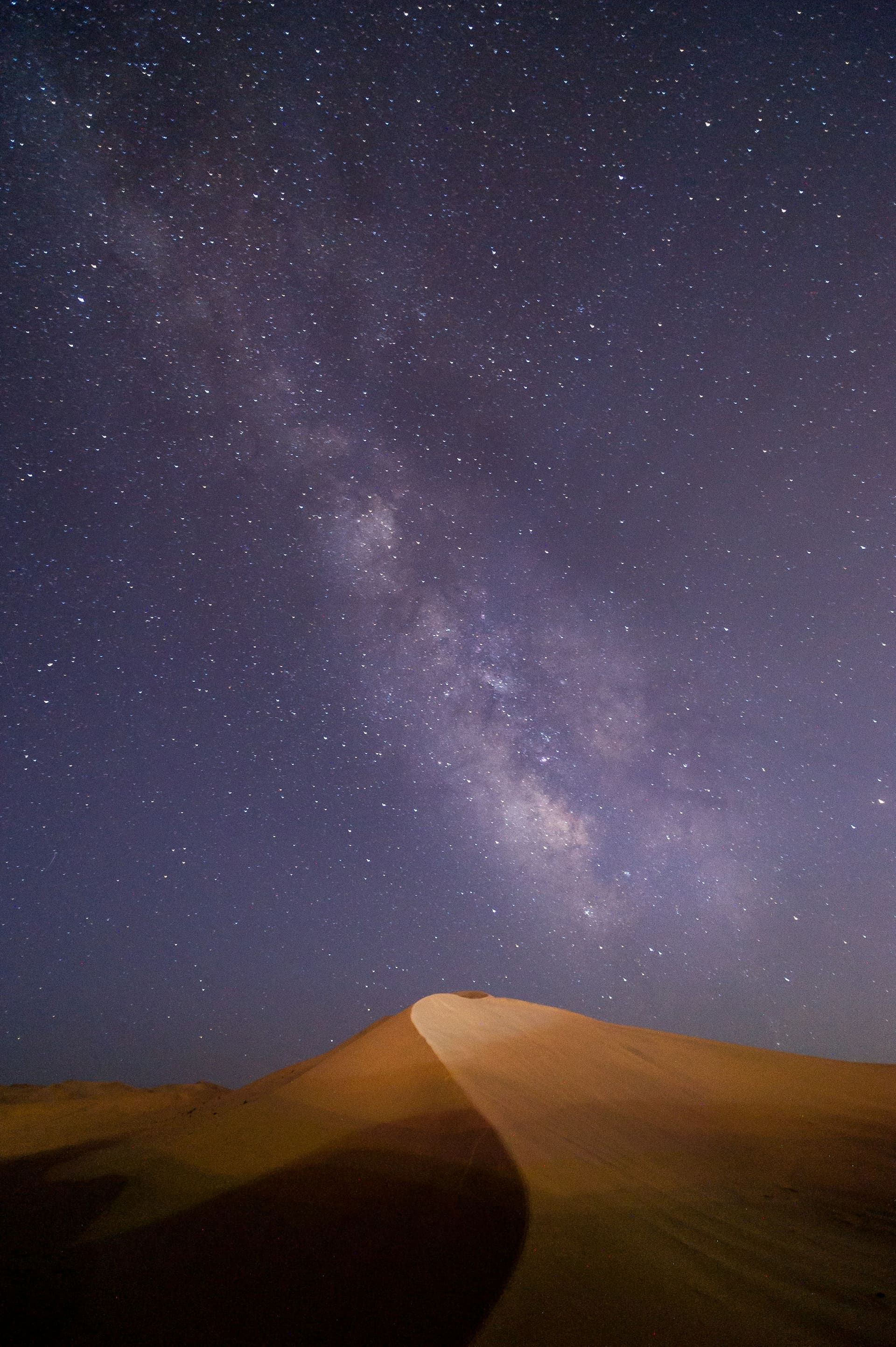
Stargazing in the Dubai desert, from new moons to meteor nights
What the Dubai desert shows that the city hides
The Dubai desert shows the faint stars that the city glow hides, and on the right night the Milky Way as well. In town the glow is strong enough that 99% of UAE residents cannot see the Milky Way from home. That figure comes from the 2016 world atlas of night sky brightness, which ranks the UAE among the most light-polluted countries.
The atlas, published in Science Advances by Fabio Falchi and colleagues, goes further. It finds that 93% of UAE residents live under skies so bright that the eye cannot fully adapt to the dark.
The change comes in stages once you leave the city. Fainter stars fill the gaps first. On a moonless night in the right season the band of the Milky Way follows, and meteors that a city sky swallows become easy to track. None of it is instant, because your eyes go on adjusting to the dark for a good while after you arrive.
How much you see depends on your distance from the glow and on the moon. The clock adds a third factor, since the sky over Dubai stays faintly lit for more than an hour after sunset.
Why the city glow hides the stars
Artificial light scatters in the air above a city and brightens the whole sky, which drowns faint stars long before it hides the bright ones.
The 2016 atlas measures that added brightness in microcandela per square metre (μcd/m²), and its thresholds explain what disappears first. Above about 688 μcd/m², the Milky Way is lost from view. Above 3,000 μcd/m², the sky stays too bright for the eye to adapt fully, and that is the band 93% of UAE residents live in.
The Bortle scale, in brief
Amateur astronomers often rate a sky on the Bortle scale, which John E. Bortle published in Sky & Telescope in February 2001. It runs in nine classes, from class 1, an excellent dark site, to class 9, an inner-city sky. This guide does not assign a Bortle class to any site.
How far out the glow fades
At least 35 km from city lights is the Dubai Astronomy Group's rule of thumb, as Khaleej Times reported it in May 2025. Next door, Abu Dhabi brought in a Dark Sky Policy covering lighting in 2024.
Moon dates that decide a dark night
Pick a night close to a new moon. At new moon the moon rises and sets with the sun, so it is absent from the night sky, while a full moon rises around sunset and lights the sky until sunrise.
The cycle repeats every 29.5 days, and the nights either side of new moon split the dark between them. A few days after new moon, a thin crescent sets in the evening and leaves the late night dark. A few days before it, the crescent rises before dawn and the evening is the dark part. The meteor calendar further down shows both cases. The Geminid night falls four days after the December new moon, and the Quadrantid night four days before the January one.
Every date below is in Dubai time (UTC+4). We converted each row from NASA's catalogue of moon phases, compiled by Fred Espenak at the Goddard Space Flight Center, which lists the phases in Universal Time (UT). That moves six dates a day later in Dubai than in the catalogue: the new moons of 8 January, 7 April and 28 December 2027, and the full moons of 21 February, 21 April and 16 September 2027.
| Moon cycle | New moon (Dubai time) | Full moon (Dubai time) |
|---|---|---|
| Nov 2026 | Mon 9 Nov 2026, 11:02 AM | Tue 24 Nov 2026, 6:53 PM |
| Dec 2026 | Wed 9 Dec 2026, 4:52 AM | Thu 24 Dec 2026, 5:28 AM |
| Jan 2027 | Fri 8 Jan 2027, 12:24 AM (UT date: 7 Jan) | Fri 22 Jan 2027, 4:17 PM |
| Feb 2027 | Sat 6 Feb 2027, 7:56 PM | Sun 21 Feb 2027, 3:23 AM (UT date: 20 Feb) |
| Mar 2027 | Mon 8 Mar 2027, 1:29 PM | Mon 22 Mar 2027, 2:44 PM |
| Apr 2027 | Wed 7 Apr 2027, 3:51 AM (UT date: 6 Apr) | Wed 21 Apr 2027, 2:27 AM (UT date: 20 Apr) |
| May 2027 | Thu 6 May 2027, 2:58 PM | Thu 20 May 2027, 2:59 PM |
| Jun 2027 | Fri 4 Jun 2027, 11:40 PM | Sat 19 Jun 2027, 4:44 AM |
| Jul 2027 | Sun 4 Jul 2027, 7:02 AM | Sun 18 Jul 2027, 7:45 PM |
| Aug 2027 | Mon 2 Aug 2027, 2:05 PM (total solar eclipse elsewhere) | Tue 17 Aug 2027, 11:29 AM |
| Aug-Sep 2027 | Tue 31 Aug 2027, 9:41 PM | Thu 16 Sep 2027, 3:04 AM (UT date: 15 Sep) |
| Sep-Oct 2027 | Thu 30 Sep 2027, 6:36 AM | Fri 15 Oct 2027, 5:47 PM |
| Oct-Nov 2027 | Fri 29 Oct 2027, 5:36 PM | Sun 14 Nov 2027, 7:26 AM |
| Nov-Dec 2027 | Sun 28 Nov 2027, 7:24 AM | Mon 13 Dec 2027, 8:09 PM |
| Dec 2027 | Tue 28 Dec 2027, 12:12 AM (UT date: 27 Dec) | Next is in January 2028 |
A date near new moon starts the plan. Fog and dust hide stars whatever the moon is doing, so the checklist below adds a forecast check.
Meteor showers to plan around in 2026 and 2027
The Geminids, on the night of 13 to 14 December 2026, are the shower to plan around. NASA calls them one of the best and most reliable annual meteor showers, and the American Meteor Society puts the moon at 15% lit that night. In Dubai the crescent sets around 9:15 PM on 13 December and leaves the rest of the night dark.
A meteor shower is Earth passing through debris shed by a comet or, less often, an asteroid. Each shower has an activity period of days or weeks and one peak night. The table takes both from the American Meteor Society's 2026/2027 calendar, with its figure for how much of the moon is lit on each peak night. The two Dubai columns are our own work. One gives the time the moon rises or sets in Dubai that night. The other gives the moon-free dark window, meaning the hours after astronomical dusk and before astronomical dawn with the moon below the horizon.
| Shower | Active | Peak night | Moon lit on peak night (AMS) | Moon in Dubai | Moon-free full dark in Dubai | Notes |
|---|---|---|---|---|---|---|
| Leonids | 6-30 Nov 2026 | 16-17 Nov 2026 | 39%, waxing crescent | Sets about 11:20 PM on 16 Nov | About 11:20 PM to 5:20 AM | NASA: best from about midnight; fewer than 3 an hour under dark skies |
| Geminids | 4-17 Dec 2026 | 13-14 Dec 2026 | 15%, waxing crescent | Sets about 9:15 PM on 13 Dec (about 10:05 PM on 14 Dec) | About 9:15 PM to 5:35 AM | AMS: Gemini well placed from 10 PM. NASA: 40 to 50 an hour under dark skies |
| Ursids | 17-26 Dec 2026 | 21-22 Dec 2026 | 89%, waxing gibbous | Sets about 5:00 AM on 22 Dec | About 5:00 to 5:40 AM only | AMS: 5 to 10 an hour in a normal year |
| Quadrantids | 28 Dec 2026 to 12 Jan 2027 | 3-4 Jan 2027 | 18%, waning crescent | Rises about 4:10 AM on 4 Jan | About 7:05 PM to 4:10 AM | AMS: peak about 03:30 UT on 4 Jan, which is 7:30 AM in Dubai, after sunrise |
| Lyrids | 14-30 Apr 2027 | 21-22 Apr 2027 | 100%, full moon | Rises about 7:25 PM on 21 Apr, sets about 6:25 AM on 22 Apr | None | Poor year |
| Eta Aquariids | 19 Apr to 28 May 2027 | 5-6 May 2027 | 2%, waning crescent | Sets about 6:00 PM on 5 May, rises about 5:10 AM on 6 May | About 8:15 PM to 4:15 AM | AMS: 10 to 30 an hour from the equator northward, best before dawn |
| Perseids | 17 Jul to 24 Aug 2027 | 12-13 Aug 2027 | 79%, waxing gibbous | Sets about 2:10 AM on 13 Aug | About 2:10 to 4:30 AM | AMS: 30 to 50 an hour from rural sites at maximum |
Hourly rates here are the sources' own figures, each for the conditions it names. Under a real sky, from any one place, you often see fewer, and nobody, BookMySafari included, can promise a count for a given night. Moon, sunset, twilight and sunrise times on this page are our own calculation for Dubai, rounded to the nearest 5 minutes. We checked the moon, sunset and sunrise times against MET Norway's sunrise service, and the twilight times against sunrise-sunset.org.
The Leonids in November
The Leonids, from debris left by comet 55P/Tempel-Tuttle, peak on the night of 16 to 17 November 2026. They are fast, at about 71 km per second, and most years they are thin. NASA's figure under dark skies is fewer than 3 meteors an hour. The moon, 39% lit on the American Meteor Society's figure, sets about 11:20 PM on 16 November, shortly before midnight, the hour from which the Leonids are best watched. Storms, which take at least 1,000 meteors an hour, are rare. The last came in 2002, and the society expects none before 2099.
The Geminids on 13 and 14 December
Under dark skies NASA's figure is 40 to 50 Geminids an hour, rising to 120 at the peak under perfect conditions. Their parent is unusual for a shower. It is the asteroid 3200 Phaethon, where most showers come from comets. In Dubai the best window opens at moonset on 13 December and lasts until full darkness ends at about 5:35 AM on 14 December. Gemini, the constellation the meteors seem to fly from, is well placed from 10 PM on the AMS calendar, and activity can start around 9 or 10 PM, about when the moon goes down. Skip the following evening if you can, because on 14 December the moon stays up until about 10:05 PM.
The Ursids and Quadrantids around New Year
The Ursids peak on 21 to 22 December under an 89% moon on the AMS figure. It stays up until about 5:00 AM, which leaves only about 40 minutes of moon-free dark before dawn. The AMS gives the Ursids 5 to 10 an hour in a normal year.
The Quadrantids follow on the night of 3 to 4 January 2027, from the asteroid 2003 EH1, and their numbers depend on whose figure you read. NASA gives 60 to 200 an hour at the peak under perfect conditions but fewer than 10 under dark skies, while the AMS expects about 25. The peak lasts only a few hours because Earth crosses a thin stream. The AMS times it for about 03:30 UT on 4 January 2027, which is 7:30 AM in Dubai, after the 7:05 AM sunrise. From Dubai, watch the small hours of 4 January, before the thin crescent rises at about 4:10 AM.
Spring and summer showers
Three more peaks fall before the end of August 2027. The Lyrids, on 21 to 22 April, meet a full moon that is up all night, so 2027 is a poor year for them. The Eta Aquariids get the opposite deal on 5 to 6 May, with a moon the AMS rates only 2% lit and below the horizon for the whole dark night. They are best before dawn, at 10 to 30 an hour from the equator northward. The Perseids peak on 12 to 13 August under a 79% moon that sets about 2:10 AM. That leaves a little over two dark hours before dawn for a shower the AMS puts at 30 to 50 an hour from rural sites. In 2026 the Perseid peak fell at new moon, Gulf News reported, which made that year the better one for them.
How long after sunset the sky turns fully dark
In December the sky over Dubai reaches full darkness about 80 minutes after sunset, near 6:50 PM; in June it takes about 90 minutes, until about 8:40 PM.
That gap is twilight, and its last stage, astronomical twilight, ends only when the sun is 18 degrees below the horizon. The table gives the arithmetic for seven nights that matter on this page: five meteor peaks, Mars at opposition and the June solstice.
| Night | Sunset | Fully dark from | Fully dark until | Sunrise |
|---|---|---|---|---|
| 16-17 Nov 2026 (Leonids) | 5:30 PM | 6:50 PM | 5:20 AM | 6:35 AM |
| 13-14 Dec 2026 (Geminids) | 5:30 PM | 6:50 PM | 5:35 AM | 6:55 AM |
| 3-4 Jan 2027 (Quadrantids) | 5:40 PM | 7:05 PM | 5:45 AM | 7:05 AM |
| 19-20 Feb 2027 (Mars at opposition) | 6:15 PM | 7:30 PM | 5:35 AM | 6:50 AM |
| 5-6 May 2027 (Eta Aquariids) | 6:50 PM | 8:15 PM | 4:15 AM | 5:40 AM |
| 21-22 Jun 2027 (June solstice) | 7:10 PM | 8:40 PM | 4:00 AM | 5:30 AM |
| 12-13 Aug 2027 (Perseids) | 6:55 PM | 8:20 PM | 4:30 AM | 5:50 AM |
Here is the Geminid night, hour by hour.
- 5:30 PM Sunset. Twilight begins and the western sky stays bright.
- 6:50 PM Full darkness. Astronomical twilight ends; the crescent moon is still up.
- 9:15 PM Moonset. The sky is dark and moon-free from here.
- 10 PM Gemini well placed, on the American Meteor Society's calendar. Activity can start around 9 or 10 PM.
- 5:35 AM Full darkness ends as astronomical twilight begins.
- 6:55 AM Sunrise.
Those times decide how much of the dark a trip out of the city can catch. The BookMySafari homepage gives the overnight format as a 3:00 PM pickup to a 9:00 AM return, which covers every dark hour in the table. Our evening vs overnight desert safari comparison sets the two formats side by side.
What the winter sky shows from November to March
Look for Orion, Sirius and the Winter Triangle in winter, and the 2026-27 season adds Jupiter and Mars, both at opposition in February 2027.
Gulf News's stargazing guide lists the winter constellations as Orion, Canis Major and Canis Minor, Gemini and Taurus, and puts them at their most distinct from about December to March. Its list adds the star Sirius, with the Winter Triangle and the Winter Hexagon as patterns worth tracing. It also names Ursa Major, Ursa Minor, Draco, Cepheus and Cassiopeia as constellations that can generally be seen all year round.
Winter air in the UAE is less humid, and the Dubai Astronomy Group told What's On that October to March brings clearer skies.
The season's planet oppositions fall on 4 October 2026 for Saturn, 11 February 2027 for Jupiter and 19 February 2027 for Mars, by Royal Museums Greenwich's dates. At opposition a planet sits opposite the sun in our sky, so it rises around sunset and stays above the horizon for much of the night. Saturn's comes first, which puts it in the evening sky as the cool season starts.
The moon table adds a wrinkle in February. Jupiter's opposition falls five days after the new moon of 6 February. Mars reaches opposition on 19 February, two days before the full moon of 21 February, so the red planet shares those nights with a bright moon.
Suhail, the star that marks the seasons
Suhail is the Arabic name for Canopus, and its first appearance low in the south-east at dawn opens the Suhail season, a traditional sign that the peak of summer heat is starting to ease. Ibrahim Al Jarwan, chairman of the Emirates Astronomy Society, has given 24 August as the date Suhail is expected before dawn, Gulf News reported in August 2026. By his count, winter traditionally begins about 100 days after it appears. Our guide to Bedouin culture in the UAE covers the wider desert heritage.
99%
of UAE residents cannot see the Milky Way from home
Falchi and colleagues, The new world atlas of artificial night sky brightness, Science Advances, 2016.
When the Milky Way core is up
The bright core of the Milky Way is a summer sight in the UAE. It is in the night sky from May to October, with the best views in July and August. Early in the season the Milky Way first appears late, around midnight in May, and by September and October it is up as soon as the sky gets dark.
Gulf News and Khaleej Times both reported that season in May 2025, and Khaleej Times added a month-by-month table of when the Milky Way first appears and when the core disappears:
- May: up from about midnight, gone by about 4 AM
- June: about 11 PM to 3:30 AM
- July: about 10 PM to 3 AM
- August: about 8:30 PM to 2 AM
- September: about 7 PM to 12:30 AM
- October: about 6 PM to 10 PM, which Khaleej Times calls the last chance of the season
So in May, June and July the core is a late-night sight, up from 10 PM at the earliest. Only from August is the Milky Way up in the evening. A good Milky Way night also asks for a moonless sky, which the moon table covers, and a site well away from the glow, which the next section covers.
Summer nights in the desert stay hot, and our guide to the best time of year for a desert safari has the month-by-month temperatures. Camera settings for a Milky Way frame live on the desert safari for photographers page.
Where to go for a darker sky near Dubai
Head out of the city. Al Qudra is one of the best-known stargazing spots in the UAE, and it lies in Dubai. This section also covers the Dubai Desert Conservation Reserve, Hatta, Al Qua'a and Mleiha. Distance from the glow decides how dark any of them gets.
In Dubai, Al Thuraya Astronomy Center in Mushrif Park, which the Dubai Astronomy Group lists as the UAE's first public observatory, was reported temporarily closed in 2024, so check with the group before going.
Al Qudra
Light pollution is Al Qudra's main drawback in What's On's guide, which suggests heading beyond the lakes and along the cycle track for a darker horizon. The AP, reporting in May 2026, described Al Qudra Lakes as "a rural area with fewer areas of light pollution".
The Dubai Astronomy Group lists meteor nights at Al Qudra Desert, so check its calendar for the season's events. For the area itself, see Al Qudra Lakes and Al Marmoom Desert Reserve.
The private conservation reserve, and how you get in
The Dubai Desert Conservation Reserve is a private area that you reach by staying at Al Maha or booking an approved tour company, as Gulf News's 2021 stargazing guide describes it. Plan any night there through one of those two routes. The reserve has its own page: Dubai Desert Conservation Reserve.
Hatta
Hatta has some light pollution, but The National noted in 2024 that it comes from the north, west and east. Face south, toward the Oman border, for the darker part of the sky.
Further out: Al Qua'a and Mleiha
Al Qua'a, in the desert about 100 km south-east of Abu Dhabi city, is the Dubai Astronomy Group's pick for the Milky Way, as Gulf News reported. In Sharjah, Mleiha National Park scheduled a Geminids night for 13 December 2025 and also hosts regular stargazing nights. Check its calendar before you plan around one.
Planning a night of stargazing from Dubai
Choose the date first, then check the forecast. Dust or fog can hide the stars on a moonless night, and a bright moon washes out an otherwise clear one.
- Pick the date from the moon table or the meteor calendar above, and note when the moon sets or rises that night.
- Check the forecast on the day with the National Centre of Meteorology, which publishes forecasts, a warnings map and safety guides for fog and sandstorms.
- Give your eyes time. NASA advises about 30 minutes in the dark before your eyes adapt. For meteors, lie on your back, feet to the south for the Geminids, and take in as much of the sky as you can.
- Pack a warm layer for winter nights. Our guide on what to wear on a desert safari covers clothing, and the timing guide linked above has night temperatures by month.
- Use a planetarium app to put names to what you see. Gulf News suggests SkyView Lite, SkyPortal and Stellarium.
- Go with others, never alone. Khaleej Times's travel tips for Milky Way trips are to go with a group in two vehicles and to tell someone your route. Agree a set return time with family, after which they raise the alarm, as Hasan Al Hariri, chief executive of the Dubai Astronomy Group, advised in Gulf News.
Carry water. Our list of what to bring covers the rest of a desert bag, and the wildlife of the UAE desert guide covers the animals that move after dark.
Staying out after dark on an overnight safari
Our overnight safari is the BookMySafari format that runs through the night, with a BBQ dinner, a desert tent and breakfast.
The homepage gives it as 18 hours, from a 3:00 PM pickup to a 9:00 AM return. For a sky-watcher, what it adds is time. That span covers the moon-free hours in the tables above.
Ask the desk about an overnight date near a new moon
Pick a night from the moon table or the meteor calendar, then send the date and your hotel to the desk on WhatsApp and ask about the overnight safari for that night. Bookings on this page are fulfilled by Velari Tourism L.L.C, DET license #1491675.
Message us on WhatsAppFrequently asked questions about stargazing in the desert
-
Is the Dubai desert good for stargazing?
Yes, once you are well away from the city glow and the moon is down. The 2016 world atlas of night sky brightness found that 99% of UAE residents cannot see the Milky Way from home, so leaving the city is the first step for anyone in Dubai who wants a dark sky. The moon matters as much as the place. At new moon it rises and sets with the sun, which leaves the night dark. The moon table on this page lists every new moon in Dubai time to December 2027. -
Where can you see stars in Dubai?
Away from the city lights, ideally 35 km or more, which is the Dubai Astronomy Group's rule of thumb. Al Qudra, in Dubai, is one of the best-known stargazing spots in the UAE, though What's On names light pollution as its main drawback and suggests heading beyond the lakes. The Dubai Desert Conservation Reserve is a private area that Gulf News's 2021 guide says you reach by staying at Al Maha or booking an approved tour company. In Hatta, face south toward the Oman border, because the area's light pollution comes from the north, west and east. -
When is the next meteor shower in Dubai?
The Leonids peak on the night of 16 to 17 November 2026, best in Dubai after the moon sets around 11:20 PM, though they are thin, with fewer than 3 an hour under dark skies. The Geminids follow on 13 to 14 December 2026. NASA calls them one of the best and most reliable annual meteor showers, and the crescent moon sets around 9:15 PM on 13 December. Then come the Quadrantids, on the night of 3 to 4 January 2027, with the predicted peak just after sunrise in Dubai. The meteor table lists every shower to August 2027. -
Can you see the Milky Way from Dubai?
Not from the city. The 2016 world atlas of night sky brightness found that 99% of UAE residents cannot see it from home. From darker desert sites the bright core is up between May and October, at its best in July and August, as Gulf News and Khaleej Times both reported in May 2025. Early in that run the Milky Way first appears late, around midnight in May and about 10 PM in July. By October it is up from about 6 PM, and the Milky Way section above gives every month. -
Is it a new moon tonight?
Check tonight's date against the moon table on this page, which lists every new and full moon in Dubai time to December 2027. New moons come round every 29.5 days. On a new-moon night the moon rises and sets with the sun and plays no part in the dark hours, and a night within a day or so of a listed date comes close to that. Around full moon it works the other way, with the moon up from about sunset to sunrise. -
What is the best month for stargazing in the Dubai desert?
For clear, comfortable nights the cool season wins, since winter air in the UAE is less humid and the Dubai Astronomy Group told What's On that October to March brings clearer skies. The winter constellations, Orion among them, are at their most distinct from about December to March, and February 2027 adds Jupiter and Mars at opposition. December has the Geminids. The Milky Way core is the exception, a summer sight that is up from May to October and best in July and August. -
Do you need a telescope to stargaze in the desert?
No. Meteors and the Milky Way are naked-eye sights, and NASA's advice for a meteor shower is to lie back and take in as much of the sky as possible. The Dubai Astronomy Group told Khaleej Times that the Milky Way needs no telescope, and the paper suggests binoculars if you want more detail on star clusters and nebulae. The bigger difference comes from the dark itself, so give your eyes about 30 minutes away from bright light before you judge the view. -
Is it safe to go stargazing in the desert on your own?
Not on your own. Gulf News's stargazing guide says not to go into the desert alone, and that remote desert areas far from the city are for visits with trained professionals only. Follow the Khaleej Times travel tips if you go out with others: travel as a group in two vehicles and tell someone your route. Agree a set return time after which someone at home raises the alarm, and check the National Centre of Meteorology for fog or dust warnings before you leave. Carry water.
