The live acts at a Dubai desert camp, and where they come from
Which safaris list the shows, and which skip them
Five BookMySafari packages print the same act list among their inclusions: the evening, red dunes, VIP and overnight safaris, and the evening without dune bashing. The morning safari has no shows. The table quotes each package page as it is printed.
| Package | Shows listed | What the package page says |
|---|---|---|
| Evening safari | Yes | "Belly dance, tanoura, sufi music (DJ) and dance, khaliji dance, dabka and drummers, and a fire show. Acts vary night to night." |
| Red dunes safari | Yes | "belly dance, tanoura, sufi music (DJ), sufi dance, khaliji dance, dabka and drummers, and a fire show; falcon photography station alongside." |
| VIP safari | Yes | "Belly dance, tanoura, sufi music (DJ), sufi dance, khaliji dance, dabka and drummers, and a fire show." |
| Overnight safari | Yes | "belly dance, tanoura, sufi music (DJ), sufi dance, khaliji dance, dabka and drummers, and a fire show." |
| A safari without dune bashing | Yes | "Belly dance, tanoura, sufi music (DJ), sufi dance, khaliji dance, dabka and drummers, and a fire show across the evening." |
| Morning safari | No | The morning and evening comparison: "Tanoura, belly dance, fire show, and falcon photography run evening only." |
Read the quoted lines as the acts that can appear, not as a fixed programme: the evening page says the acts vary night to night, so ask the booking desk which acts run on your date. If you are still choosing between formats, the page on a morning or evening safari sets the two side by side.
The luxury and private safaris describe their evenings in their own words, so this table leaves them out. Their pages sit with all eight safari packages, and the BookMySafari homepage sets every format out in one table.
Tanoura, the spinning skirt dance from Egypt
Tanoura is a whirling dance in which the performer spins inside several heavy skirts, and it grew out of the Sufi whirl of the Mevlevi order. When the three main acts are all on, tanoura comes first.
Where the dance comes from
UNESCO describes the Mevleviye as an ascetic Sufi order founded in 1273 in Konya and known for its whirling dances. Their ceremony, the Sema, is on UNESCO's Representative List for Türkiye: proclaimed in 2005 and inscribed in 2008. AFP, in a 2022 report carried by Qantara, says most tanoura dancers trace their art to that Mevlevi tradition, and that Egyptian Sufis adopted the ritual and kept adding colours and rhythms until it became a folk art. The same report counts more than 15 million Sufis in Egypt, across nearly 80 orders.
Whether tanoura belongs to Bedouin or Emirati heritage is a separate question. Bedouin culture in the UAE has a section on what is Egyptian and what is Emirati at the camp.
What the layered skirts mean
Tanoura is the Arabic word for skirt. A dancer wears "three skirts, if not more", in Egyptian Streets' words, and AFP gives the symbolism: the topmost skirt represents the sky, and the one below it the earth.
The weight depends on who you ask. AFP puts each skirt at nearly 10 kilograms, while Egyptian Streets says one skirt can weigh up to 15. During the act the dancer unties the cords that hold the skirts together and lifts one high overhead, AFP reports. Some dancers, particularly in hotels and entertainment venues, attach lights to their skirts.
How a stage tanoura differs from the Mevlevi whirl
The Turkish dervishes are known for white robes and camel-wool hats (AFP). Egyptian Streets draws the contrast in one line: the whirling dervishes wear long white robes and perform in groups, unlike tanoura's solo performance. Solo is the usual form rather than a rule, because the troupe AFP followed also spins in pairs.
Direction differs too. Danced for spiritual reasons, the turn runs anti-clockwise, which Egyptian Streets links to the circling of the Kaaba during pilgrimage. Danced as entertainment, the performer may spin either way.

Belly dance at a desert camp, and where the stage form took shape
Belly dance as a stage act goes by raqs sharqi in Arabic, which means "eastern dance". AramcoWorld's 2018 review of Heather D. Ward's history, Egyptian Belly Dance in Transition (McFarland), notes that historians date the form to Egypt's British colonial era, the late 19th and early 20th centuries, and Ward's book covers 1890 to 1930. It was presented in the Arab-owned entertainment halls of that era.
Those historians tied the form to Western influence, and Ward argues against them. Drawing on accounts by the Egyptians who created the dance, she reads raqs sharqi as a way for Egyptians to define and assert their own cultural and national identity under foreign occupation. In her account the costume came from an indigenous style with Ottoman influence. It was no Western fantasy costume.
That is where the stage form took shape, not the whole history of the dance. The Bedouin culture guide covers how belly dance relates to Emirati culture.
If you would rather know before you book: belly dance is on the act list of all five packages in the table above.

The fire show and the rest of the line-up
Beyond tanoura and belly dance, the table above shows the other acts, and the mix changes from night to night.
The order of the main acts
When all three main acts are on, tanoura opens, belly dance follows and the fire show comes after them. The camp sets the exact show times; ask the desk for your date. The evening from pickup to drop-off is in what to expect on your first safari.
The fire show at the camp
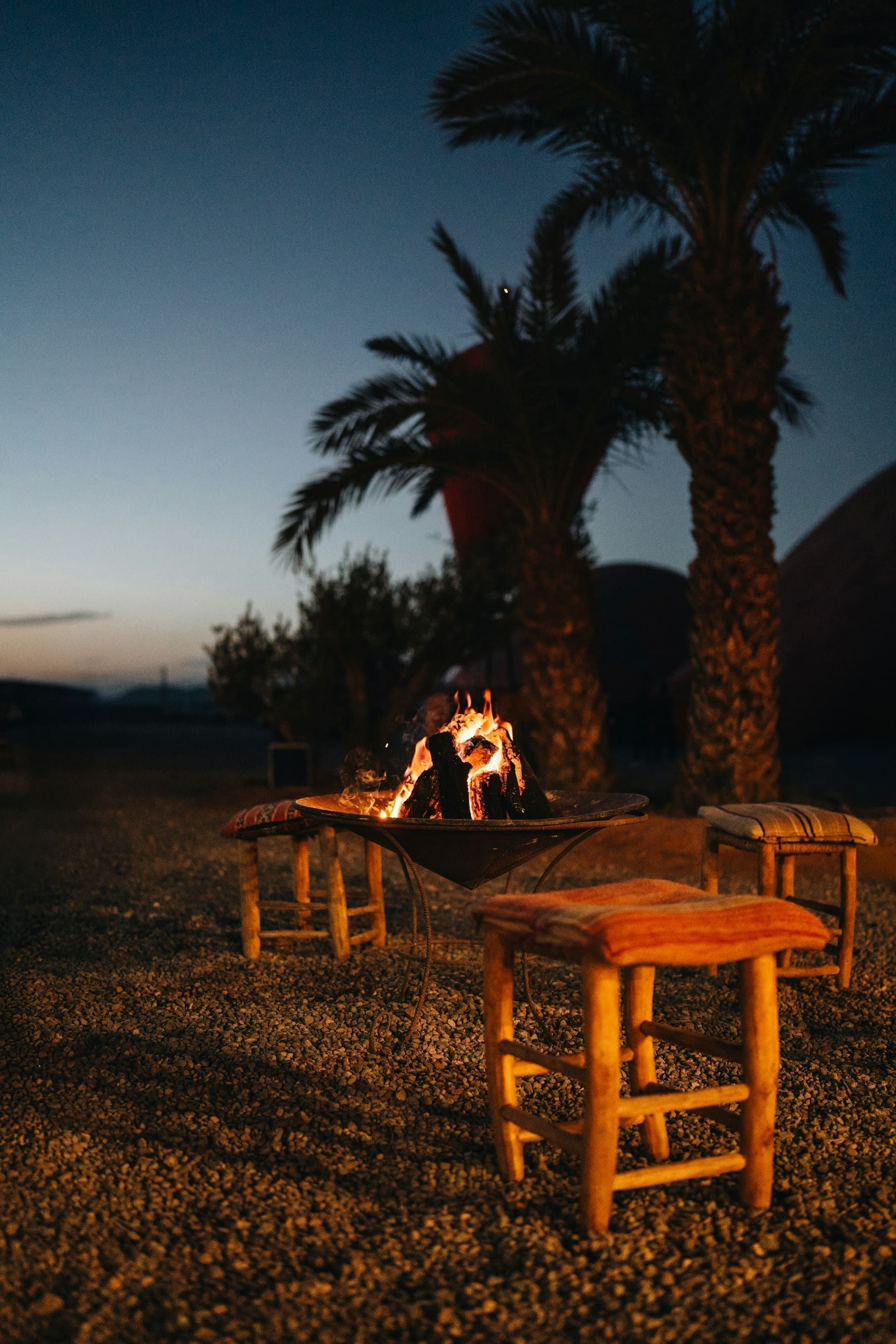
The fire show is on all five act lists, and the morning and evening comparison names it among the acts that run in the evening only. During the fire show, stay where the camp team asks you to.
Parents deciding whether the fire show suits a young child will find age guidance in the guide to a safari with kids. On the red dunes package the falcon photography station runs alongside the shows, and falconry on a desert safari has its own page.
Dabka and the drummers
Dabka, also spelled dabkeh, is a line dance. In UNESCO's entry for dabkeh in Palestine, inscribed in 2023, dancers form a straight line or a semicircle, joined by clasped hands and shoulders, and the steps leap and stamp the ground. It belongs to festivals and celebrations such as weddings and graduations. The package pages pair it with drummers and say nothing more about the camp's version.
Sufi music and khaliji dance
Two items on the list are named and not described. The package pages print "sufi music (DJ)" and "sufi dance", which the evening page joins as "sufi music (DJ) and dance", and they print "khaliji dance". If either act is the reason you are booking, ask the desk what it involves on your date.
Photographing the acts
You can photograph the stage freely. Ask before a close-up portrait of a dancer, a member of staff or another guest, and keep direct flash off the tanoura dancer. The Bedouin culture guide puts the general point plainly: photograph people only after asking. Tipping the performers has its own section in the guide to how much to tip.

Emirati performing arts on UNESCO's list
The UAE's own performing arts on UNESCO's Representative List include Al-Ayyala (2014) and Al-Razfa (2015), both shared with Oman, and Al Ahalla (2025).
In Al-Ayyala, two rows of about twenty men face each other, carrying thin bamboo sticks that stand for spears or swords, while musicians between the rows play large and small drums, tambourines and brass cymbals. In the UAE, UNESCO adds, girls in traditional dresses stand at the front, tossing their long hair from side to side. It is performed at weddings and other festive occasions.
Al-Razfa began as a communal celebration of victory, according to UNESCO. Male performers form two facing lines and sing chants antiphonally, many of them verses of Nabati poetry, while dancers between the lines hold wooden replica rifles. In some performances young girls swing their hair in time to the music. Abu Dhabi Culture calls those young women the Na'ashat and lists weddings and national holidays among its occasions.
Al Ahalla is listed for the UAE alone. Its performers, usually men, gather in circles of up to sixty and recite poetry in alternating chants, keeping the rhythm with bamboo sticks called khayzaran. Unlike Al-Ayyala, it uses no drums or tambourines. UNESCO ties it historically to diving trips and names weddings and public events among its occasions.
Those three are not the whole UAE listing. UNESCO's UAE page also carries Al-Taghrooda, chanted Bedouin poetry shared with Oman (2012), Al Azi, a performed poetry of praise, on the Urgent Safeguarding List (2017), and the zaffa in the traditional wedding (2025). The package pages name none of these arts among the camp acts. For how the camp programme relates to Emirati heritage, read the Bedouin culture guide.
What changes at the shows during Ramadan
During Ramadan, belly dance comes off the programme and the fire show pauses. Oud and qanun music takes the place of the tanoura and the fire show, and the bonfire stays lit. The full Ramadan evening is on the page about a safari during Ramadan.
Ask the desk which acts run on your date
Message the desk on WhatsApp with your date and the package you have in mind, and ask which acts run that evening. Bookings on this page are fulfilled by Velari Tourism L.L.C, DET license #1491675.
Message us on WhatsAppBefore you book
Questions about the camp acts
-
What desert safari shows are included on an evening package?
The evening package lists belly dance, tanoura, sufi music (DJ) and dance, khaliji dance, dabka and drummers, and a fire show, and its page adds that the acts vary night to night. The red dunes, VIP, overnight and no-dune-bashing packages print the same acts. The morning safari has no shows. -
What is the tanoura dance in Dubai?
Tanoura is a whirling dance in which the performer spins inside several heavy skirts. Tanoura is Arabic for skirt. The dance grew out of the Sufi whirl of the Mevlevi order of 13th-century Konya, and Egyptian Sufis turned the ritual into a folk art by adding colours and rhythms, AFP reported in 2022. At a Dubai desert camp it is one of the evening stage acts. -
Is the tanoura dance religious?
Its roots are. Tanoura descends from the whirling of Sufi dervishes, and UNESCO describes the Mevlevi order as an ascetic Sufi order founded in Konya in 1273. A tanoura at a camp is a stage show in coloured skirts, so watch it as a performance and give the dancer the courtesy you would give any performer. -
Is there a belly dance on a Dubai desert safari?
Yes, on the packages that list it: the evening, red dunes, VIP, overnight and no-dune-bashing packages all name belly dance among their live acts. It comes off the programme during Ramadan; the page on a safari during Ramadan explains what replaces the shows that month. -
Can I take photos or videos of the performers?
Yes, of the stage. Ask before a close-up portrait of a dancer, a member of staff or another guest, and keep direct flash off the tanoura dancer. The general courtesy at the camp is to photograph people only after asking. -
Does the morning safari include the shows?
No. The morning and evening comparison says tanoura, belly dance, the fire show and falcon photography run in the evening only. If the shows matter to you, pick the evening, red dunes, VIP or overnight safari, or the evening without dune bashing.
