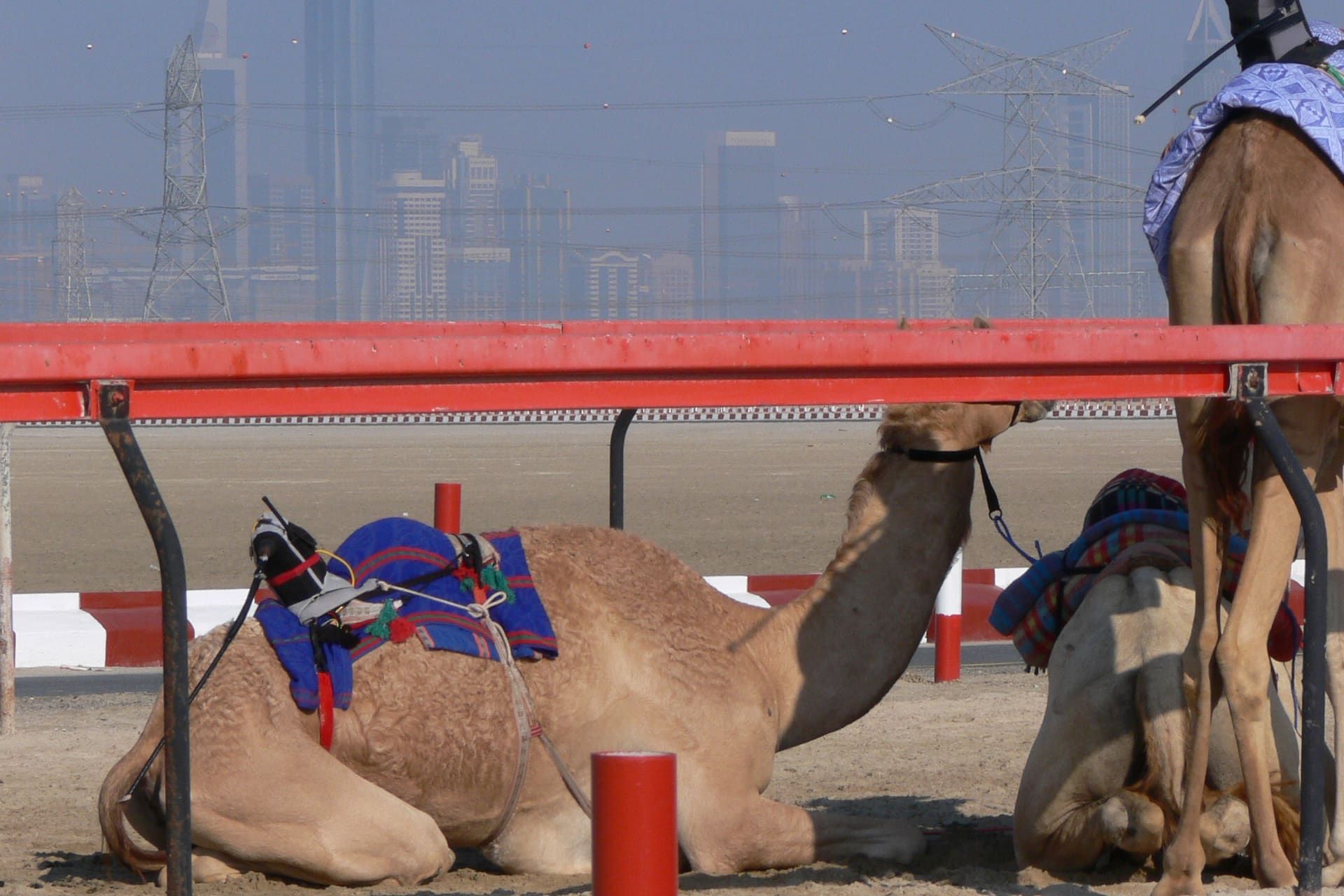
Camel racing in Dubai, the Al Marmoom season and how to watch it
Where camel racing happens in Dubai
The Al Marmoom camel racetrack on E66, the Dubai-Al Ain Road, is one of the most prominent tracks run by the Dubai Camel Racing Club, which manages others as well. It has its own Al Marmoom Heritage Village. In its notice launching the 2026-27 season the club calls the venue the Al Marmoom Smart Camel Racing Track.
The racetrack and the heritage village
The track was built in 2008, according to the club's Arabic racecourse page, which puts the Al Marmoom area amid the Saih Al Salam sands and also places a camel market inside the track area. The page is undated and gives the distance as about 40 km from Dubai city.
In 2019 the festival programme put a market and folk performances in the village, and The National's preview gave its hours as 6:00 PM to 10:00 PM, after the day's racing. The sources give no village hours outside festival weeks. In 2026 the village arena hosted the 13th Al Marmoom Camel Auction, which Aletihad reported had concluded after four days of trading.
The camel racetrack and the desert reserve that share a name
Two places carry the Al Marmoom name, and they are easy to mix up. The Al Marmoom camel racetrack is a sports venue run by the club, with its own race calendar and a camel market in the track area. The Al Marmoom Desert Conservation Reserve is the wider protected desert: the club's racecourse page describes the track's setting inside the Al Marmoom area, with the reserve around it.
The reserve has its own guide: Al Marmoom Desert Reserve.

When the racing season runs
The Dubai Camel Racing Club opened its 2026-27 season at the Al Marmoom track on 11 September 2026. Tribesmen went first. Their races started on Friday 11 September, and the sheikhs' races were due from Monday 14 September, both opening with the young camels' races (club preview, 10 September 2026). The National's 2019 preview described that year's Al Marmoom Heritage Festival as marking the end of the season.
The club's 2026 reports show racing from 11 September, with sessions dated on all seven days of the week. Before you plan an early-season drive out, check the best time of year to visit the desert for month-by-month desert weather.
What the sources say about the season
Season dates shift with the source and the year.
| Source | Date | What it states |
|---|---|---|
| Dubai Camel Racing Club | 11 September 2026 | Season 2026-27 launched with effect from 11 September 2026 at the Al Marmoom track |
| Dubai Camel Racing Club, Arabic preview | 10 September 2026 | Tribesmen's races from Friday 11 September, sheikhs' races from Monday 14 September, each opening with the young camels' races |
| Aletihad, preview | 1 April 2026 | Festival final day set for Thursday (2 April 2026, per Aletihad's report that day) |
| The National, preview | 3 April 2019 | Season runs from September to April |
| UAE University paper (Al-Shorepy), introduction | 2011 | Late October to early April |
The spring festival finale
The 2026 Al Marmoom Heritage Festival closed on Thursday 2 April, as Aletihad reported that day. Its preview the day before put that final day after 12 race days and a programme of 333 races, with a total prize purse of AED 8,950,000 and more than 6,000 camels. In 2024 the final day fell on 27 March, per Dubai Media Office. For 2019, The National's preview set the 38th edition for 6 to 18 April, with 378 races. The date has shifted between those years, so confirm it with the club before you build a trip around it.
Race days and start times
The club's preliminary-session reports from 11 September to 8 October 2026 list 6:00 AM starts, moving to 6:30 AM on 7 and 8 October. Each morning is given to one age group over 16 to 25 rounds, with females and males run as separate rounds.
Festival days follow a different clock. The National's 2019 preview set races from 7:00 AM to 10:30 AM and again from 2:30 PM to 5:30 PM, and Aletihad's preview of the 2026 final day encouraged visitors to arrive from 1:30 PM. Older descriptions differ, and the introduction to a 2011 UAE University paper described the racing of its day as mostly Thursday to Saturday, with races at 7:30 AM and 2:30 PM.

How a camel race works
Camels race only against their own age class and sex, so females and males of the same age run in separate rounds. Distance grows with age and varies by meeting: 2 to 6 km in the club's 2026 preliminary sessions, 8 km at the festival finals. UNESCO's listing says a round usually has 15 to 20 camels. The animals on the track are dromedary camels (Camelus dromedarius), the one-humped species, and Khaleej Times noted in 2018 that racing is usually limited to dromedaries. Animal Diversity Web puts the earliest evidence of the species' domestication at about 4,000 years ago, on a small island off the Abu Dhabi coast.
Age classes from Haqayeq to Zomool
Six class names follow a racing camel from age two to six and over. Spellings vary from source to source, so the table gives the order and spelling Abu Dhabi Media Office uses, with the club's English spelling beside it.
| Class | Club spelling | Age | Distances run, September and October 2026 |
|---|---|---|---|
| Haqayeq | Hagaga | 2 | 2 km (11 Sep); 3 km (25 Sep, 4 Oct) |
| Laqaya | Laqaiya | 3 | 4 km (12 Sep, 26 Sep, 5 Oct) |
| Itha'a | Jatha'a | 4 | 4 km (13 Sep); 5 km (27 Sep, 6 Oct) |
| Thanaya | Thanaiya | 5 | 5 km (19 Sep); 6 km (7 Oct) |
| Houl (females) | Haul (Zullal) | 6 and over | 5 km (20 Sep) |
| Zomool (males) | Zumool | 6 and over | 5 km (20 Sep) |
Distances come from the club's session reports between 11 September and 7 October 2026. Its 7 October report gives Thanaiya as five years old, and its 26 September report gives Laqaiya as three, although the 12 September report says four. The 8 October session for Houl and Zomool is left out because the club's English and Arabic reports give different distances.
Distances and speeds
In the club's September and October 2026 sessions the youngest camels ran 2 or 3 km and the five-year-olds 5 or 6 km, while the 2026 festival finals ran over 8 km, the longest distance on the programme according to Aletihad. The National's 2019 preview had that festival opening with under-threes over 4 km.
| Measure | Figure | Source and date |
|---|---|---|
| Preliminary-session distances | 2 to 6 km | Dubai Camel Racing Club reports, September and October 2026 |
| Festival-final distance | 8 km | Aletihad, 2 April 2026; The National, 2019 preview |
| Average speed of race camels | 10.6 m/s, about 38 km/h | UAE University paper (2011), 2008 race data |
| Average speed over 8,000 m | 10.15 m/s, about 36.5 km/h | UAE University paper (2011), 2008 race data |
| Remas, Open Haul winner over 8 km | 11:57.08, about 40 km/h | Aletihad, 2 April 2026 (speed derived from the time) |
A UAE University study of race data from 2008 put the average speed of race camels at 10.6 metres a second, about 38 km/h; the study recorded the first ten finishers in each race. Over 8,000 m the average was 10.15 metres a second, about 36.5 km/h. In 2026 the Open Haul winner, Remas, covered 8 km in 11:57.08, about 40 km/h, which like the other two figures is an average over the whole race. None of these sources measures a sprint top speed.
Local and crossbred camels
Camels are grouped by origin. Purebred local camels, called mahalli, descend from Omani or Najdi lines, and crosses with Sudanese types are muhajjan (UAE University). The club's 2026 race cards label rounds Local and Hybrid, run separately for Abkar (females) and Jeadan (males).
Sheikhs' races and tribesmen's races
Ownership sets a second split. The UAE University paper describes two race types by owner category, sheikhs' races and tribesmen's races, and The National's 2019 preview counted 132 of the first and 246 of the second. In 2026-27 the tribesmen's races started three days before the sheikhs', according to the club's preview.

Why children no longer ride in camel races
The minimum age for camel jockeys rose in stages until no child could legally ride. A ban on jockeys under 15 was enforced from 1 September 2002, the limit later stood at 16, and Law No. 15 of 2005 banned riders under 18. Robot jockeys raced in a trial in Abu Dhabi that July.
- 2002 From 1 September, the UAE enforces a ban on camel jockeys under 15 (Gulf News).
- 2005 Law No. 15 of 2005 bans riders under 18, up from a limit of 16. In July, robots of up to 15 kg race in a trial in Abu Dhabi (Al Jazeera).
- 2008 The Al Marmoom camel racetrack is built.
- 2020 UNESCO inscribes camel racing as a joint UAE and Oman element.
- 2026 The Al Marmoom Heritage Festival closes on 2 April; the 2026-27 season opens on 11 September.
The sources do not date the step from 15 to 16. They agree on where it ended: Abu Dhabi Police cites the law as Law 15/2005, which bans children under 18 from camel races.
How the robots work
At the July 2005 trial, Al Jazeera reported robots of up to 15 kg, dressed in jockey clothes and taking orders from an instructor through a remote control system. Ten years later, trainers told The National that they control the robot during the race with a voice-activated remote, and that each robot cost AED 1,000 to AED 2,000.
One trainer said a robot's strokes hurt the camel less than a rider's whip did. That is his view as reported in 2015, not a measured result.
333 races
The 2026 Al Marmoom Heritage Festival programme, which closed on 2 April
Aletihad preview, 1 April 2026.
How to watch a race at the Al Marmoom camel racetrack
The surest way to watch is the spring festival. Aletihad's preview of the 2026 final day said entry was free and listed viewing from the tourist Big Bus at no charge. The club's undated racecourse page urges visitors to come early and describes two bridges built for the public to follow the races. Neither that page nor the club's race reports give spectator terms for regular sessions, so check with the club at dubaicrc.ae before you drive out.
Getting to the track
The track sits on E66, Tahnoun Bin Mohammed Al Nahyan Road, also called the Dubai-Al Ain Road, about 40 km from Dubai city (club racecourse page). The festival's website, which still carries the 2019 village programme, gave the drive as about 40 minutes from Downtown Dubai, 45 minutes from Dubai International Airport and 50 minutes from Al Maktoum International Airport. Those figures are undated estimates. The same site pointed public-transport users to the RTA public transport page. For the 2026 final, Aletihad's preview listed parking at the venue along Al Ain Road.
What happens on a race day
Camels race in rounds of their own class, and owners follow the race alongside the track to watch and cheer, as The National described in 2019. That preview also said a free public bus would run alongside the track during races. For the 2026 final day, Aletihad's preview listed free viewing from the tourist Big Bus.
Photos and manners at the track
Ask before you photograph people at the track, the same courtesy we publish for guests at the desert camp.

Prizes, auctions and the saffron finish
Prizes at Al Marmoom have mixed cash with swords, daggers and rifles. Aletihad's preview of the 2026 final day gave a total prize purse of AED 8,950,000 and described saffron paste for the winning camels at the finish line.
On that final day four races ran over 8 km, and the winner of the fourth, the Open Haul, took the UAE Sword and AED 2 million. Remas won it in 11:57.08 for the Presidential team, trained by Sultan Al Wehaibi (Aletihad, 2 April 2026).
The 2019 festival shows the full range. The National's preview listed trophies, daggers, rifles, swords, saddle seats, vehicles and cash among the prizes, with the Emirates Sword for the final Houl and Zomool race and saffron for the winners' heads.
Camels also change hands at the festival. Aletihad reported on 2 April 2026 that the 13th Al Marmoom Camel Auction, for Fatameen (Batch C), offered 279 lots over four days of trading in the heritage village arena. On its final day 69 camels were presented and 44 sold for a combined AED 2.972 million. The report also gives a highest bid of AED 600,000, for a female camel.
Camel racing as UNESCO-listed heritage
UNESCO added camel racing to its Representative List of the Intangible Cultural Heritage of Humanity in 2020, as a joint nomination from the UAE and Oman.
The entry, "Camel racing, a social practice and a festive heritage associated with camels" (decision 15.COM 8.b.11), covers the whole practice around the race. Racing camels are chosen for their type, origin and age and fed a special diet. They train in groups on the track, and a round usually has 15 to 20 camels running over a distance set by age. Specialised community committees supervise the races, while a preparation committee checks each camel's origin. The entry also calls camel racing a source of inspiration for poetry and song.
UNESCO lists the practice, not a venue: the entry covers camel racing across both countries, wherever it is run. For the herding and hospitality side of camel culture, read our guide to Bedouin culture in the UAE; falconry and its UNESCO listing covers a second desert tradition on UNESCO's lists.
Racing camels and the camel at a desert camp
The camel at a desert camp and a race camel do different work. On the morning and evening safaris booked through BookMySafari, the included camp ride is short. In the Dubai Camel Racing Club's 2026 sessions and festival final, race camels ran 2 to 8 km against their own age class.
For the camp side, camel riding at the desert camp covers the mount and the dismount, and the morning safari includes a camel ride at the camp.
Plan the desert side of your trip
BookMySafari books desert safaris operated by Velari Tourism L.L.C, DET license #1491675, the Dubai-licensed tour operator behind this platform. Message the desk on WhatsApp with your date and hotel area to add a morning or an evening in the dunes to your trip.
Message us on WhatsAppQuick answers
Frequently asked questions about camel racing
-
When is camel racing season in Dubai?
The Dubai Camel Racing Club opened the 2026-27 season at the Al Marmoom camel racetrack on 11 September 2026. Tribesmen's races started that Friday and sheikhs' races were due from Monday 14 September, both opening with the young camels' races. The National's 2019 preview described that year's Al Marmoom Heritage Festival as marking the end of the season. In 2026 the festival's final day was 2 April, as Aletihad reported that day. Older sources give September to April (2019) or late October to early April (a 2011 study). The festival date is not fixed, so check the club's news page first. -
Where do camel races take place in Dubai?
The Dubai Camel Racing Club runs several tracks, and one of its most prominent is the Al Marmoom camel racetrack on E66, the Dubai-Al Ain Road, about 40 km from the city. The track was built in 2008. It has its own Al Marmoom Heritage Village, where the 2019 festival programme put an evening market and the 2026 camel auction was held. Do not confuse it with the Al Marmoom Desert Conservation Reserve: the reserve is the wider protected desert around the area, while the track is a sports venue with its own race calendar. -
Is camel racing in Dubai free to watch?
The 2026 festival final day, Thursday 2 April, was free to attend, according to Aletihad's preview the day before. The preview listed grandstand views and free viewing from the tourist Big Bus. The National's 2019 preview said a free public bus would run alongside the track during races. The Dubai Camel Racing Club's racecourse page urges visitors to come early, but neither it nor the club's race reports give spectator terms for the regular sessions from September onwards. Confirm access with the club before you drive out. Budget for the drive itself: the track is about 40 km from Dubai city. -
Do camel races still use child jockeys?
No. Law No. 15 of 2005 bans camel jockeys under 18. Before that law, the UAE enforced a ban on jockeys under 15 from 1 September 2002, and the age limit later stood at 16. Robot jockeys raced in a trial in Abu Dhabi in July 2005, at up to 15 kg each. Trainers interviewed in 2015 said they control the robot during the race with a voice-activated remote. -
How fast does a racing camel run?
In 2008 race data studied at UAE University, race camels averaged 10.6 metres a second, about 38 km/h, and over 8 km the average was about 36.5 km/h; the study recorded the first ten finishers in each race. In 2026 the Open Haul winner, Remas, ran 8 km in 11:57.08, about 40 km/h, by Aletihad's report of the final. These are averages across a whole race, not sprint speeds. -
What is the Al Marmoom Heritage Festival?
The Al Marmoom Heritage Festival is a spring camel racing festival at the Al Marmoom camel racetrack, organised by the Dubai Camel Racing Club. Its 2026 edition ended on Thursday 2 April. Aletihad's preview put that final day after 12 race days and a programme of 333 races, with a total prize purse of AED 8,950,000. A camel auction ran alongside it in the heritage village arena, and the 2019 programme put an evening market with folk performances in the village. In 2024 the final day was 27 March, and the 2019 edition was scheduled for 6 to 18 April. -
How is the camel at a desert camp different from a race camel?
The camel at a desert camp carries guests. On BookMySafari's morning and evening safaris, the included camp ride is short. A race camel runs a timed contest against camels of the same age class and sex, over distances of 2 to 8 km at the Dubai Camel Racing Club's 2026 meetings. UNESCO's listing describes how racing camels are chosen and then trained in groups. In 2026 the Open Haul winner took the UAE Sword and AED 2 million over 8 km.
