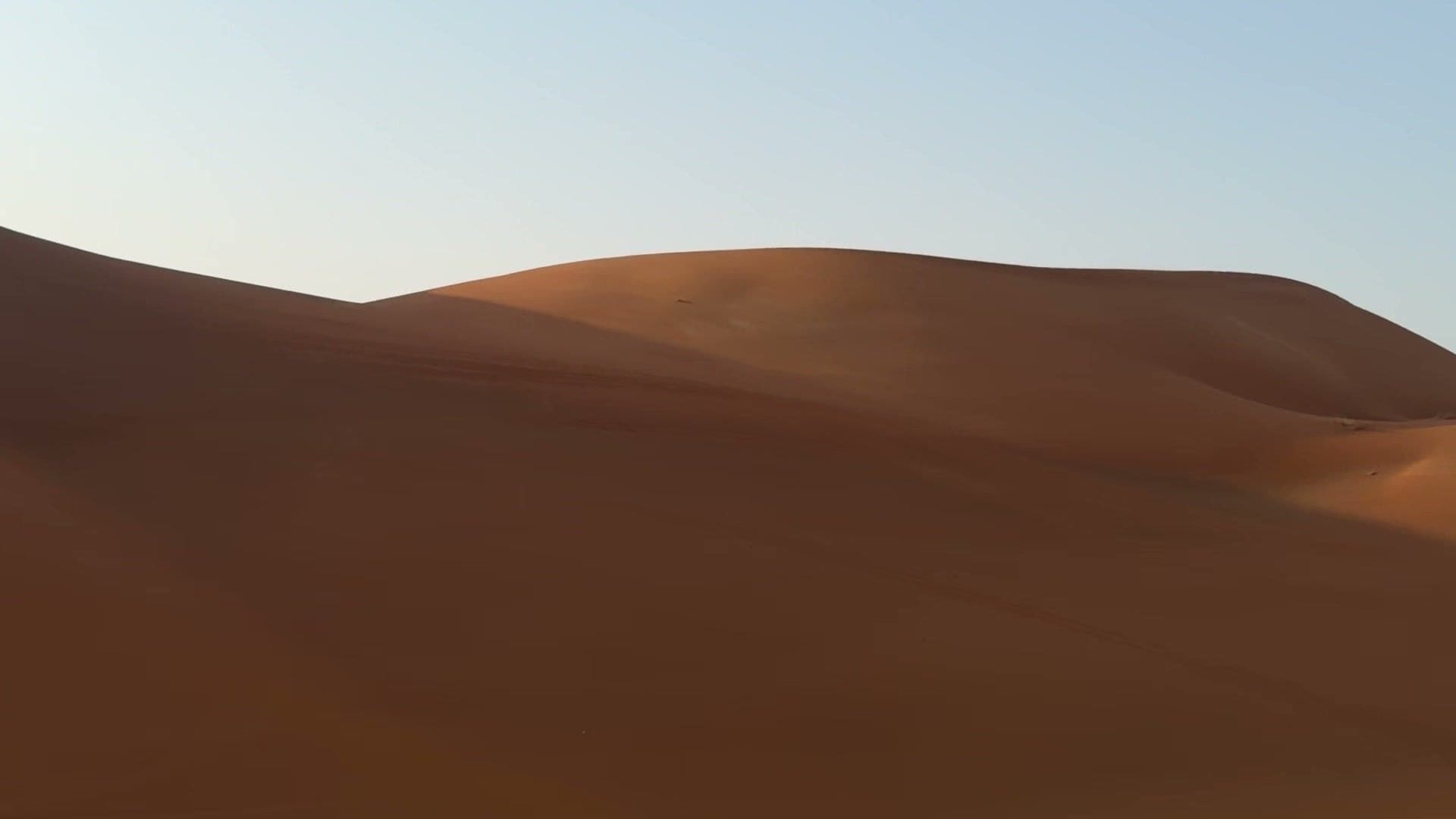
How sand dunes form, and where their colour comes from
How wind turns loose sand into a dune
A dune starts with wind strong enough to move grains and a bed of loose sand to move. Under those conditions a flat sand surface does not stay flat. Physicists who study how sand dunes form call it unstable, and it breaks into two kinds of ridge: ripples, a few centimetres tall, and dunes, which are typically metres tall and can reach 100 metres.
Geologists define sand as mineral grains between 62.5 and 2,000 micrometres across. Anything finer is dust. The wind moves sand in three ways. Grains of roughly 70 to 500 micrometres bounce along the surface in a path called saltation. Grains above about 500 micrometres are too heavy to hop far: they settle after a hop of under a centimetre, or roll and slide along the ground, pushed by the grains that land on them.
The US National Park Service gives the plain version for Great Sand Dunes in Colorado. Sand is light enough for wind to lift and heavy enough that it does not stay in the air, so it bounces along the surface and collects where the wind slows or an obstacle gets in the way. That collecting is the first stage of a dune.
Why a dune has a gentle side and a steep side
A dune has a gentle windward side and a steep lee side because wind pushes grains up one slope and gravity drops them down the other. Grains hop up the windward side and settle on the crest. When the slope on the lee side passes the angle of repose of dry sand, about 34 degrees, the surface relaxes through small avalanches and a slip face forms.
That gives a dune its motion. Grains climb the windward side, gather at the crest and roll down the slip face to the foot of the lee side, so the whole dune walks downwind. Barchans, the best-known type of dune, can travel 30 to 100 metres in a single year. Small dunes move faster than big ones, since a dune's speed scales with the inverse of its size.
Four dune shapes and the winds that build them
Geologists sort dunes into four main types, and the sorting comes down to two questions: how many directions the wind blows from, and how much sand lies on the ground. The table sets out each type.
| Dune type | Wind and sand supply | Shape |
|---|---|---|
| Transverse | Steady wind from about one direction, with enough sand to cover the ground | Long ridges at right angles to the wind |
| Barchan | Steady wind from one direction, with little sand on the ground | A crescent whose two horns point the way the dune moves |
| Linear (seif) | Wind that shifts between at least two main directions through the year | Long, meandering ridges parallel to the net direction of sand transport |
| Star | Winds from several directions | Several arms radiating from one peak; can reach several hundred metres |
A team from the British Geological Survey calls the giant dunes of Liwa megabarchans, which puts them in the second row. We found no published survey that sorts the dunes at Lahbab into these four types, so this page does not label them.
How to read a dune's wind from its shape
Three clues tell you which way the wind blew when a dune formed. The gentle slope faces into the wind and the steep slope faces away from it, so the slip face points downwind. Ripples a few centimetres tall cover the surface and line up across the wind, at right angles to it. On a barchan, the two horns of the crescent point the way the dune is travelling.
Dunes that sit under two opposing winds are harder to read. At Great Sand Dunes the predominant wind blows from the southwest and pushes the ridges toward the mountains, but storm winds from the northeast sometimes flip a crest into a sharp ridge. A single visit shows one wind. The shape records many.
34 degrees
the angle of repose of dry sand, where a dune's lee side gives way and a slip face forms
Kok and colleagues, The physics of wind-blown sand and dust, Reports on Progress in Physics, 2012.

Where the sand under Dubai came from
The sand under Dubai is part of the Rub' al-Khali, which NASA calls the largest sand sea in the world. It runs from the Gulf coast of the UAE south into Saudi Arabia, Oman and Yemen, and NASA puts it at roughly the size of France, holding about half as much sand as the entire Sahara. Most of its grains have been used before. Zircon dating by the British Geological Survey traces most of the UAE's young sediments back to the Precambrian Arabian Shield, and the dune sands have been recycled, sometimes many times, from older deposits.
The modern dunes take their sand from nearby rock. Along the Gulf coast, Miocene sandstones and Quaternary palaeodunes lie exposed. Wind strips grains from them, a process called deflation, and the northwesterly Shamal wind carries the grains inland.
The carbonate dunes along the coast have a different parent. The carbonate palaeodunes there come from sediments the Tigris-Euphrates river system laid down in the Gulf when sea level was low in the Pleistocene, and the Shamal blew that material ashore. Modern dune sand near the coast shows a clear Gulf component that fades inland as sand from the Miocene sandstones mixes in. East of Abu Dhabi, deflation of the Miocene Barzaman Formation and the Quaternary Hili Formation frees sand with a clear Hajar Mountains signature. That signature is a heavy-mineral fingerprint, and the ophiolite rock behind it holds magnetite and hematite among its minerals.
Why inland UAE sand is red and the coast is pale
Across the UAE, dune sand changes colour between the coast and the interior. Sand along the Gulf coast is pale beige carbonate sand with only a small share of grains from silicate rock. Further south, including the giant megabarchans of Liwa, the sand is darker reddish-orange-brown, iron-coated and dominated by quartz. The Lahbab dunes lie inland, east of Dubai city, and they look red. The published change between coast and interior is the nearest account on record.
Why is the sand red in the Dubai desert? The evidence for inland UAE sand points to a thin coating on each grain. Researchers who mapped sand redness across the Nafud Al-Thuwayrat sand sea in central Saudi Arabia found iron-oxide-coated grains in every sample they took. The reddest sands were well-sorted, medium to fine quartz sands, and the iron-coated grains were of wind origin. Dust in that area is rich in iron oxide and appears to be a major contributor to the redness. NASA's description of the southern Rub' al-Khali gives the same cause: the sand acquired its red hue from iron oxides.
Iron oxide was not the only control on colour in the Saudi study, because paler sands carried coarser grains, feldspar, calcite and gypsum. The British Geological Survey work on the UAE traces heavy minerals. It does not say that Hajar rock painted the dunes red, and it does not explain how the coating forms. For the shift from coast to interior, the survey paper cites earlier studies that point either to a falling share of lime-rich Gulf sand as you move inland or to a falling share of sand from the Zagros Mountains of Iran. No study we found sampled the Lahbab dunes by name.
Why the red looks deeper at sunset
The red looks deeper at sunset because low sunlight is redder. The coating sets the sand's colour, and the light decides how much of it you see. As the sun drops, its light crosses more of the atmosphere, scatters more of the blue out of the beam and leaves reds and yellows to reach the ground. NASA adds that dust and other small particles scatter blue too, which pushes the light further toward red.
A dune can look duller at noon and deeper red near sundown with no change in the sand. The Lahbab desert guide sets out when the colour peaks through the year.
When a dune turns to rock
A dune turns to rock when its grains are cemented together. The Environment Agency Abu Dhabi describes fossil dunes as outcrops of lightly cemented, cross-bedded dune sands, cemented by calcium carbonate and other salts that precipitated from groundwater during the glacial period. Their shape records the wind and the sand supply that built them.
Quaternary palaeodune sandstones lie across the central UAE. They show in interdune hollows and form the floor over which the modern dunes migrate. At Al Wathba the agency asks visitors not to climb on the fossil dunes, and it calls drawing or writing on them unacceptable behaviour.
What the shape of a dune means on a safari
The red dunes safari that BookMySafari offers runs into the Lahbab dunes. On the dune bashing page, the Land Cruiser crests a ridge and descends the leeward face. On an active dune that steep lee side is the slip face. The sandboarding page covers riding a board down a dune.
Ask the desk about a visit to the Lahbab dunes
Send your date and hotel to the desk on WhatsApp and ask which safari reaches the red dunes. Bookings on this page are fulfilled by Velari Tourism L.L.C, DET license #1491675.
Message us on WhatsAppQuick answers
Frequently asked questions about sand dunes
-
How do sand dunes form?
Sand dunes form when wind strong enough to move grains blows over a bed of loose sand. A flat sand surface under that wind does not stay flat. Grains bounce along the ground in a motion called saltation and collect where the wind slows or meets an obstacle. The pile grows, and once its lee side passes the angle of repose of dry sand, about 34 degrees, the face slides and a slip face forms. Grains then climb the windward side, gather at the crest and roll down the slip face, so the dune creeps downwind. -
Why is the sand red in the Dubai desert?
Inland UAE dune sand, the sand the Dubai desert belongs to, is reddish-orange-brown because its quartz-rich grains carry an iron coating. A British Geological Survey team describes the sand of the giant Liwa dunes this way, against pale beige carbonate sand on the Gulf coast. A study of Saudi dunes found iron-oxide-coated grains in every sample and reported that iron-rich dust appears to be a major contributor to redness. No study we found sampled the Lahbab dunes by name, so the explanation describes the UAE as a whole. -
What is a slip face?
A slip face is the steep lee side of a dune, where sand slides. Wind carries grains up the gentle windward side and over the crest. When the slope on the far side passes the angle of repose of the sand, about 34 degrees for dry sand, the surface relaxes through small avalanches. Sand that rolls down the slip face is the sand that moves the dune forward. -
How fast do sand dunes move?
Barchans, crescent-shaped dunes known for how quickly they move, can travel 30 to 100 metres in a single year. Speed falls as size rises, because a dune moves at a rate that scales with the inverse of its size, so a small dune overtakes a large one. We found no published rate for the dunes at Lahbab. Moisture and plant cover can hold a dune in place. -
How tall can sand dunes get?
Most dunes are a few metres tall, and some reach 100 metres. Star dunes, which form where wind comes from several directions, can climb to several hundred metres. Both figures come from a 2012 review of the physics of wind-blown sand in Reports on Progress in Physics. We found no height from a published survey for the dunes at Lahbab. -
Where does the sand in the UAE desert come from?
Most of it was recycled from older rock. Zircon dating by the British Geological Survey traces most of the UAE's young sediments, the deposits the dunes draw on, back to the Precambrian Arabian Shield. The modern dunes take their grains from Miocene sandstones and Quaternary palaeodunes along the Gulf coast, which wind has stripped and carried inland. The pale carbonate dunes of the coast trace back to sediment that the Tigris-Euphrates river system laid down in the Gulf when sea level was low. -
What is the difference between sand and dust?
Size. Geologists define sand as mineral grains between 62.5 and 2,000 micrometres across, and anything finer as dust. Sand hops and rolls close to the ground and builds dunes. Dust grains below about 20 micrometres can stay suspended in the air for a long time. The two meet in the colour of the dunes, because the Saudi sand-colour study found that iron-rich dust appears to be a major contributor to the redness of dune sand. -
What are fossil dunes?
Fossil dunes are old sand dunes turned to rock. The Environment Agency Abu Dhabi describes them as outcrops of lightly cemented, cross-bedded dune sands, cemented by calcium carbonate and other salts that precipitated from groundwater during the glacial period. The agency notes similar dunes elsewhere in the emirate and asks visitors not to climb on the Al Wathba formations, and it calls drawing or writing on them unacceptable behaviour. -
Can a sand dune stop moving?
Yes. Plants stabilise sand, and the review of wind-blown sand physics names increased soil moisture as an important contributor to immobilising dunes. Vegetation also changes the shape a dune takes, producing U-shaped parabolic dunes where plants cover the ground. The Saudi sand-colour study found dome dunes that were not migrating but building up.
