Snakes and scorpions in the UAE desert: what to do after a bite
Snakes and scorpions in the UAE desert at a glance
Yes, there are snakes in the Dubai desert, and the list of dangerous ones is short. The UAE has 13 snake species according to The National, and four of them are venomous vipers. A 2009 Khaleej Times report quotes Mayas Qarqaz of Environment Agency Abu Dhabi (EAD) on six venomous snakes in the UAE and names the two others, the Afro-Asian sand snake and the hooded malpolon, as back-fanged.
Dubai Municipality's reserve table gives the local picture. The Dubai Desert Conservation Reserve (DDCR) has 28 recorded reptiles, and the Municipality names a horned viper, the Sindh saw-scaled viper and the hooded malpolon among them. Al Marmoom Desert Conservation Reserve has 26 recorded reptiles, and its entry names geckos and the spiny-tailed lizard but no snake.
Scorpions are harder to pin down. Drew Gardner of Zayed University put the UAE total at about 25 species in 2008, and no published UAE study of scorpion envenomation existed then. This guide takes the safety angle: what lives in the sand, when it moves, and what the sources say to do. Species lists, oryx and falcons are in Wildlife of the UAE desert, and the wider picture is in Are Dubai desert safaris safe in 2026?

The four vipers of the UAE and where each lives
Two of the four UAE vipers live on sand and coast, and two live in the northern mountains. The table sets the range given by the UAE National Red List, by Johannes Els of the Sharjah Environment and Protected Areas Authority and by a 2009 Khaleej Times report side by side.
| Viper | Range in the UAE | What the sources add | On Dubai Municipality's DDCR list |
|---|---|---|---|
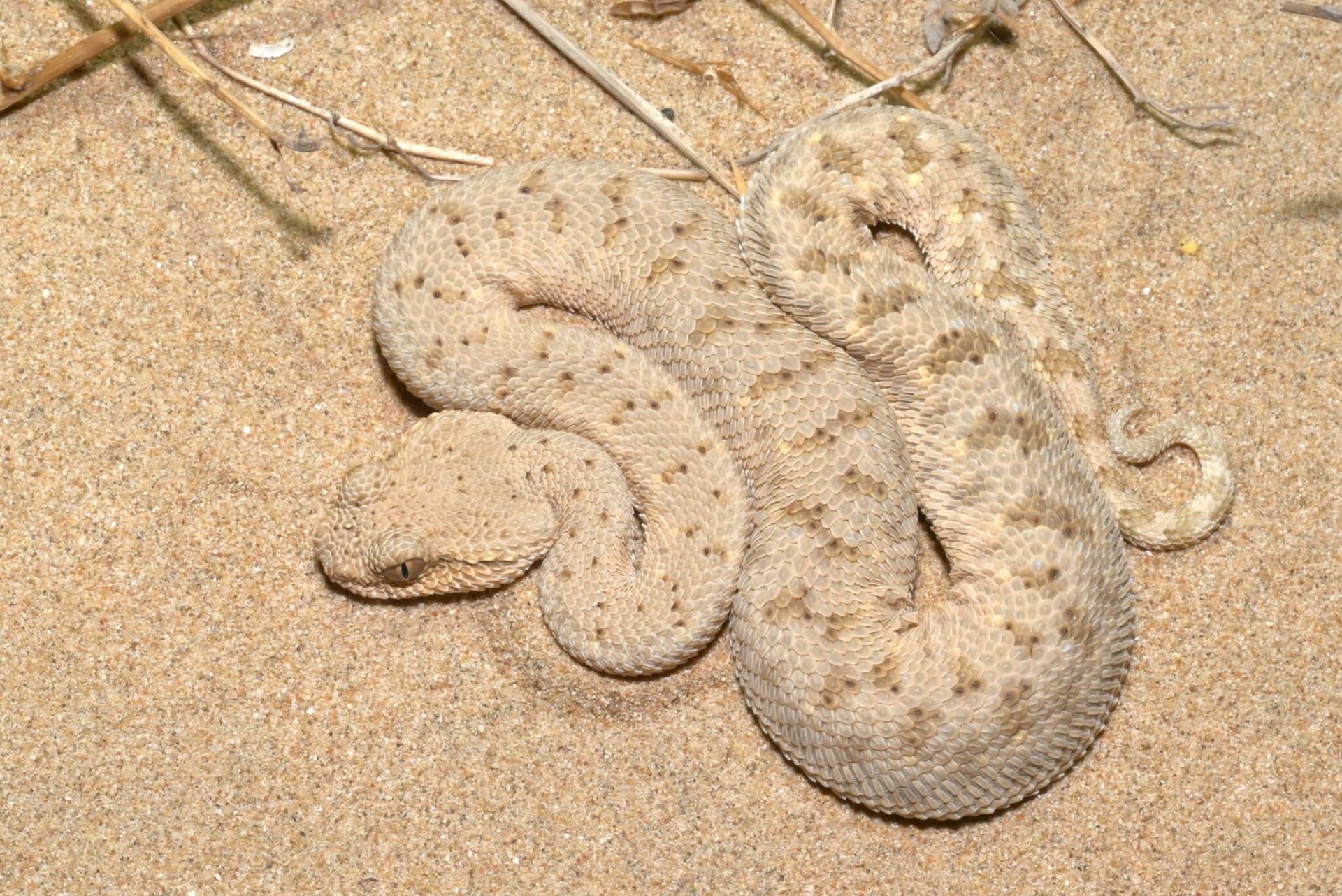
| Arabian horned viper (Cerastes gasperettii), the sand viper | Sandy regions from Ras al Khaimah to the Saudi border, from sea level to 400 m. Khaleej Times (2009): throughout UAE deserts, from Liwa to the coast. | Nocturnal. Lies partly buried in soft sand with only eyes, horns and snout showing. Moves by sidewinding. UAE Red List: Least Concern. | Yes, a "Horned Viper" (the Municipality lists it as Cerastes cerastes) |
| Sindh saw-scaled viper (Echis carinatus sochureki) | Nationwide, coast and inland (Els). Khaleej Times (2009): mainly coastal dunes, uncommon in true desert. | Least Concern (Els). Els says it and the horned viper are in regular conflict with people. | Yes |
| Oman carpet viper (Echis omanensis) | Northern mountains, more common near permanent water (Els). | The only viper endemic to the UAE and Oman. Least Concern (Els). | No |
| Persian false-horned viper (Pseudocerastes persicus) | Known from three mountain localities in the UAE (Els). | Seldom seen. Vulnerable (Els). | No |
The horned viper, the one to know on sand
The Arabian horned viper is the most widespread viper in the sandy desert of the UAE, according to Els, and the Red List adds that it may travel up to a kilometre a night while foraging. It shuffles sand to the sides until only its eyes, horns and snout show above the surface. That habit is why the first rule in the desert after dark is to look before stepping.
The saw-scaled viper and the two back-fanged snakes
The Sindh saw-scaled viper is the second Dubai species, and the Khaleej Times report places it mainly on coastal dunes. The report names the two back-fanged snakes as the Afro-Asian sand snake and the hooded malpolon. Els writes that almost nothing is known about the ecology of any UAE viper, so every behaviour note in this guide comes from a short list of assessments, not from field studies of safari routes.
What is known about scorpions in the UAE desert
Scorpions in the UAE desert are poorly studied. Drew Gardner wrote in The National in 2008 that about 25 species are thought to live in the country, and that two are dangerous: Leiurus quinquestriatus and Androctonus crassicauda, the black fat-tailed scorpion. He added that no published UAE study of scorpion envenomation existed at that time.
A 2009 Khaleej Times report says three scorpions are officially recorded as dangerous in Abu Dhabi's deserts: Androctonus crassicauda, Leiurus quinquestriatus and Parabuthus liosoma. It says the last two are not native and likely arrived through human transport, which puts the two sources at odds over the deathstalker. It quotes Mayas Qarqaz of EAD that five other common species have not been studied in clinical toxicology, and that anecdotal reports point to acute local pain as the main symptom.
A dangerous native scorpion exists, the black fat-tailed scorpion. The deathstalker's status is disputed. No sting figures turned up.
How often bites and stings happen, and what the sources leave out
No source found for this guide gives a yearly count of snake bites or scorpion stings in the UAE. The table lists what each source does say, with its date, so the gaps stay visible.
| Question | What the source says | Source and date |
|---|---|---|
| How many people are bitten by snakes in the UAE each year? | Khaleej Times reported no accurate data in Abu Dhabi on the number bitten each year. | Khaleej Times, published 2009, updated 2022 |
| How many scorpion stings are recorded? | No published UAE study of scorpion envenomation existed. | Drew Gardner, The National, 27 September 2008 |
| Have bites been fatal? | No snake bite deaths reported in the UAE for well over a decade. | The National, 26 November 2023 |
| Where do cases come from? | Mainly farms and the desert, with no recent reports from heavily populated areas. | The National, 10 July 2012 |
| How does that compare worldwide? | About 5.4 million bites a year, 1.8 to 2.7 million envenomings and 81,410 to 137,880 deaths. Children often suffer more severe effects. | World Health Organization, snakebite envenoming fact sheet |
The National wrote in July 2026 that snake encounters are uncommon for UAE residents. Busschau told the paper that a large proportion of snake bites occur when people intentionally interact with snakes.

When snakes and scorpions are active
Snakes are active at night and in the warm months on either side of summer, and none of the sources publishes a month-by-month risk table. The table lists only what each source says.
| Hour or season | What the sources say | Source |
|---|---|---|
| Night | The Arabian horned viper is nocturnal. The Khaleej Times report advises a torch and good boots at night. | UAE National Red List, 2018. Khaleej Times, 2009. |
| Winter days | The horned viper may bask on winter days. Reptiles stay active through warm winters and hibernate when temperatures drop. | UAE National Red List, 2018. Salvador Carranza in The National, 2023. |
| April, May, September, October | Encounters tend to peak, when it is warm enough for snakes and mild enough for people to be outdoors. | The National, 26 November 2023 |
| Summer | A 2009 Khaleej Times report named snakes and scorpions, besides heat, as a reason to avoid the desert in summer, and said they can be met in winter too. A safari operator quoted in it, Mohammed Khalifa, said snakes seek out the warmer layer of the sand. | Khaleej Times, 2009 |
Seven ways to avoid a bite or sting in the desert
These seven habits cover what the sources advise, and five of them come from a 2009 Khaleej Times report.
- Wear closed shoes or sturdy boots, and carry a torch for any walk after dark (Khaleej Times, 2009).
- Look before stepping on sand at night, and skip barefoot walks. The horned viper lies partly buried with only its eyes, horns and snout showing (UAE National Red List).
- Keep hands and fingers out of burrows (Khaleej Times, 2009).
- Shake out shoes, clothing and towels before putting them on (Mayas Qarqaz of EAD, in Khaleej Times, 2009).
- Leave snakes alone. Bites usually follow a person stepping on or near a snake, or trying to pick it up or kill it, and a snake left alone moves away (The National, 2023; Busschau, 2026).
- Clear litter and food waste around a camp. Litter draws rodents, and rodents draw snakes (Khaleej Times, 2009).
- Use yellow outdoor lights. They draw fewer insects and so fewer scorpions (Khaleej Times, 2009).
28
reptile species recorded in the Dubai Desert Conservation Reserve, two of them vipers
Dubai Municipality, Dubai Protected Areas, checked 21 October 2026.
What to do after a snake bite
Call 998, the UAE ambulance number that works from anywhere in the country according to u.ae, and get the person to a hospital as soon as possible. WHO, Rashid Hospital's emergency doctor Gulam Yasin Naroo, and the Abu Dhabi health authority (as reported by Khaleej Times in 2009) then overlap on a short list.
What the sources say to do:
- Move away from the snake, and reassure the person (WHO).
- Keep the person still and splint the limb (WHO); immobilise the limb (Abu Dhabi health authority).
- Remove rings, bracelets and other tight items near the bite (WHO); remove clothing and jewellery from the area (Abu Dhabi health authority).
- Clean the bite with water (Naroo, 2012).
- Hospitals may ask for a description of the snake, because different snakes need different antivenoms (Khaleej Times, 2009).
What the sources say to avoid:
- A tight arterial tourniquet (WHO; Naroo).
- Cutting the wound, and sucking it (WHO; Naroo; sucking also by the Abu Dhabi health authority).
- Herbal remedies and other unproven first aid (WHO).
- Antiseptic lotion, antibiotic cream and raising the limb (Naroo).
The sources differ on two points. Gardner recommended a light-pressure bandage with the limb strapped or splinted in 2008, while WHO limits the pressure-bandage method to bites by neurotoxic snakes that cause no local swelling. The 998 operator and hospital staff decide that, not a bystander. On timing, Naroo said in 2012 to try to reach a government hospital within 30 to 45 minutes, Khaleej Times wrote in 2009 that antivenom works best within about an hour, and Busschau says the idea that you have only a few minutes is simply not true.
WHO notes that antivenom is the most effective treatment, and Busschau says the belief that no antivenom exists in the UAE is false. To report a snake in Dubai, call Dubai Municipality on 800900.

What to do after a scorpion sting
Gardner advised painkillers such as paracetamol and ice for a sting, and hospital care if systemic symptoms appear, which can be delayed by several hours. Call 998 if they do. The 2009 Khaleej Times report quotes EAD's Mayas Qarqaz that anecdotal accounts of the common species point to acute local pain as the main symptom.
The National took the stricter line in July 2026, writing that venomous bites should always be treated as medical emergencies. A sting from a scorpion you cannot identify is the case where that line applies, because the UAE has at least one dangerous native species, the black fat-tailed scorpion.
Snakes and scorpions on a safari day
On a safari day the hours that matter are after dark at camp, because the horned viper is nocturnal. No source counts snake or scorpion sightings on safaris, and BookMySafari publishes no snake or scorpion incident figures.
Closed shoes are already on the packing list, and the what-to-wear guide covers footwear in full. Add a phone torch for the walk to the toilets or the vehicle, stay on lit paths and leave anything that moves alone. The evening safari from AED 199 runs through sunset and dinner, and the overnight safari from AED 399 sleeps in a desert tent in the Lahbab dunes, so pack a head torch.
Ask the desk about camp lighting and night walks
Send your date and hotel on WhatsApp and say that snakes or scorpions are your worry. The desk tells you which package fits and answers what it can about the camp. Bookings on this page are fulfilled by Velari Tourism L.L.C, DET license #1491675.
Message us on WhatsAppQuick answers
Frequently asked questions about snakes and scorpions in the desert
-
Are there snakes in the Dubai desert?
Yes. Dubai Municipality lists a horned viper and the Sindh saw-scaled viper among the 28 reptiles recorded in the Dubai Desert Conservation Reserve, and the UAE National Red List calls the Arabian horned viper widespread throughout the sandy regions from Ras al Khaimah to the Saudi border. It is nocturnal and often lies partly buried in soft sand. Bites are defensive: the herpetologist Theo Busschau of NYU Abu Dhabi told The National in July 2026 that no snake, scorpion or spider in the UAE attacks a person on purpose. -
Which snakes in the UAE desert are venomous?
Four vipers are venomous: the Arabian horned viper, the Sindh saw-scaled viper, the Oman carpet viper and the Persian false-horned viper. The first two live on sand and coast, and the other two are mountain species. A 2009 Khaleej Times report quoted Mayas Qarqaz of Environment Agency Abu Dhabi (EAD) on six venomous snakes in the UAE, and lists the two others as back-fanged: the Afro-Asian sand snake and the hooded malpolon. -
Are there scorpions in the UAE desert?
Yes. Drew Gardner of Zayed University wrote in The National in 2008 that about 25 scorpion species are thought to live in the UAE, two of them dangerous: Leiurus quinquestriatus and Androctonus crassicauda. A 2009 Khaleej Times report names three dangerous scorpions in Abu Dhabi's deserts. It says two of them likely arrived through human transport, which leaves the black fat-tailed scorpion, Androctonus crassicauda, as the native one. -
What should you do if a snake bites you in the desert?
Call 998, keep the person still and splint the bitten limb, and remove rings and other tight items near the bite. Get to a hospital as soon as possible, because antivenom is the treatment. WHO and the UAE doctors quoted agree on what to avoid: a tight tourniquet, cutting the wound and sucking it. WHO adds herbal remedies and other unproven first aid. A 2009 Khaleej Times report said hospitals may ask for a description of the snake, since different snakes need different antivenoms. -
What should you do after a scorpion sting in the UAE?
Drew Gardner advised painkillers such as paracetamol and ice for a sting, and hospital care if systemic symptoms appear, which can be delayed by several hours. Call 998 if they do. The National wrote in July 2026 that venomous bites should always be treated as medical emergencies, so a sting from a scorpion you cannot identify is a reason to call. -
How many people are bitten by snakes in the UAE each year?
No published figure turned up. A 2009 Khaleej Times report said there is no accurate data on how many people are bitten in Abu Dhabi each year, and Drew Gardner wrote in 2008 that no UAE scorpion envenomation studies had been published. The National reported in 2023 that no snake bite deaths had been reported in the UAE for well over a decade. For scale, WHO estimates 5.4 million snakebites a year worldwide. -
Do snakes come out in the Dubai desert in winter?
Some do. The UAE National Red List says the Arabian horned viper may bask on winter days, and the biologist Salvador Carranza told The National that reptiles stay active through warm winters and hibernate when temperatures drop. The same report said encounters tend to peak in April, May, September and October. Closed shoes and a torch after dark apply in every month. -
Will you see a snake on a desert safari?
No source counts snake sightings on safaris, and no BookMySafari package promises a sighting or its absence. The horned viper is nocturnal, so the hours that matter are after dark at camp: wear closed shoes, use a phone torch and stay on lit paths. The evening safari runs through sunset, dinner and the shows, and the overnight safari sleeps in a desert tent. -
Who do you call to report a snake in Dubai?
Call Dubai Municipality on 800900. Its head office page says the line takes inquiries and notifications round the clock. The National advised in July 2026 to contact the municipality or the environmental authority, not ordinary pest control, and not to try to kill or handle the animal.
