The environmental impact of a desert safari, and what limits it
What a desert safari does to the desert floor
A desert safari wears on the desert floor in two places: where vehicles leave set tracks, and where litter stays behind. The managers of the Dubai Desert Conservation Reserve (DDCR) list the visitor behaviours they act against, and the list covers concession staff and suppliers as well as guests: littering, off-road driving and speeding. The research below explains why the first two matter.
What tyre tracks do to plants and sand
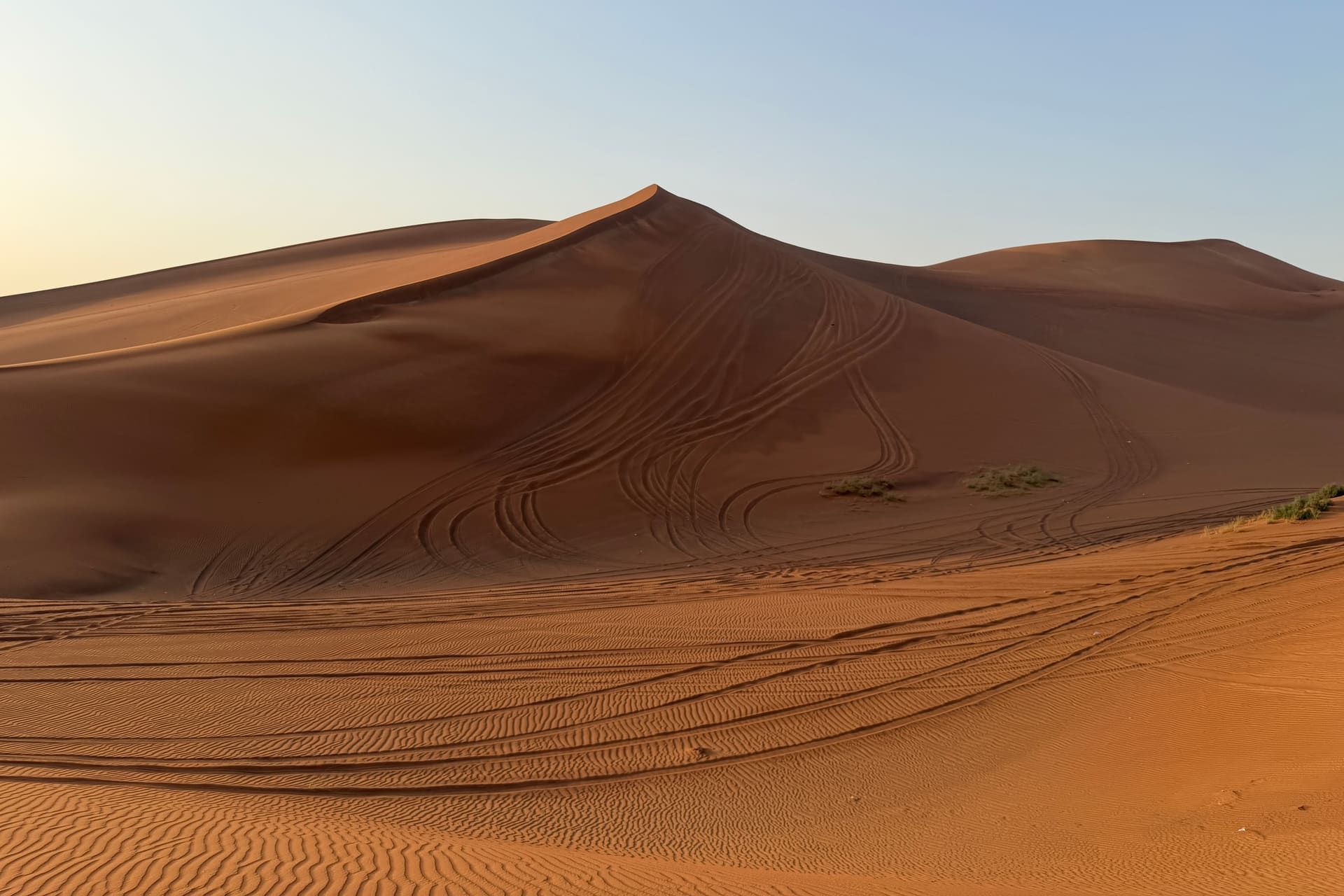
Repeated passes compact the soil and thin out the plants. On test plots in China's Otindag Sandy Land, researchers drove one Toyota Prado at 40 km/h across three slope bands (0 to 2.5, 8.5 to 10.5 and 16 to 17.5 degrees), either 10 or 100 times a year from June 2020 to October 2023. The paper's abstract reports plant diversity, scored on the Shannon-Wiener index (a standard diversity measure), 58.62% to 81.31% below untouched plots, with damage that grew as the slope steepened. Soil bulk density, a measure of how tightly the soil is packed, rose by 0.08 to 0.26 g/cm³ against the controls (Wang and colleagues, 2025).
Soil crusts tell a similar story. Across 26 desert sites in the United States, vehicle disturbance appeared to reduce nitrogen fixation (how the crust adds nitrogen to the soil) in biological soil crusts at every site, significantly at 12, and sandier soils lost more as their sand content rose (Belnap, 2002).
Neither study timed a safari. Both are field experiments with deliberate vehicle disturbance. The desk found no published measurement of safari tracks in Dubai's dunes, so the evidence cited here comes from other settings.
How litter builds up between clean-ups
Litter outlasts the trip that dropped it. In 2011 a balloon operator told Khaleej Times that desert clean-ups ran at most twice a year and that the rubbish was back within weeks. The DDCR's current plan records litter blowing in from nearby villages, farms, roads and camping, and it sets a zero-tolerance policy on littering for every visitor. Inside the reserve, drones flown by Zayed University now help locate areas with heavy littering.
How reserve camps handle water and waste
The DDCR says it pumps water from water holes with solar power and recycles waste at every tour-operator camp, and its About page lists nine camps. Its management plan sets out waste segregation at all commercial operations and has reserve officers monitor waste management at the operators' camps.
How the dune drive and the camp differ in footprint
In the view of Dr David Gallacher, safaris are acceptable because each camp covers a small area, while dune bashing destroys the vegetation and the structure of the dune. He was then an assistant professor in Dubai and a member of the Dubai Natural History Group, and he made the point in a Gulf News piece first published in 2009. It is one academic's view, not a measurement.
Does the wind undo the damage?
The desk found no study showing that it does, for crushed plants or for a broken soil crust. In 2008 one safari operator told Gulf News that the wind keeps changing the landscape. What the studies above do show is two other things: damage grew as the slope steepened, and crusts on sandier soil lost more of their nitrogen fixation.
How the dune drive works inside a reserve
Inside the Dubai Desert Conservation Reserve (DDCR), the dune drive is confined by zone and by route. Only approved Dubai-based safari operators with qualified, registered guides are permitted to run four-wheel dune drives there, only in the Development and Recreation Zone, and only on pre-planned routes. The reserve's management plan commits to keeping high-impact visitor activities to existing designated areas, while low-impact nature visits get wider access. What happens inside the vehicle is covered in how dune bashing works.
31%
of Dubai's total area lies inside eight protected areas, Dubai Municipality's approximate figure

What the law and reserve rules limit inside Dubai's protected areas
Article 8 of Law No. 11 of 2003 bars any work or activity that would destroy or harm natural life in Dubai's nature reserves or in their adjoining areas. It also names particular bans. Among them are taking living animals, rocks or soils from a reserve, and using vehicles without permission and an approved licence (clauses 2 and 6). Ruler's Decree No. 22 of 2014 named six reserves under that law. Separately, about 31% of Dubai's total area sits inside the eight protected areas that Dubai Municipality lists, including Ras Al Khor Wildlife Sanctuary and Hatta Mountain Reserve. Of the eight, the DDCR is the only one this guide found publishing a route system and a visitor ceiling, so most of the detail below comes from the DDCR.
Protection of Dubai's inland desert built up between 1999 and 2019:
- 1999 Al Maha opens with a 27 km² conservation reserve and 70 reintroduced Arabian oryx.
- 2003 The DDCR is created at 225 km², 4.7% of Dubai.
- 2008 All domestic livestock leave the DDCR.
- 2014 Ruler's Decree No. 22 establishes six nature reserves under Law No. 11 of 2003, Al Marmoom and the DDCR among them.
- Jan 2018 Al Marmoom Desert Conservation Reserve launches.
- Dec 2018 The federal waste law, No. 12 of 2018, is dated 18 December.
- 2019 DDCR approved tours launch.
The DDCR's four zones
The DDCR divides its 225 km² into four zones, and the dune drive is allowed in only one of them.
| Zone | What the zone allows |
|---|---|
| Wilderness Zone | No human intervention except for research and observation; wildlife moves freely across it |
| Rehabilitation Zone | Only infrastructure for wildlife and habitat programmes, such as watering points; used for seeding native plants |
| Ecotourism Activities Zone | Low-impact activities such as nature walks and camel and horse rides |
| Development and Recreation Zone | Four-wheel dune drives on pre-planned routes and small dune dinner camps, run by approved Dubai-based operators with registered guides |
How the DDCR caps safari numbers
The DDCR caps safari traffic by controlling who enters and how many. Every visit runs through a tour operator that holds a concession agreement with the reserve, or as a guest of the Al Maha Desert Resort, and no private access is permitted. A small group of concession operators each drives the designated routes written into its agreement, and DDCR management reviews each operator's performance and renewal every 3 years. Al Maha holds no concession of its own; its excursions run through contracted operators.
The reserve's regulations set a maximum of 350,000 visitors a year (Article 5.4). Counted traffic in the annual report's monthly table is about 210,000 visitors a year in each of the last two reporting years. It swings hard with the season. In 2024-25 the reserve counted 28,456 visitors in December 2024 and 6,178 in August 2024, the lowest month, so December brought about 4.6 times August's traffic. Commercial tourism pays for about 50% of the reserve's annual spending.
How Al Marmoom's rules work
Al Marmoom falls under Law No. 11 of 2003: Ruler's Decree No. 22 of 2014 listed Al Marmoom Desert Nature Reserve among six reserves under that law, and the reserve launched on 16 January 2018. Dubai Municipality describes Al Marmoom Desert Reserve as open to the public for sustainable recreation and says it is classified as IUCN Category II. The one written list of site rules found for this guide comes from signs at the Al Qudra Lakes inside the reserve. A Gulf News report on the new Dubai Municipality signs, updated in November 2018, listed bans on camping, bonfires, barbecues and dog walking, among other activities. Signs change, so check the ones posted on arrival. The permits behind camping in the Dubai desert, and what is confirmed, are set out in a separate guide.

Too many grazers: a separate pressure inside the reserve
The DDCR's own plan puts about 650 Arabian oryx in the reserve in April 2025, against a carrying capacity for oryx of 250 to 300. It also says the ungulate populations (oryx and the two gazelle species) now exceed the reserve's carrying capacity and are destroying natural habitats. That makes grazing a further pressure on the same sand, beside vehicles and litter. None of the sources cited here ranks one pressure above another.
How the herd outgrew the reserve
The herd grew because it was fed and nothing hunted it. The plan says the oryx and gazelle receive supplementary feed and face no natural check such as food shortage, migration or predators. The 2024-25 annual report estimates up to about 900 oryx in 2020 and records a relocation programme from April 2021; in November 2024, 157 oryx moved to private conservation areas across Dubai.
The counts differ by date and source. The report gives a rough estimate of 600 oryx, the plan gives about 650 for April 2025, and the DDCR's About page shows about 400, a count the page does not date. The plan aims to bring oryx and gazelle numbers down to carrying capacity by the end of 2026, partly by introducing an apex predator.
Grazing before the oryx: camels
Camels were the earlier grazers at Al Maha, the study area. Gallacher and Hill (2006, Journal of Arid Environments) start from the recognised view that camel grazing is a primary cause of ecological degradation in the UAE. They compared grazed desert with an area there where oryx and gazelle had replaced camels for five years, and found substantial regeneration, greatest on gravel ground and mostly from the regrowth of plants already there. All domestic livestock left the DDCR in 2008.
Whether desert safaris harm the dunes is only part of the picture on a reserve carrying too many grazers. The animals themselves, oryx and gazelle, are covered in wildlife of the UAE desert.
The fines for littering or damaging the desert
The federal fine for littering in the desert, as in any other open area, is up to AED 30,000 for a person and up to AED 1,000,000 for a private establishment (Federal Law No. 12 of 2018, Articles 29 and 28). That law bans throwing, burying, burning or disposing of waste in open areas, and it leaves room for heavier penalties under other laws (Article 27). Dubai's own waste-management law, Law No. 18 of 2024, applies across the emirate, and its amounts are not covered here. Damage inside a Dubai reserve is a matter for the courts under Article 10 of Law No. 11 of 2003, and this guide gives no fine figure for it. Inside the DDCR, the reserve's plan also lets it censure violations with fines or by excluding the violator, and the plan gives no amount.
| Rule | What it bans | Maximum penalty | Source |
|---|---|---|---|
| Federal Law No. 12 of 2018 on Integrated Waste Management, Article 8(1) | Throwing, burying, burning or disposing of waste in open areas, roads, waterways, public parks or any other area not set aside for it | Up to AED 30,000 for a person (Article 29); up to AED 1,000,000 for a private establishment (Article 28); these do not displace a heavier penalty set in another law (Article 27) | English text, FAOLEX |
| Law No. 11 of 2003 on nature reserves in Dubai, Article 8 | Any work or activity in a reserve or its adjoining areas that would destroy or harm natural life, including hunting or moving animals, taking living animals, rocks or soils, and using vehicles without permission and a licence | Not stated in this guide | English translation hosted by the DDCR |
| DDCR Management Plan 2025-2030 | Breaches of the reserve's regulations | Fines or exclusion from the reserve; the plan gives no amount | DDCR |
Both laws are quoted here from English translations; the official texts are in Arabic. Licensing for safari companies is a separate subject, covered in desert safari permits and regulations.

Five ways to lower your footprint on a safari
These five choices are yours, not the operator's. Each rests on a regulator's advice or a written rule.
- Ask the driver to keep to existing tracks. Environment Agency Abu Dhabi tells desert visitors to use existing tracks. It also asks drivers to keep off plants and out of water pools.
- Carry every piece of litter out. Environment Agency Abu Dhabi tells visitors to bin their rubbish and leave no mess behind, and Federal Law No. 12 of 2018 fines anyone who leaves waste in open areas.
- Leave animals unfed and plants where they grow. Environment Agency Abu Dhabi advises against feeding animals, and inside Dubai's reserves Article 8 bars activity that harms natural life or damages habitats.
- Book a reserve route if you want your ticket to fund conservation. By the DDCR's own plan, commercial tourism helps pay for the reserve, and every visit there runs through a concession operator or as a guest of Al Maha.
- Ask any operator the four questions behind the DDCR seal. They are set out below.
What the DDCR approved-tour seal requires
The DDCR's approved-tour seal rests on four written criteria:
- The tour focuses on nature or culture.
- The guide is certified by the DDCR on fauna, flora, geology and culture.
- Every part of the tour takes account of its environmental impact and its waste.
- Guests can record wildlife sightings for the reserve.
Ask any operator how it meets these four, or which published standard it works to instead.
What an eco label on a listing should prove
An eco claim is worth trusting when it names a standard and says where that standard is published. The DDCR seal publishes its criteria. Of the promotional articles about an eco desert safari read for this guide in October 2026, some gave no figures at all and others gave figures with no source. Ask which standard a label refers to and where its criteria are published; a label with no named standard gives you nothing to check.
Where BookMySafari fits
BookMySafari.ae is a booking platform. Dubai desert safaris booked here are operated by Velari Tourism L.L.C (DET license #1491675), the Dubai-licensed tour operator behind this platform. License verifiable on the UAE National Economic Register.
Message us on WhatsAppQuick answers
Questions about the environmental impact of a desert safari
-
Do desert safaris harm the dunes?
They can, where vehicles leave set tracks or where litter is left behind. The evidence comes from field experiments, not from Dubai itself: on sandy land in China, repeated passes cut plant diversity and compacted the soil, more on steeper slopes. In US deserts, vehicle disturbance appeared to reduce nitrogen fixation in soil crusts. A Dubai academic told Gulf News that each camp covers a small area. Inside the DDCR, dune drives keep to pre-planned routes in a single zone. -
Is dune bashing bad for the environment?
On vegetated ground and dune faces, it can be. Dr David Gallacher, a member of the Dubai Natural History Group, told Gulf News that dune bashing destroys the vegetation and the structure of the dune. Test-plot research in China found that off-road damage grew as the slope steepened. The desk found no study showing that wind repairs crushed plants or a broken soil crust. -
What makes an eco desert safari in Dubai different?
A written standard you can check. The DDCR's approved-tour seal asks for four things. The tour focuses on nature or culture, and the guide is certified by the DDCR on fauna, flora, geology and culture. Every part of the tour takes account of its environmental impact and waste, and guests can record wildlife sightings for the reserve. Ask any operator how it meets those four, or which published standard it works to instead. -
How do I find an eco-friendly desert safari that supports wildlife conservation?
Book a route inside a reserve through one of its approved operators. In the DDCR, every visit runs through a concession operator or as a guest of the Al Maha Desert Resort, and the reserve's plan says commercial tourism helps pay for it. Outside a reserve, ask before you pay whether the drivers keep to existing tracks and how waste from the camp leaves the desert. The DDCR seal's four criteria give you a starting list of questions, and you can ask any operator which published standard it works to. -
What is the fine for littering in the UAE desert?
Under federal law, up to AED 30,000 for a person and up to AED 1,000,000 for a private establishment (Federal Law No. 12 of 2018, Articles 29 and 28). The law bans throwing, burying, burning or disposing of waste in open areas, roads, waterways, public parks or anywhere else not set aside for it, inside a reserve or not. It leaves room for heavier penalties under other laws (Article 27), and Dubai's own waste law, Law No. 18 of 2024, applies in the emirate; this guide does not give its amounts. Inside the DDCR, the reserve's plan also lets it censure violations with fines or exclusion. -
Can I take sand or a plant home from a desert reserve?
Not rocks or soil from a Dubai reserve. Article 8(2) of Law No. 11 of 2003 bans taking living animals, rocks or soils, and Article 8 also bars any activity that destroys natural life or damages habitats. Clause 8(2) names soils, not sand or plants, so leave both where they are. Signs inside a reserve can list further bans, as the Al Qudra Lakes signs did, so read them where you stop. -
Does safari tourism help pay for conservation?
In the DDCR, yes. The reserve's 2025-2030 management plan calls commercial tourism an essential source of income and puts it at about 50% of the reserve's annual spending. No private access is allowed there: every visit runs through a tour operator that holds a concession with the reserve, or as a guest of the Al Maha Desert Resort. Each concession operator's performance and renewal is reviewed every 3 years.
